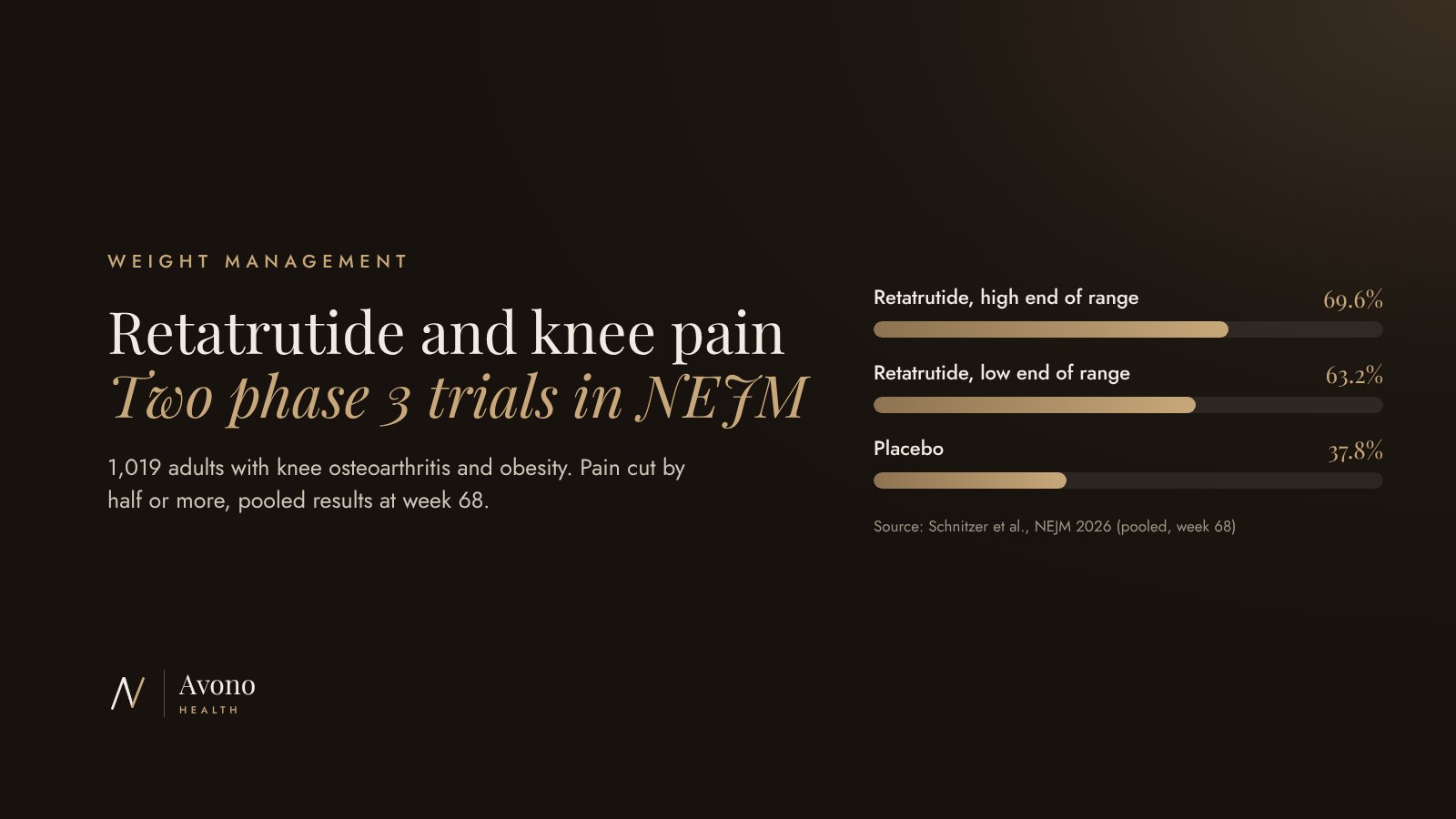
An experimental weekly shot called retatrutide eased knee arthritis pain and cut body weight in two large phase 3 trials, published November 8 in the New England Journal of Medicine. In pooled results, 63.2% to 69.6% of people on the drug had their knee pain cut at least in half, compared with 37.8% on placebo.
Key takeaways
- Two trials tested retatrutide in 1,019 adults with painful knee osteoarthritis and overweight or obesity, but without diabetes.
- On average, people on the drug lost 17.5% to 24.8% of their body weight, depending on the dose and trial. People on placebo lost 4.3% to 4.6%.
- Pain scores fell more on retatrutide than on placebo at every dose tested.
- Side effects were common, mostly nausea, diarrhea and constipation. Serious side effects and stopping the drug because of side effects were more common on retatrutide.
- Retatrutide is not FDA approved. The trials were not designed to show whether it slows joint damage or helps people avoid knee replacement.
What the study found
Retatrutide is an investigational drug made by Eli Lilly. It acts on three hormone receptors: GIP, GLP-1 and glucagon. Semaglutide (Wegovy, Ozempic) acts on one of these, and tirzepatide (Zepbound, Mounjaro) acts on two. Osteoarthritis (OA) is a long-term joint disease in which the cushioning in the joint wears down, which can cause pain and stiffness.
Researchers measured pain with the WOMAC pain scale, which runs from 0 to 10, with higher numbers meaning more pain. People started the trials with average pain scores of about 6, according to the authors’ accepted manuscript.
In the first trial, called TRIUMPH-4, pain scores at 68 weeks fell by 3.96 points on the 9 mg dose and 3.74 points on the 12 mg dose, compared with 2.12 points on placebo. Body weight fell by 20.0% and 23.7% on the two doses, compared with 4.6% on placebo. All of these differences were statistically significant (p<0.001).
In the second trial, TRIUMPH-1-OA, pain scores at 80 weeks fell by 3.22, 3.48 and 3.64 points on the 4 mg, 9 mg and 12 mg doses, compared with 1.87 on placebo. Weight fell by 17.5%, 22.9% and 24.8%, compared with 4.3% on placebo.
People on retatrutide also had better scores for physical function, a measure of how well they could do daily tasks such as walking and climbing stairs. The same pattern held in people who started with a body mass index (BMI) of 35 or higher.
| Trial and group | Change in weight | Change in pain score (0 to 10) | Stopped drug due to side effects |
|---|---|---|---|
| TRIUMPH-4, 9 mg (68 weeks) | -20.0% | -3.96 | 12.9% |
| TRIUMPH-4, 12 mg | -23.7% | -3.74 | 18.2% |
| TRIUMPH-4, placebo | -4.6% | -2.12 | 4.0% |
| TRIUMPH-1-OA, 4 mg (80 weeks) | -17.5% | -3.22 | 2.8% |
| TRIUMPH-1-OA, 9 mg | -22.9% | -3.48 | 8.4% |
| TRIUMPH-1-OA, 12 mg | -24.8% | -3.64 | 15.3% |
| TRIUMPH-1-OA, placebo | -4.3% | -1.87 | 6.2% |
Source: Schnitzer et al., NEJM 2026, author manuscript (Tables 2 and 3). Weight uses the treatment-regimen analysis and pain uses the hybrid-treatment analysis, as reported in the paper.
How to read these numbers
The two trials ran for different lengths of time (68 and 80 weeks) and tested different doses, so the most meaningful comparison is each dose against the placebo group in the same trial. The placebo groups also improved, by about 2 points on the pain scale. That is why the gap between drug and placebo matters more than the drug group’s change alone.
The paper also reports a second way of counting, called an intention-to-treat analysis, which handles people who stopped treatment differently. With that method, the gaps between drug and placebo were somewhat smaller but still significant. For example, in TRIUMPH-4 the 9 mg dose beat placebo by 1.70 points instead of 1.83.
The authors compared their results with earlier studies of other treatments, including semaglutide, in which 65.2% of people had their knee pain cut at least in half. But they wrote that direct comparisons are not feasible because of different study types and analyses. No trial has tested retatrutide head to head against semaglutide or tirzepatide for knee pain.
Who was studied
TRIUMPH-4 enrolled 445 people at 49 centers in 5 countries. TRIUMPH-1-OA enrolled 574 people at 66 centers in 7 countries, in North America, Europe and Australia. Everyone was an adult with moderate to severe knee pain from OA, X-ray signs of knee OA, a BMI of 27 or higher with at least one weight-related health problem, and at least one failed attempt to lose weight by diet. People with diabetes were excluded.
The average age was about 55 to 56, and the average BMI was about 40. About 63% of people in TRIUMPH-4 and 76% in TRIUMPH-1-OA were women. Roughly 8 in 10 had a BMI over 35. The drug was started at 2 mg a week and raised every 4 weeks to the assigned dose.
Side effects and safety
The most common side effects on retatrutide were nausea, diarrhea and constipation. The authors reported that most stomach and gut side effects were mild to moderate and usually happened while the dose was being raised.
- Stopping because of side effects: 2.8% to 18.2% on retatrutide, depending on dose, compared with 4.0% to 6.2% on placebo. Higher doses had higher rates.
- Serious side effects: 9.5% and 10.8% on the two doses in TRIUMPH-4 versus 2.0% on placebo; 4.2% to 14.6% on retatrutide versus 6.9% on placebo in TRIUMPH-1-OA.
- Dysesthesia: an unusual or unpleasant feeling on the skin, such as tingling or burning. It occurred in 6.3% to 20.9% of people on retatrutide and 0.7% on placebo. The authors said it was generally mild and rarely led people to stop the drug.
- Deaths: two people died in TRIUMPH-4, one in each retatrutide group. Investigators judged both deaths unrelated to the study drug. No one died in TRIUMPH-1-OA.
The paper also lists smaller numbers of other events, including two confirmed cases of pancreatitis (inflammation of the pancreas) in the 9 mg group of TRIUMPH-1-OA and a few serious gallbladder events. Doses could be lowered for side effects, too much weight loss, or reaching a BMI of 22.
The trial report does not discuss eye problems. Drugs in the GLP-1 family that are already approved now carry the FDA’s new vision-loss warning for GLP-1s, about a rare condition that can cause sudden vision loss in one eye.
What the researchers said
Dr. Thomas Schnitzer, professor at Northwestern University Feinberg School of Medicine and corresponding author, in a Northwestern news release
Schnitzer said a major factor is that “you’re loading your knees less and therefore, there’s less pain.” He added that GLP-1 type drugs are thought to have anti-inflammatory effects, but the reason is not fully known.
Dr. Thomas Schnitzer, Northwestern University
An outside expert was more cautious. Dr. Timothy Gibson, an orthopedic surgeon and medical director of the MemorialCare Joint Replacement Center at Orange Coast Medical Center, who was not involved in the study, told Medical News Today that “the magnitude of weight loss achieved in this study is likely the primary driver of the improvement in symptoms.”
Gibson also said that “we do not yet have convincing clinical evidence that it directly repairs cartilage.”
Limits of the study
- The trials only included people with overweight or obesity. The authors wrote that effects in a broader OA population are unknown.
- The trials were not designed to test whether retatrutide slows OA, changes the joint itself, or helps people avoid knee replacement.
- Pain was first checked at week 16, so it is not known how soon relief starts.
- Inflammation markers were measured only at the start and end, so changes over time could not be tracked.
- Eli Lilly funded the trials, helped design and run them, analyzed the data and helped write the paper. Several authors are Lilly employees.
- About a quarter of people did not complete treatment: 28.1% in TRIUMPH-4 and 24.6% in TRIUMPH-1-OA.
What it means for you
The authors concluded that in people with painful knee OA and obesity, retatrutide led to significant drops in both pain scores and body weight. They said it is still unknown whether the drug could change how OA progresses or reduce the need for joint replacement.
Retatrutide is not approved by the FDA and is not available outside clinical trials. Any product sold online as retatrutide is not the drug tested in these trials, and its contents and safety are unknown. You can read more about the risks of gray-market peptides. Compounded versions of any drug like this would not have been studied in these trials either.
If knee pain and weight are concerns for you, talk with a licensed clinician about the options that are approved today. For background on how this drug class works, see how GLP-1 medications work for weight loss.
The bottom line
In two phase 3 trials of 1,019 adults with knee OA and obesity, weekly retatrutide reduced knee pain more than placebo and led to average weight loss of 17.5% to 24.8%. Side effects, serious side effects and stopping the drug were more common than on placebo, especially at higher doses. The drug is still experimental, and the trials do not show whether it repairs or protects the joint.
Frequently asked questions
What is retatrutide?
Retatrutide is an experimental once-weekly injection made by Eli Lilly. It acts on three hormone receptors (GIP, GLP-1 and glucagon). It is not FDA approved.
Does retatrutide help knee arthritis pain?
In two phase 3 trials published in NEJM, people with knee OA and obesity had larger drops in pain scores on retatrutide than on placebo. In pooled results, 63.2% to 69.6% had pain cut at least in half, compared with 37.8% on placebo.
How much weight did people lose on retatrutide in the knee trials?
Average weight loss ranged from 17.5% on the 4 mg dose to 24.8% on the 12 mg dose over 80 weeks. People on placebo lost about 4% to 5%.
What are the side effects of retatrutide?
The most common were nausea, diarrhea and constipation. Dysesthesia, an unusual skin sensation such as tingling, occurred in 6.3% to 20.9% of people on the drug versus 0.7% on placebo. Between 2.8% and 18.2% stopped the drug because of side effects.
Is the pain relief just from weight loss?
The researchers do not know yet. The lead author said less load on the knee is a major factor, and that the role of reduced inflammation needs more research. An outside surgeon said weight loss is likely the main driver.