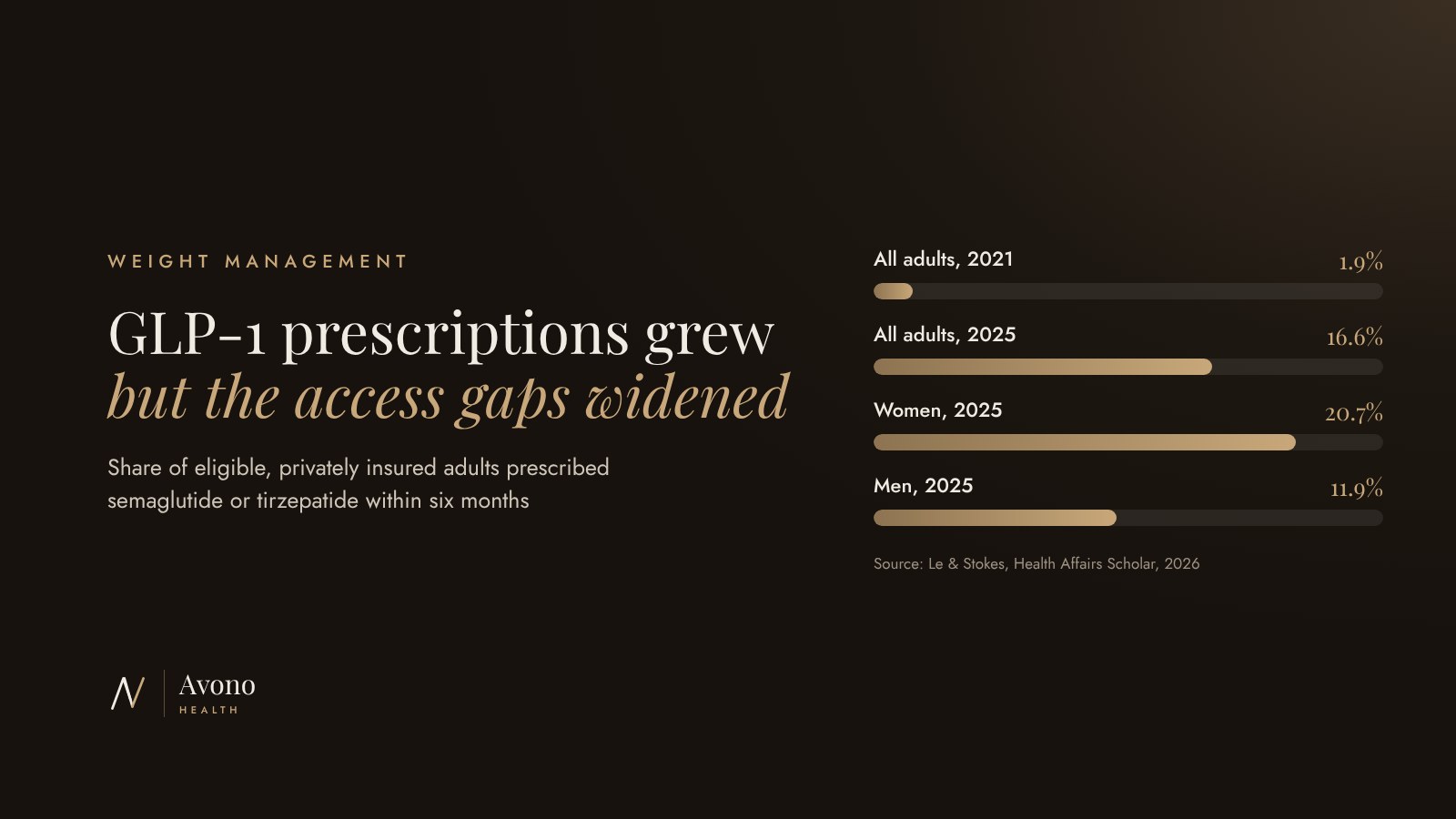
The share of eligible U.S. adults with private insurance who were prescribed semaglutide or tirzepatide for weight rose from 1.9% to 16.6% between 2021 and 2025, according to a study in Health Affairs Scholar. But the gaps between groups grew wider over the same years, with men, younger and older adults, and patients of clinics in less-advantaged neighborhoods less likely to get a prescription.
Key takeaways
- Researchers at Boston University looked at insurance claims for 512,389 commercially insured adults ages 18 to 64 with overweight or obesity and no type 2 diabetes.
- Within six months of becoming eligible, 8.5% were prescribed semaglutide or tirzepatide. That rate climbed from 1.9% in mid-2021 to 16.6% in mid-2025.
- Men had 58% lower odds of a prescription than women, after the researchers adjusted for other factors.
- Patients whose clinicians worked in the lowest-education ZIP codes had about 35% lower odds of a prescription in 2024 to 2025, up from about 15% earlier.
- The study used claims data and shows patterns, not causes. It did not count prescriptions bought outside insurance.
What the study found
Semaglutide (sold as Wegovy and Ozempic) and tirzepatide (sold as Zepbound and Mounjaro) are GLP-1 medicines. They copy gut hormones that help control appetite and blood sugar. The FDA approved semaglutide for long-term weight management in 2021 and tirzepatide in 2023. For a plain-language overview, see how GLP-1 medications work for weight loss.
Minh Trung Le and Andrew Stokes of the Boston University School of Public Health wanted to know who was actually getting these drugs. They followed each eligible patient for six months and checked whether a prescription for either drug appeared in their insurance claims. According to the paper, 43,495 of the 512,389 patients (8.5%) were prescribed one of the two drugs in that window.
Use grew quickly. The six-month rate rose from 1.9% in the third quarter of 2021 to 16.6% in the second quarter of 2025. Semaglutide prescriptions peaked at 11.0% in mid-2023 and then fell to 7.1% by mid-2025 as tirzepatide prescriptions rose to 11.9%. Patients in 2024 to 2025 had 2.67 times the odds of a prescription compared with 2021 to 2023.
Even so, most eligible patients did not get a prescription. And the gaps between groups grew, especially in 2024 and 2025, the researchers reported.
Who was less likely to get a prescription
The researchers used a statistic called an adjusted odds ratio. It compares the odds of getting a prescription in one group with a reference group, after accounting for differences such as age, weight and other health conditions. A number below 1 means lower odds. For example, 0.42 means 58% lower odds.
| Group | Compared with | Adjusted odds ratio (95% CI) |
|---|---|---|
| Men | Women | 0.42 (0.41 to 0.43) |
| Non-Hispanic Black patients | Non-Hispanic White patients | 0.89 (0.85 to 0.92) |
| Hispanic or Latino patients | Non-Hispanic White patients | 0.89 (0.86 to 0.93) |
| Overweight (BMI under 30) | Class III obesity (BMI 40 or higher) | 0.38 (0.37 to 0.40) |
| Clinician in lowest-education ZIP codes | Clinician in highest-education ZIP codes | 0.75 (0.73 to 0.78) |
In the most recent quarter, mid-2025, 20.7% of eligible women had been prescribed one of the drugs, compared with 11.9% of men. Among patients whose clinicians worked in the highest-education ZIP codes, 21.7% were prescribed, compared with 14.4% to 15.2% in the other three groups. The gap for patients of clinicians in the lowest-education areas grew from about 15% lower odds in 2021 to 2023 to about 35% lower odds in 2024 to 2025.
Age mattered too. Compared with adults ages 18 to 24, those ages 35 to 54 had about twice the odds of a prescription. Adults ages 55 to 64 had higher odds than the youngest group (1.46) but lower odds than middle-aged adults. Non-Hispanic Asian patients were not statistically different from White patients in this study.
The neighborhood gap was larger at lower body weights. For patients in the overweight range, the odds ratio for the lowest-education group was 0.60. For those with class III obesity, it was 0.90. The gap was also largest among men.
Who was studied
The data came from Komodo Health, a national claims database covering more than 175 million people. The study period ran from July 2021 to June 2025. To be included, adults had to be 18 to 64, have private (commercial) insurance, and have a recorded BMI of 30 or higher, or 27 or higher with a weight-related health problem. People with type 2 diabetes, pregnancy or certain diabetes drugs in the prior year were left out. So were people on Medicare or Medicaid and people without insurance, according to Medical Economics.
The study measured neighborhood advantage by the share of adults with a bachelor’s degree in the ZIP code where the clinician worked. It did not have patients’ own income or education. The study was funded by the Robert Wood Johnson Foundation and the American Heart Association.
How this compares with an earlier study
A 2025 study in JAMA, led by researchers at Yale, found similar patterns using a different data source. It used electronic health records from about 280 U.S. health systems covering patients of all insurance types from 2020 to 2024. Of about 39 million eligible adults, 887,110 had been prescribed semaglutide or tirzepatide, according to coverage in AJMC. Men were less likely than women to get a prescription (1.2% vs 3.0%), and so were rural patients compared with patients in metro areas (1.5% vs 2.4%).
The overall rates in the two studies should not be compared directly. The Yale study counted prescriptions written in medical records across a whole population and a longer period. The Boston University study counted claims within six months among newly eligible, commercially insured adults, and its rate rose sharply in 2024 and 2025. The two studies also differ on Asian patients: the Yale study found lower prescribing for Asian patients than White patients, while the Boston University study found no clear difference. The sources do not explain that difference. The meaningful comparison in each study is between groups inside that same study.
What the researchers said
We have better treatments for obesity than ever, but access to them hasn’t caught up.
Andrew Stokes, associate professor of global health, Boston University School of Public Health, senior author, in Medical Economics
We need to look at how drug benefits are designed, including prior authorization, step therapy, and out-of-pocket costs that land unevenly on different patients.
Minh Trung Le, lead author, in Medical Economics
Prior authorization means an insurer must approve a drug before it will pay. Step therapy means a patient must try other treatments first.
The new direct-to-consumer channels for GLP-1s are increasing inequity, as ability to pay, rather than need or potential benefit, is what determines access.
Katherine Hempstead, senior policy officer, Robert Wood Johnson Foundation, which helped fund the study, in Medical Economics
Turns out, very few people who could benefit from these drugs are actually getting them.
Yuan Lu, ScD, Yale School of Medicine, senior author of the 2025 JAMA study, in a Yale news article
Stokes also pointed to the role of diabetes in coverage. In Medical Economics, he said: “It is much easier for people with diabetes to get these drugs covered by insurance.”
Limits of the study
- It is an observational study. It shows which groups were less likely to get a prescription, not why.
- Prescriptions bought outside insurance, including through direct-to-consumer services, were not counted. The authors say this likely means uptake was underestimated, and they do not know how it varies by group.
- About one-third of patients (32.2%) had no race or ethnicity recorded, which may bias the racial comparisons.
- Obesity diagnosis codes are used unevenly by clinicians and may miss people with lower levels of obesity.
- The database is not formally representative of all insured Americans, and it includes only people with private insurance ages 18 to 64.
- Neighborhood advantage was measured where the clinician worked, not where the patient lived.
What the study did not look at
This study tracked who was prescribed the drugs. It did not measure weight loss, side effects or safety. All GLP-1 medicines carry risks, and labels have changed over time, including the FDA’s new vision-loss warning for GLP-1s.
The study does not report on compounded versions of semaglutide or tirzepatide. Compounded versions are not FDA approved, and the results here apply only to the prescriptions the researchers counted in insurance claims.
What it means for you
The authors conclude that prescribing of these drugs for obesity grew fast from 2021 to 2025 but stayed low overall, and that gaps by gender, age, body weight and clinic neighborhood grew wider. They call for policies that support under-resourced clinics and fairer drug benefit design. Le said practices need help with tasks like prior authorization paperwork, according to Medical Economics.
If you have overweight or obesity and want to know whether a GLP-1 medicine fits your health, talk with a licensed clinician about your situation, the benefits and risks, and your coverage options.
The bottom line
Among privately insured adults without diabetes, prescriptions for semaglutide and tirzepatide grew almost ninefold between 2021 and 2025. But most eligible people still did not get one, and men, younger adults and patients of clinics in less-advantaged areas fell further behind. The study shows patterns in insurance claims and cannot say what caused them.
Frequently asked questions
How many eligible people get prescribed semaglutide or tirzepatide?
In the Boston University study of commercially insured adults, 8.5% were prescribed one within six months of becoming eligible. The rate rose from 1.9% in 2021 to 16.6% in mid-2025 (Health Affairs Scholar).
Are men less likely to get GLP-1 drugs for weight loss?
Yes, in both the 2026 Boston University study and the 2025 Yale study. In the Boston University study, men had 58% lower odds of a prescription than women after adjusting for other factors.
Who counts as eligible for these weight loss drugs?
The study used the FDA-approved criteria: a BMI of 30 or higher, or 27 or higher with at least one weight-related health problem. It left out people with type 2 diabetes.
Did the study include people who pay cash or use online services?
No. Prescriptions obtained through direct-to-consumer channels were not captured, so the true number of people using these drugs is likely higher, the authors wrote.