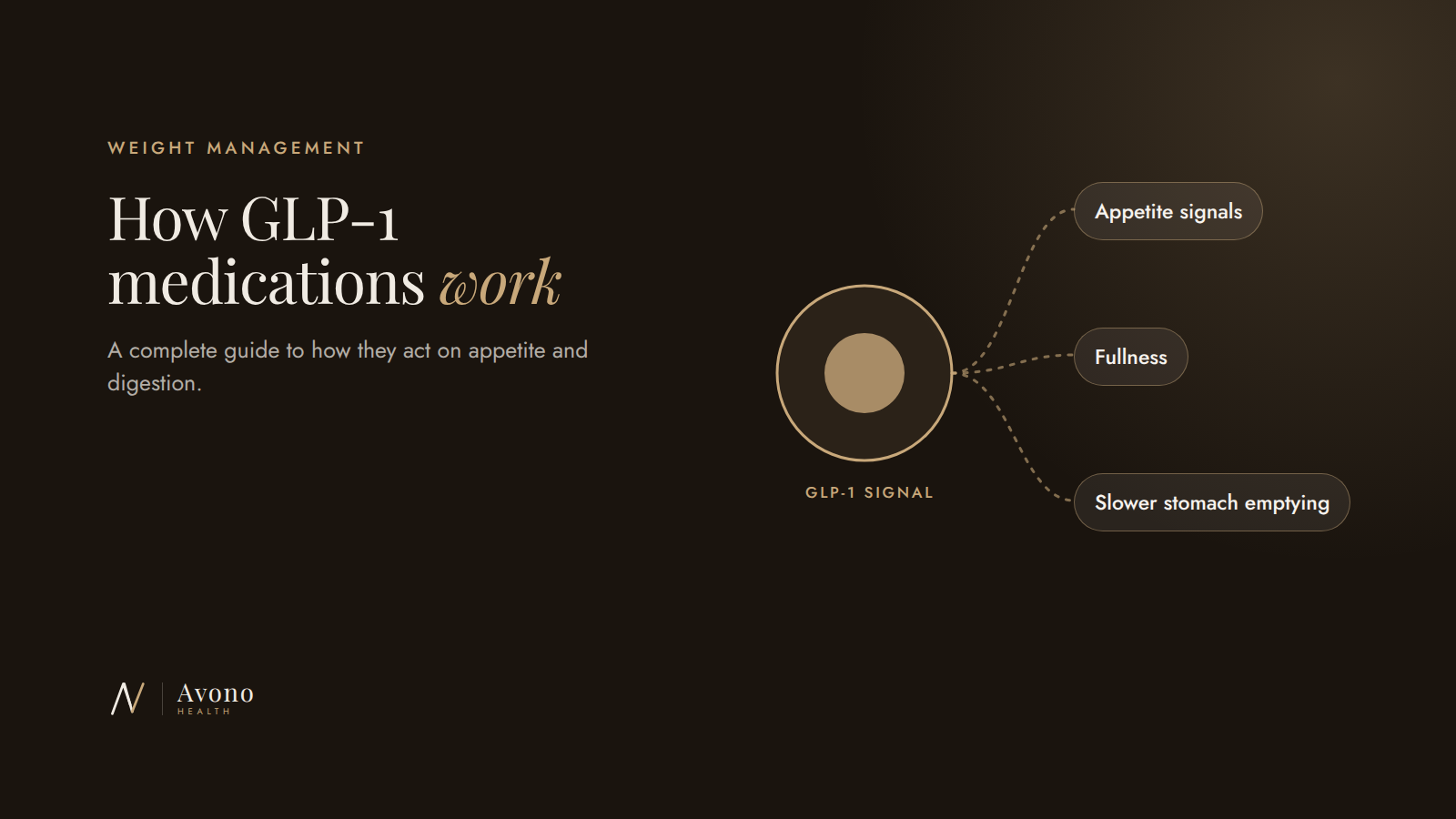
GLP-1 medications have changed the conversation around medical weight management. But despite how often names like semaglutide and tirzepatide now appear online, the biology behind these treatments is often oversimplified.
They do not simply “speed up metabolism.” They are not traditional stimulants. And they do not cause weight loss by somehow burning fat directly.
Instead, GLP-1-based medications influence several systems involved in hunger, fullness, eating behavior and blood-sugar regulation.
Understanding those effects can make it easier to understand both why these medications can work and why the experience is different from one person to another.
What is GLP-1?
GLP-1 stands for glucagon-like peptide-1.
It is a hormone naturally produced in the body, particularly in the gastrointestinal tract after eating. GLP-1 participates in communication between the digestive system, pancreas and brain.
Among other functions, naturally occurring GLP-1 helps:
- signal fullness after eating
- regulate insulin secretion when blood glucose rises
- influence glucagon secretion
- affect appetite and food intake
- influence digestive function
GLP-1 medications are designed to activate the GLP-1 receptor for much longer than the body’s naturally produced GLP-1 remains active.
That prolonged signaling is one reason these medications can have much larger effects than the body’s short-lived natural GLP-1 response.
How do GLP-1 medications help with weight loss?
Weight loss with GLP-1-based treatment appears to involve several overlapping mechanisms rather than one single effect.
1. They can reduce hunger
For many people, the most noticeable change is simply feeling less hungry.
GLP-1 receptors are present in areas of the brain involved in appetite and energy regulation. Activating those pathways can change how strongly hunger is experienced and how quickly a person feels satisfied.
Clinical studies of semaglutide have found reductions in hunger and food intake as well as increases in fullness and satiety.
In one controlled study involving adults with obesity, participants receiving semaglutide consumed substantially fewer calories during measured meals than participants receiving placebo. Research has also demonstrated reductions in food cravings and improved control of eating.
This does not necessarily mean someone loses all interest in food.
A more typical experience may be:
- becoming satisfied sooner during a meal
- thinking about food less frequently
- finding smaller portions adequate
- experiencing fewer strong cravings
- finding it easier to stop eating when full
The degree of appetite change varies significantly from person to person.
2. They can change how rewarding food feels
Eating behavior is not driven only by physical hunger.
Smell, habit, stress, environment, reward and cravings can all affect how much someone eats. Researchers are increasingly studying how GLP-1 medications influence these reward-related processes.
A 2026 randomized study of semaglutide found persistent reductions in calorie intake over 60 weeks and changes in measures related to food reward and food preoccupation.
This may help explain the phenomenon many patients informally describe as reduced “food noise.”
Food noise is not a formal medical diagnosis. It is a popular term used to describe frequent or intrusive thoughts about eating, planning meals, snacking or craving particular foods.
Not everyone experiences this effect, but for some people it is one of the most noticeable differences during treatment.
3. GLP-1 affects blood-sugar regulation
GLP-1 signaling also plays an important role in glucose regulation.
When blood glucose is elevated, GLP-1 receptor activation can promote insulin secretion. GLP-1 signaling also influences glucagon, another hormone involved in blood-sugar regulation.
This is one reason GLP-1 receptor agonists were originally developed extensively in the treatment of type 2 diabetes before becoming prominent in obesity medicine.
Weight-management treatment and diabetes treatment are not interchangeable, however. Medication choice, formulation, dosage and clinical goals can differ.
4. GLP-1 medications can affect digestion
GLP-1 signaling can also influence gastric emptying, meaning the movement of food from the stomach into the small intestine.
You will often hear that GLP-1 medications work by “keeping food in your stomach longer.”
That explanation is incomplete.
Changes in gastric emptying can contribute to medication effects, particularly earlier in treatment, but appetite regulation involves multiple pathways. Studies of semaglutide have demonstrated strong effects on appetite and calorie intake even when measurable differences in gastric emptying were not present later in treatment.
So it is more accurate to think of GLP-1 treatment as affecting a network of appetite, digestive and metabolic signals rather than simply slowing the stomach.
Semaglutide vs. tirzepatide: are they both GLP-1 medications?
They are related, but they are not identical.
Semaglutide activates the GLP-1 receptor.
Tirzepatide activates both the GLP-1 receptor and the GIP receptor, another incretin-hormone pathway involved in metabolic regulation.
For that reason, tirzepatide is often described as a dual GIP/GLP-1 receptor agonist.
Both molecules have substantial clinical-trial evidence in weight management.
In the STEP 1 trial, adults with overweight or obesity without diabetes who received studied once-weekly semaglutide 2.4 mg plus lifestyle intervention lost an average of 14.9% of their starting body weight over 68 weeks, compared with 2.4% with placebo.
In SURMOUNT-1, studied tirzepatide doses produced average weight reductions ranging from approximately 15% to 20.9% over 72 weeks in adults with overweight or obesity without diabetes.
These results apply to the specific products, dosages, populations and protocols studied. They do not predict how much weight any individual patient will lose.
Do GLP-1 medications increase metabolism?
This is a common misconception.
The primary explanation for weight loss is not that GLP-1 medications dramatically increase the number of calories the body burns.
Reduced calorie intake appears to play a major role.
When hunger decreases and fullness increases, maintaining a calorie deficit may become more achievable than it was previously.
That distinction matters.
A GLP-1 medication does not eliminate the importance of nutrition, physical activity, sleep, muscle preservation and other components of long-term weight management.
Instead, it can change some of the biological signals that make maintaining those behaviors difficult.
Why does the dose usually increase gradually?
GLP-1-based medications are commonly started at a lower dose and increased gradually under clinician supervision.
One reason is tolerability.
Gastrointestinal effects including nausea, diarrhea, vomiting and constipation are among the most commonly reported side effects of approved semaglutide and tirzepatide products. Gradual dose escalation gives the body time to adjust and may help clinicians manage tolerability.
More medication is also not automatically better.
The appropriate dose depends on the medication, formulation, individual response, side effects and treatment plan determined by the prescribing clinician.
Does everyone respond the same way?
No.
Clinical trials report averages across large groups of participants. Individual results can be substantially higher or lower.
Response may be affected by:
- starting weight
- underlying health conditions
- medication and dose
- treatment duration
- adherence
- eating patterns
- physical activity
- sleep
- other medications
- individual biology
Some people experience pronounced appetite changes relatively early. Others notice gradual changes. Some people experience side effects that limit dose escalation or require a different approach.
Treatment should be individualized rather than judged against someone else’s result online.
Are GLP-1 medications a temporary diet?
Increasingly, obesity is treated as a chronic medical condition rather than a temporary failure of willpower.
That has implications for medication treatment.
For some patients, GLP-1-based treatment may be part of a longer-term weight-management strategy rather than a short course designed only to reach a particular number on the scale.
Studies following patients after discontinuation have found significant weight regain in many participants after medication was withdrawn.
That does not mean every patient must remain on the same medication forever. It does mean that what happens after weight loss deserves as much planning as how the weight is lost.
The bottom line
GLP-1-based medications support weight management by changing biological systems involved in appetite, fullness, eating behavior and metabolic regulation.
They do not replace nutrition, activity or long-term health habits. Instead, they may make those behaviors more manageable by reducing some of the biological pressure to eat.
Semaglutide and tirzepatide work through related but different mechanisms, and neither treatment is appropriate for everyone.
At Avono Health, prescription weight-management treatments require clinical review. A licensed clinician evaluates your health history and determines whether a treatment is medically appropriate.
Suggested internal links: Weight Management, Semaglutide, Tirzepatide, How It Works, Compounded Medications
Frequently asked questions
Do GLP-1 medications burn fat directly?
Not in the way stimulant-style “fat burners” are marketed. Their weight-management effects are driven largely by changes in appetite, food intake and metabolic signaling.
How quickly do GLP-1 medications reduce appetite?
Timing varies. Some people notice appetite changes relatively early, while others experience more gradual effects as treatment progresses and dosing changes.
Is tirzepatide a GLP-1?
Tirzepatide activates the GLP-1 receptor but also activates the GIP receptor. It is therefore more precisely described as a dual GIP/GLP-1 receptor agonist.
Can you take a GLP-1 medication if you do not have diabetes?
Certain FDA-approved GLP-1-based medications have indications for chronic weight management in eligible people without diabetes. Eligibility is determined by a prescribing clinician.
Do you still need to diet while taking a GLP-1 medication?
Medication can reduce appetite and calorie intake, but nutrition quality, adequate protein, physical activity and other health behaviors remain important parts of weight management.
Comparing GLP-1 options? See semaglutide and tirzepatide programs and current prices.