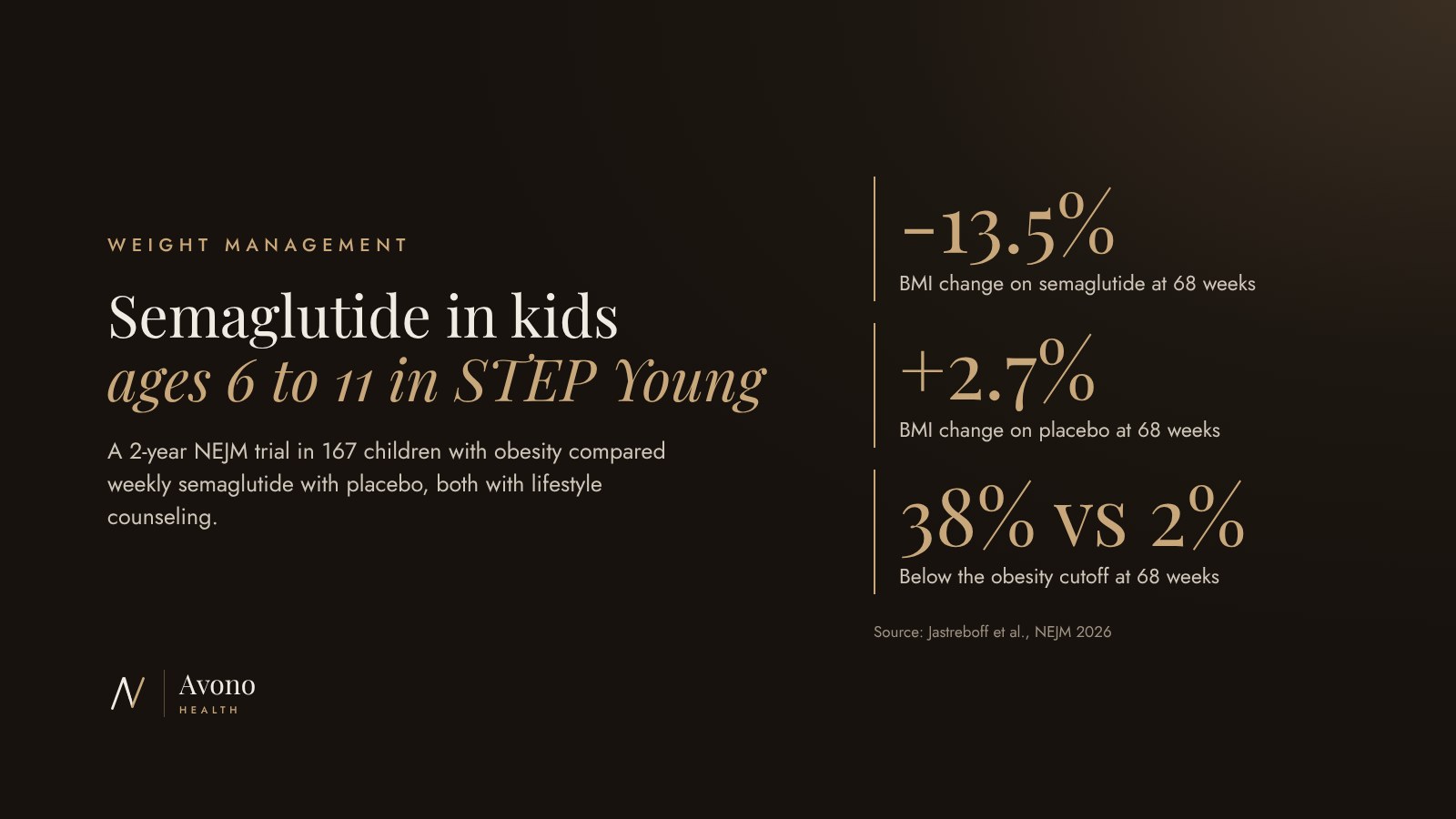
A two-year trial of weekly semaglutide injections in children ages 6 to 11 with obesity found that their body mass index (BMI) fell 13.5% at 68 weeks, while BMI rose 2.7% in children given a placebo. The results of the STEP Young trial were published November 16 in The New England Journal of Medicine.
Key takeaways
- 167 children ages 6 to under 12 with obesity got weekly semaglutide or placebo for 104 weeks, plus lifestyle counseling in both groups.
- At 68 weeks, 38% of children on semaglutide had a BMI below the obesity cutoff, compared with 2% on placebo.
- The BMI drop was smaller by week 104 (9.4%), and BMI began to rise again during a 7-week break off the drug.
- Stomach side effects were common: vomiting in 70% vs 29% on placebo. Serious side effects were 9% in both groups.
- Semaglutide is not FDA approved for children under 12. The trial was funded by its maker, Novo Nordisk.
What the study found
STEP Young was a phase 3, randomized, double-blind trial. That means children were assigned by chance to semaglutide or a look-alike placebo shot, and neither the families nor the study team knew who got which. The main goal was the percent change in BMI after 68 weeks, according to Pharmacy Times.
At 68 weeks, BMI fell 13.5% in the semaglutide group and rose 2.7% in the placebo group. The difference between the groups was 16.2 percentage points (95% confidence interval, 19.4 to 12.9 points; P<0.001), as reported by Contemporary Pediatrics. A confidence interval is the range where the true result most likely falls.
Children’s BMI is judged against growth charts for their age and sex. Obesity in children means a BMI at or above the 95th percentile. At 68 weeks, 79% of children on semaglutide moved down at least one BMI category, compared with 23% on placebo. And 38% of children on semaglutide fell below the obesity cutoff, compared with 2% on placebo, according to Healio.
Children kept taking the drug or placebo until week 104. At that point, BMI was down 9.4% with semaglutide and up 8.4% with placebo, a difference of 17.8 percentage points (95% CI, 22.2 to 13.3). So the drop in the semaglutide group narrowed between weeks 68 and 104, while the gap with placebo held, Contemporary Pediatrics reported.
The researchers also measured heart and blood sugar markers at 68 weeks. Waist size shrank 8.5 cm with semaglutide and grew 2.7 cm with placebo. Triglycerides, a type of blood fat, fell 26.3% vs rising 0.4%. A marker of inflammation called hs-CRP fell 68.3% vs 14.4%. Systolic blood pressure (the top number) fell 4.4 vs 0.9 mm Hg, according to Healio. Pharmacy Times noted these extra results were not adjusted for multiple comparisons, so they are supportive, not proof.
Why there are two sets of numbers
You may see higher figures in some reports, such as a 17.4% BMI drop. That number comes from a different way of analyzing the same trial. The 13.5% figure counts all children as randomized, including those who stopped treatment. The 17.4% figure estimates what would have happened if every child had stayed on treatment, according to Novo Nordisk and Contemporary Pediatrics, which advised reading the higher figures with caution. This article uses the first set of numbers unless stated otherwise.
| Measure | Semaglutide | Placebo |
|---|---|---|
| BMI change at week 68 | -13.5% | +2.7% |
| BMI change at week 104 | -9.4% | +8.4% |
| Below obesity cutoff at week 68 | 38% | 2% |
| Moved down at least 1 BMI category, week 68 | 79% | 23% |
| Vomiting | 70% | 29% |
| Diarrhea | 62% | 35% |
| Nausea | 58% | 24% |
| Serious adverse events | 9% | 9% |
| Stopped because of side effects | 4% | 2% |
Who was studied
The trial enrolled 167 children at 48 sites in 9 countries. 112 got semaglutide and 55 got placebo. Their average age was about 10, and about 59% were girls. More than 85% had class II or III obesity, the more severe levels, according to Pharmacy Times.
Semaglutide was given as a weekly shot under the skin. The dose was raised slowly over 16 weeks. The top dose was 2.4 mg for children who weighed more than 60 kg (about 132 pounds) at the start, 1.7 mg for those who weighed 45 to 60 kg, or the highest dose a child could tolerate. Both groups got lifestyle counseling. After 104 weeks, all children stopped the shots for 7 weeks, according to Pharmacy Times.
Side effects and safety
Almost every child had some kind of side effect: 96% on semaglutide and 93% on placebo. Stomach and gut problems were the most common and happened more often with semaglutide. Vomiting affected 70% vs 29%, diarrhea 62% vs 35%, and nausea 58% vs 24%. These were mostly mild to moderate and happened more during the weeks when the dose was being raised, according to Healio.
Serious adverse events happened in 9% of each group. 4% of children on semaglutide and 2% on placebo stopped because of side effects. Psychiatric side effects were reported in 21% on semaglutide and 24% on placebo. There were no deaths, according to Healio and Pharmacy Times.
Growth was watched closely because these children are still growing. Children on semaglutide gained less height than those on placebo. The median gain at week 68 was 5.7 cm vs 7.8 cm, and at week 104 it was 8.8 cm vs 12.1 cm. Bone age, bone density and puberty stage were similar in both groups. The authors suggested that the drop in BMI may partly explain the smaller height gains, Pharmacy Times reported. Children with obesity tend to be taller than their peers, and obesity treatment may slow that faster growth, researcher Antje Körner said at the meeting, according to Healio.
Like all GLP-1 drugs, semaglutide now carries a label warning about NAION, a rare cause of sudden vision loss in one eye, as explained in our report on the FDA’s new vision-loss warning for GLP-1s.
What the researchers said
In children living with obesity, once-weekly injectable semaglutide resulted in substantial and clinically meaningful reductions in BMI
Ania Jastreboff, MD, PhD, director of the Yale Obesity Research Center and lead author, at ObesityWeek 2026 (Healio)
We did not see any effects on puberty progression, puberty development or bone mineral density,
Antje Körner, MD, PhD, University of Leipzig, a trial researcher (Healio)
The BMI began to increase, and the placebo group continued on the [increasing] trajectory it was on,
Ania Jastreboff, describing the 7-week break off treatment (Healio)
Daniel Hsia, MD, chief of pediatric endocrinology at Emory University and Children’s Healthcare of Atlanta, was not involved in the trial. He told Healio: “This supports a paradigm shift moving away from watchful waiting to earlier treatment of obesity.” He also said many questions remain, including which children benefit most and what happens after 2 years.
Limits of the study
- It was fairly small, with 167 children, and only 55 in the placebo group.
- Most children were White, and the trial did not screen for eating disorders, according to Pharmacy Times.
- Nearly 40% of the placebo group had stopped their assigned treatment by week 104.
- BMI began to rise during the 7-week break. Data on 26 weeks off the drug are still to come, Jastreboff said.
- Treatment lasted 2 years. Long-term effects on growth, puberty and weight after stopping are not yet known.
- Novo Nordisk, which makes semaglutide, funded the trial. Several researchers reported ties to Novo Nordisk and other drug companies.
What it means for you
Semaglutide (sold as Wegovy for weight) is FDA approved for weight management in adults and in teens 12 and older. It is not approved for children under 12, so use in this age group is still investigational, Patient Care Online noted. Novo Nordisk did not mention plans to seek approval for this age group, according to Pharmacy Times. Compounded semaglutide was not studied in this trial and is not FDA approved.
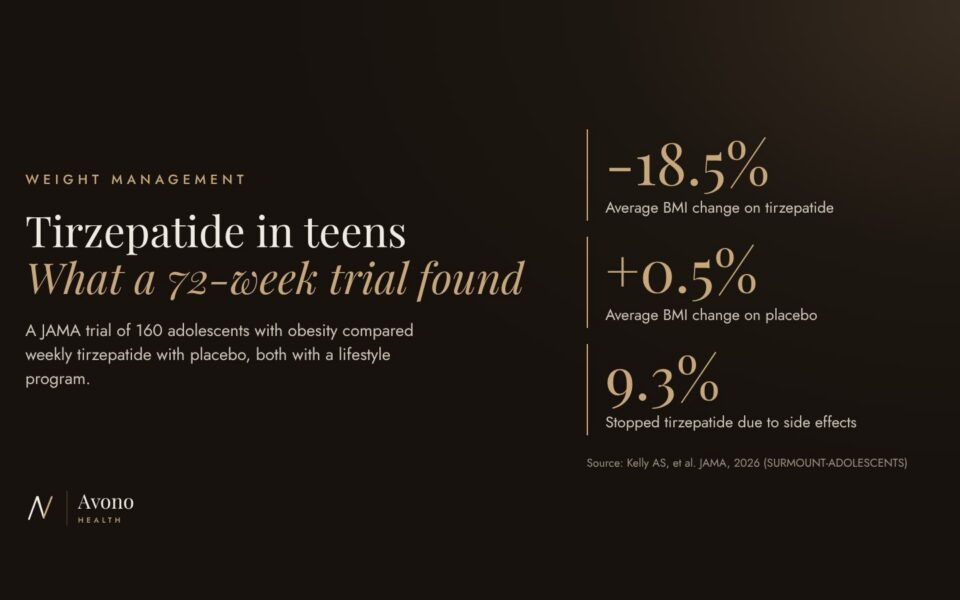
Expert guidance also differs. The American Academy of Pediatrics’ 2023 guideline allows medicine from age 8, while World Health Organization guidance recommends it only for ages 10 to 11 who cannot lower BMI through lifestyle changes alone, Hsia noted, according to Healio. If you have questions about your child’s weight or health, talk with your child’s pediatrician or another licensed clinician. For older teens, see our coverage of tirzepatide trial results in teens with obesity.
The bottom line
In a 2-year trial in 167 children ages 6 to 11 with mostly severe obesity, weekly semaglutide plus lifestyle counseling lowered BMI much more than placebo. Stomach side effects were common, children on the drug grew less in height over the study, and BMI began to rise once the shots stopped. The drug is not approved for this age group, and longer studies are still needed.
Frequently asked questions
Is Wegovy approved for children under 12?
No. Semaglutide (Wegovy) is FDA approved for weight management in adults and teens 12 and older. Use in children under 12 is investigational, according to Patient Care Online.
How much did BMI go down in the STEP Young trial?
At 68 weeks, BMI fell 13.5% with semaglutide and rose 2.7% with placebo. At 104 weeks, it was down 9.4% with semaglutide and up 8.4% with placebo (Contemporary Pediatrics).
What were the most common side effects in children?
Stomach and gut problems: vomiting (70% vs 29% on placebo), diarrhea (62% vs 35%) and nausea (58% vs 24%), mostly mild to moderate (Healio).
Did semaglutide affect children's growth?
Children on semaglutide gained less height than those on placebo (8.8 cm vs 12.1 cm median at week 104). Bone age, bone density and puberty stage were similar between groups (Pharmacy Times). Longer-term data are still needed.
What happens when children stop semaglutide?
In a 7-week break after treatment, BMI began to increase, the lead researcher said. Data on 26 weeks off the drug are expected in the coming months (Healio).