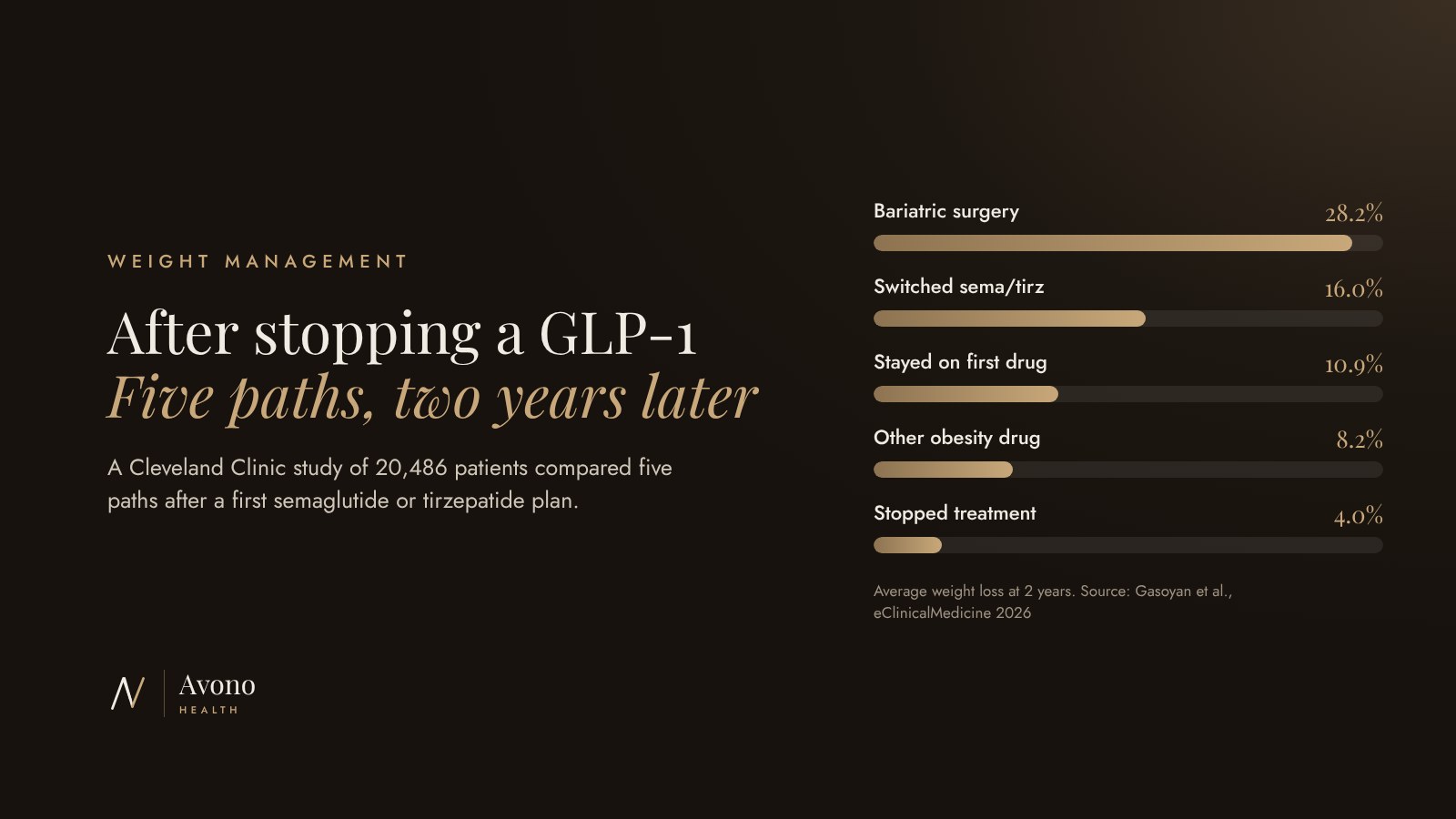
A new Cleveland Clinic study of 20,486 patients looked at what happened to body weight after people moved off their first injectable GLP-1 plan. Two years later, people who stopped all obesity treatment had lost about 4% of their body weight, compared with about 11% for people who stayed on their drug and 16% for those who switched between semaglutide and tirzepatide, according to the paper in eClinicalMedicine.
Key takeaways
- Researchers used health records from Cleveland Clinic patients in Ohio and Florida who took injectable semaglutide or tirzepatide for at least three months.
- At two years, average weight loss was about 28% after bariatric surgery, 16% after switching between semaglutide and tirzepatide, 11% when staying on the first drug, 8% after moving to another obesity drug and 4% after stopping treatment.
- Patients who stopped all treatment also had the smallest improvements in blood sugar and blood pressure.
- This was an observational study that used records to imitate a trial. It shows associations, not proof that one choice caused the result.
- Very few patients had surgery or switched drugs, and the results assume people stuck with their chosen path.
Why this question matters
Semaglutide (sold as Wegovy and Ozempic) and tirzepatide (sold as Zepbound and Mounjaro) are weekly shots in a drug class often called GLP-1s. Many people stop them. The Cleveland Clinic news release says cost, insurance limits and side effects are common reasons. It also cites Gallup data showing GLP-1 use for weight loss rose to 11% of U.S. adults in 2026, up from 3% in 2024.
Earlier research has shown that weight often comes back after stopping. We covered that in what happens when you stop a GLP-1 medication. This new study asks a different question: when people move off their first GLP-1 plan, which next step is linked to the most weight loss two years later?
Who was studied
The team, led by Hamlet Gasoyan, PhD, of Cleveland Clinic’s Center for Value-Based Care Research, used electronic health records from the Cleveland Clinic health system. Adults started injectable semaglutide or tirzepatide between January 2021 and December 2023 and had at least 90 days of continuous supply. Follow-up ran through the end of 2025, according to a detailed summary of the paper.
In all, 20,486 patients entered the analysis. Their average age was 56.7 years, and 63% were women. About two-thirds had type 2 diabetes (65.7%) and 68% had high blood pressure. Average starting weight was 109.0 kg (about 240 pounds), with an average body mass index (BMI, a measure of weight relative to height) of 38.0. About 73% started on semaglutide, Healio reported.
The study was a “target trial emulation.” That means researchers used existing records and statistical methods to imitate a clinical trial as closely as they could. No one was randomly assigned to a treatment. The study was funded by Cleveland Clinic, according to the publisher’s record.
What the study found
The researchers compared five paths people could take after their first three months: keep taking the same drug, switch between semaglutide and tirzepatide, move to a different obesity medication, have metabolic or bariatric surgery, or stop obesity treatment entirely.
| Path after first GLP-1 | Weight change at 1 year | Weight change at 2 years |
|---|---|---|
| Bariatric surgery | -21.8% (-24.6 kg) | -28.2% (-31.5 kg) |
| Switched between semaglutide and tirzepatide | -11.3% (-12.7 kg) | -16.0% (-18.0 kg) |
| Stayed on the first drug | -10.0% (-11.2 kg) | -10.9% (-12.3 kg) |
| Moved to another obesity drug | -6.0% (-6.7 kg) | -8.2% (-9.2 kg) |
| Stopped treatment | -4.0% (-4.5 kg) | -4.0% (-4.5 kg) |
Direction of the switch mattered. People who started on semaglutide and switched to tirzepatide lost 3.0 kg more than those who stayed on semaglutide. People who stayed on tirzepatide lost 4.5 kg more than those who switched from tirzepatide to semaglutide.
Health markers followed a similar pattern. In people with type 2 diabetes, A1C (a measure of average blood sugar) fell by 1.76 percentage points at one year after surgery, 1.43 after a switch, 1.32 when staying on the first drug, 1.03 after moving to another drug and 0.48 after stopping. In people with high blood pressure, systolic pressure (the top number) fell by 7.2 mmHg after surgery and 0.2 mmHg after stopping, according to the paper summary.
How to read these numbers
These groups are not equal in size or in who chose each path. Most patient time in the study (84.8%) was spent continuing the first drug. Only 2.7% switched between semaglutide and tirzepatide, 2.6% moved to another obesity drug and 0.9% had surgery, while 9.0% stopped. People who choose surgery may differ in many ways from people who stop treatment. The researchers used weighting methods to adjust for 38 baseline factors, but that cannot remove every difference.
The fairest way to read the table is each path against the “stopped treatment” group from the same study, not as a ranking you can expect for yourself. The figures also describe people who stuck with their chosen path, which is called a per-protocol estimate. These real-world numbers also should not be compared directly with results from the large randomized trials that led to these drugs’ approval, which used different people, rules and follow-up.
Side effects and safety
This study was not designed to compare the safety of the five paths over two years. It did look at the first six months of semaglutide or tirzepatide. Rates of emergency department visits were 26.88 per 100 person-years with semaglutide and 25.05 with tirzepatide. Rates of a combined stomach and gut outcome were 1.35 and 1.38 per 100 person-years. After statistical adjustment, the rate ratios comparing the two drugs were 0.94 and 1.06, according to the paper summary.
Side effects were linked to stopping. Patients who had an emergency visit in the first 90 days had 1.78 times the odds of stopping. Those with a stomach or gut related visit had 5.32 times the odds. Surgery carries its own risks, which this study did not report.
GLP-1 labels also now include the FDA’s new vision-loss warning for GLP-1s, about a rare cause of sudden vision loss in one eye.
What the researchers said
When a patient stops a GLP-1 medication, the most important question is what comes next
Ali Aminian, MD, director of Cleveland Clinic’s Bariatric and Metabolic Institute and study co-author, in the Cleveland Clinic news release
In our study, patients who stopped all treatment had the least weight loss and the smallest metabolic benefits
Ali Aminian, MD, Cleveland Clinic, in the news release
Obesity is a complex, chronic disease, and we cannot approach treatment with a one-size-fits-all approach
Hamlet Gasoyan, PhD, lead author, Cleveland Clinic, in the news release
Our study highlights the importance of continued obesity management
Hamlet Gasoyan, PhD, as quoted by Healio
Dr. Gasoyan presented the findings at ObesityWeek 2026 in National Harbor, Maryland, Bariatric News reported.
Limits of the study
- It is observational. It shows links between choices and outcomes, not cause and effect.
- Patients came from one health system in Ohio and Florida, so results may not apply everywhere.
- The main results assume people kept following their chosen path. In real life, cost, supply and side effects often get in the way.
- Diet changes, use of compounded drugs, heart events and long-term kidney outcomes were not tracked in a systematic way.
- The surgery and switching groups were small shares of the data, which makes those estimates less certain.
- Reported figures vary slightly by source. Healio, covering the conference talk, listed 26.6% weight loss for surgery, while the paper figure reported by Bioengineer.org is 28.2% and the news release says about 28%.
- The authors say prospective real-world studies are still needed.
Compounded semaglutide and tirzepatide were not studied as a treatment path in this research, and compounded versions are not FDA approved.
What it means for you
The authors’ main point is that stopping a first GLP-1 does not have to mean stopping obesity care. Dr. Gasoyan said the findings could support patient-clinician discussions about other options when people consider stopping. If you are thinking about stopping or changing a GLP-1, talk with a licensed clinician about your own health, goals and risks. Our guide on choosing between tirzepatide and semaglutide explains how the two drugs differ.
The bottom line
In this large records study, people who stopped all obesity treatment after their first GLP-1 kept off the least weight at two years, about 4%. Every path that kept some treatment going was linked to more weight loss, with surgery and switching drugs showing the largest numbers. Because the study was observational and some groups were small, it cannot prove which choice is best for any one person.
Frequently asked questions
What happens to your weight if you stop a GLP-1 and do nothing else?
In this Cleveland Clinic study, people who stopped all obesity treatment had lost about 4% of their starting weight at two years, the least of the five groups studied.
Is switching from semaglutide to tirzepatide linked to more weight loss?
In this study, people who switched from semaglutide to tirzepatide lost 3.0 kg more than those who stayed on semaglutide. The study was observational, so it does not prove the switch caused the difference.
Did bariatric surgery lead to the most weight loss after a GLP-1?
Yes, in this study surgery was linked to the largest average loss, about 28% at two years. Fewer than 1% of the patient time in the study involved surgery, and surgery has its own risks.
Does this study apply to compounded semaglutide or tirzepatide?
No. Compounded versions were not studied as a treatment path, and compounded drugs are not FDA approved.