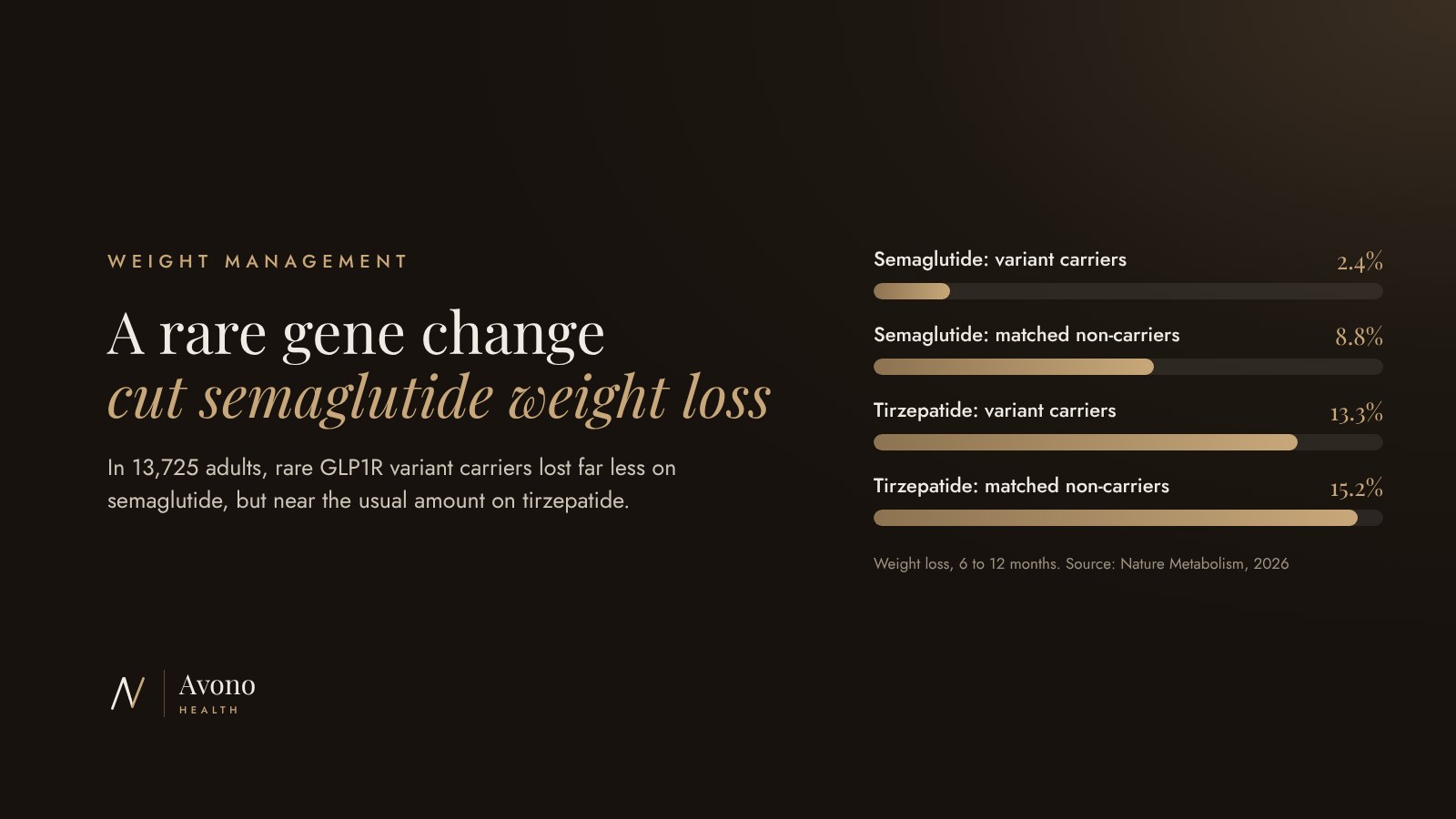
People who carry rare, damaging changes in the gene for the GLP-1 receptor lost far less weight on semaglutide than similar people without those changes: 2.4% of body weight versus 8.8%, according to a study published Nov. 11 in Nature Metabolism. On tirzepatide, the same kind of carriers lost 13.3% versus 15.2%, a gap the researchers did not find to be statistically significant.
Key takeaways
- Researchers linked DNA data to health records for 13,725 U.S. adults who started semaglutide (Wegovy, Ozempic) or tirzepatide (Zepbound, Mounjaro) in routine care.
- Only 33 people, about 0.2% of the group, carried a qualifying rare variant in the GLP1R gene.
- On semaglutide, carriers lost about one quarter of the usual weight. On tirzepatide, carriers lost close to the usual amount.
- This was an observational study with very small carrier groups, run mostly by scientists at the genetics company Helix. It does not show that gene testing should guide treatment today.
What the study found
Semaglutide works by acting on one target in the body, the GLP-1 receptor. A receptor is a protein on the surface of cells that a hormone or drug attaches to. Tirzepatide acts on the GLP-1 receptor too, but it also acts on a second one, the GIP receptor. The gene that holds the instructions for the GLP-1 receptor is called GLP1R.
The research team asked a simple question: do people born with rare, harmful changes (variants) in GLP1R respond differently to these drugs? Across both drugs combined, carriers lost a mean of 8.2% of their body weight, compared with 12.5% for matched non-carriers. The paper reports a response ratio of 0.65 (95% confidence interval 0.46 to 0.85; P = 0.0007). A response ratio of 1.0 would mean carriers and non-carriers lost the same amount.
The difference came almost entirely from semaglutide:
- Semaglutide: 17 carriers lost 2.4% of body weight, versus 8.8% for their matched non-carriers (response ratio 0.27, P = 0.0007).
- Tirzepatide: 19 carriers lost 13.3%, versus 15.2% for their matched non-carriers (response ratio 0.88, P = 0.23, not statistically significant).
- A formal test confirmed that the effect of carrying a variant was different between the two drugs (P = 0.009).
- Looking person by person, 15 of 17 semaglutide users with a variant (88%) lost less than their matched comparison group. For tirzepatide, it was 11 of 19 (58%).
The team also looked at rare variants in GIPR, the gene for tirzepatide’s second target. Carriers of the most clearly damaging GIPR variants lost about the same amount of weight as non-carriers on either drug. A small overall difference in this group did not hold up when the researchers adjusted for genetic ancestry.
| Group (6 to 12 months of treatment) | Carriers of rare GLP1R variant | Matched non-carriers | Response ratio |
|---|---|---|---|
| Semaglutide, main study | 2.4% weight loss (17 people) | 8.8% weight loss | 0.27 (P = 0.0007) |
| Tirzepatide, main study | 13.3% weight loss (19 people) | 15.2% weight loss | 0.88 (P = 0.23) |
| Semaglutide, separate Helix check group | 4.1% weight loss (7 people) | 7.5% weight loss | 0.54 (P = 0.004) |
| Semaglutide, All of Us check | 2.6% weight loss (8 people) | 5.7% weight loss | 0.46 (P = 0.12) |
How to read these numbers
The meaningful comparison is inside each row: carriers against the non-carriers who were matched to them on the same drug. The rows should not be compared with each other. The researchers did not set out to compare semaglutide with tirzepatide, and the people on each drug were different. So the 8.8% and 15.2% figures for non-carriers are not a head-to-head test of the two drugs.
The non-carriers also lost less than people did in the large drug trials, which the paper notes reached average losses of 10% to 21% over 68 to 72 weeks. The paper does not directly explain this gap. What it does report is that this study measured weight over 6 to 12 months, used routine health records rather than trial visits, and that medication use and weight were imperfectly recorded in this kind of data. The check groups at the bottom of the table also used different eligibility rules and data, which may be part of why their numbers differ.
Who was studied
The researchers used the Helix Research Network, which links clinical-grade DNA sequencing with electronic health records and insurance claims from 13 North American health systems, covering 351,818 people. From that group, they found 13,725 adults with a body mass index (BMI) of 25 or higher who started injected semaglutide or tirzepatide in routine care. Records ran through Dec. 31, 2025. People with past weight loss surgery, a recent pregnancy or recent cancer were left out.
Each person with a rare variant was matched with up to 10 people without one who were similar in drug, dose, sex, diabetes status, past GLP-1 use, genetic ancestry, starting BMI and length of follow-up. The 33 GLP1R carriers were matched with 274 non-carriers. The outcome was the percent change in body weight over 6 to 12 months.
The team tried to repeat the finding in two other groups. In the National Institutes of Health’s All of Us Research Program, 8 semaglutide users with a variant lost 2.6% versus 5.7% for non-carriers. That pointed the same way but was not statistically significant (P = 0.12). In a separate, newer group from the same 13 health systems, 7 semaglutide users with a variant lost 4.1% versus 7.5% (P = 0.004), while 11 tirzepatide users with a variant showed no reduced response.
Side effects and safety
This study measured weight change only. It did not report on side effects such as nausea or vomiting. An earlier genetic study in Nature from the 23andMe Research Institute, published in April, did look at side effects in 27,885 GLP-1 users. It linked variation in both GLP1R and GIPR to nausea or vomiting, with the GIPR link limited to people using tirzepatide. Separately, the FDA now requires a warning about a rare cause of sudden vision loss on every GLP-1 label.
The drugs in this study were prescribed in routine care. Compounded versions of semaglutide and tirzepatide were not studied separately in this research, and compounded drugs are not FDA approved.
What the researchers said
The study team did not give interviews in the sources reviewed for this article. These lines come from their published paper.
These findings suggest that carriers of rare damaging GLP1R variants may be preferentially suited to tirzepatide or other agents engaging non-GLP-1R pathways.
Matthew E. Levy, Elizabeth T. Cirulli and colleagues, Helix, in Nature Metabolism
The number of rare variant carriers is small, particularly in drug-specific subgroups, limiting variant-level inferences.
Levy et al., Nature Metabolism
The authors also wrote that whether tirzepatide’s second target makes up for a weaker GLP-1 receptor still needs to be proven: “Direct experimental evidence is required to establish whether GIPR co-agonism compensates for impaired GLP-1R signalling.”
Outside experts have not yet commented publicly on this paper in the sources reviewed. When the April 23andMe gene study came out, independent researchers urged caution about genetics and GLP-1 response. G. Caleb Alexander, an epidemiologist at the Johns Hopkins Bloomberg School of Public Health, told The Washington Post:
A lot of clinicians and patients don’t seem to recognize that GLP-1s don’t work in everybody.
G. Caleb Alexander, Johns Hopkins Bloomberg School of Public Health, in The Washington Post
Dr. Marie Spreckley of the University of Cambridge, commenting on that same April study to pharmaphorum, said that “genetics is only one part of a much more complex picture.”
Limits of the study
- Very few carriers. The semaglutide result rests on 17 people with a variant, and the tirzepatide result on 19.
- Observational design. The study shows an association, not cause and effect. People were not randomly assigned to a drug.
- Real-world records. The authors note that adherence (taking the drug as prescribed) and weight were imperfectly recorded, and that some confounding (other hidden factors) is possible.
- Limited diversity. Most carriers had genetic ancestry similar to European reference groups.
- Computer-predicted variants. Most variants were labeled harmful by prediction software, which the authors say can be less reliable for this type of receptor.
- One replication was not significant. The All of Us result pointed the same way but did not reach statistical significance.
- Company-led. Eight of the authors, including the lead and senior authors, work for Helix. The paper says the work received no specific funding.
What it means for you
The authors’ takeaway is that a rare genetic change in the GLP-1 receptor may explain why a small number of people lose much less weight on semaglutide, and that these people may do better on tirzepatide or drugs that work through other pathways. They describe this as a step toward precision, or personalized, obesity treatment. The variants are rare: about 2 in every 1,000 treated people in this study carried one.
The study does not test whether checking genes before treatment leads to better results, and it does not say that most people who lose little weight on semaglutide have one of these variants. If you want to understand how GLP-1 medications work or are weighing tirzepatide versus semaglutide, talk with a licensed clinician about your own health, history and goals. This article is not medical advice.
The bottom line
In a large set of U.S. health records, the rare people born with damaging changes in the GLP-1 receptor gene lost about a quarter of the usual weight on semaglutide, but close to the usual amount on tirzepatide. The finding is based on small numbers of carriers in an observational study, and the researchers say more work is needed to confirm how it happens.
Frequently asked questions
Why do some people not lose weight on semaglutide?
Many factors play a role. This study found that rare damaging changes in the GLP1R gene, carried by about 0.2% of treated people, were linked to much less weight loss on semaglutide. An earlier Nature study found a common GLP1R variant linked to a small amount of extra weight loss, about 0.76 kg per copy.
Does tirzepatide work if semaglutide did not?
This study did not test switching drugs. It found that people with rare GLP1R variants lost close to the usual amount of weight on tirzepatide. The authors suggest this may be because tirzepatide also acts on the GIP receptor, but they say direct experiments are needed to prove it.
Is there a genetic test for GLP-1 response?
Some companies offer reports based on genetic research. This study does not show that testing before treatment improves results, and an independent expert said of the earlier April study that genetics is only one part of a much more complex picture (pharmaphorum).
How common are these gene variants?
Rare. Only 33 of 13,725 treated adults in the main study carried a qualifying GLP1R variant, about 0.2%, according to the paper.