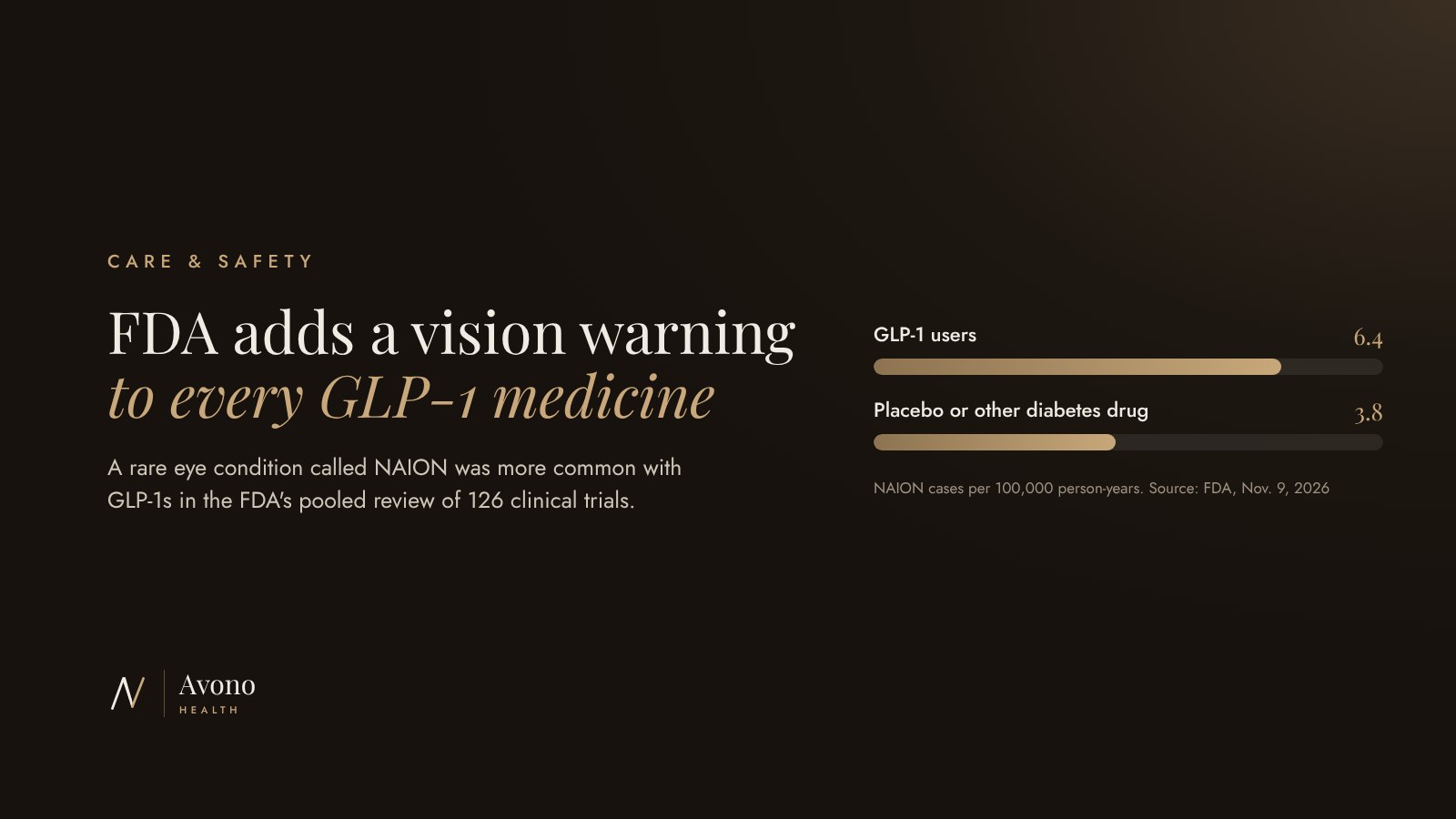
On November 9, 2026, the U.S. Food and Drug Administration (FDA) said all GLP-1 medications, including Ozempic, Wegovy, Mounjaro and Zepbound, must carry a new warning about a rare eye condition that can cause permanent vision loss. In the FDA’s review of 126 clinical trials, the condition occurred at a rate of 6.4 cases per 100,000 person-years in people taking GLP-1s, compared with 3.8 in people taking a comparison treatment (FDA).
Key points
- The FDA now requires a warning about NAION (non-arteritic anterior ischemic optic neuropathy) in the Warnings and Precautions section of every GLP-1 drug label.
- The FDA calls this a potential increased risk of a rare condition. It did not say GLP-1s have been proven to cause it.
- In 126 trials with 134,253 patients, there were 15 probable NAION cases: 10 in GLP-1 users and 5 in people on placebo.
- Symptoms include sudden, painless vision loss in one eye, often noticed on waking. The FDA says to contact a health care professional right away.
- Novo Nordisk says the data do not establish cause and effect. Eli Lilly says the notice has no findings specific to its medicines.
What the FDA announced
The FDA issued a Drug Safety Communication about a “potential increased risk” of NAION linked to glucagon-like peptide-1 receptor agonists, or GLP-1 RAs (FDA). GLP-1 RAs are medicines that copy a natural gut hormone. They help lower blood sugar after meals and act on parts of the brain that control appetite.
The agency is requiring the companies that make every GLP-1 medicine to add NAION information to the Warnings and Precautions section of their labels. The FDA’s list includes semaglutide (Ozempic, Rybelsus, Wegovy), tirzepatide (Mounjaro, Zepbound), liraglutide (Victoza, Saxenda), dulaglutide (Trulicity), combination products Xultophy and Soliqua, and orforglipron (Foundayo), a pill approved in 2026 (FDA). The FDA notes that tirzepatide acts on both GIP and GLP-1 receptors.
The FDA said NAION cases “have been reported for all currently marketed GLP-1 RA products” (FDA). That is why the warning covers the whole drug class, not only semaglutide. Europe’s earlier review in 2025 covered semaglutide only (Ophthalmology Times).
What is NAION?
NAION is caused by reduced blood flow to the front part of the optic nerve, the nerve that carries signals from the eye to the brain. The FDA says the underlying cause “is not completely understood.” Risk factors may include smoking, diabetes, high blood pressure, sleep apnea, anemia and kidney disease. If NAION happens in one eye, the risk of it happening in the other eye goes up (FDA).
NAION also happens in people who do not take GLP-1s. Based on published studies, the FDA says it occurs in 2.3 to 10.2 of every 100,000 adults over age 50 each year (FDA).
What the FDA’s review found
The review started after a July 2024 study in JAMA Ophthalmology linked semaglutide to NAION. The FDA said it found “several limitations” in that study but decided more review was needed. It then looked at clinical trials, animal studies, side effect reports and real-world data (FDA).
Results are given in person-years. One person-year means one person taking a drug for one year. So 100,000 person-years could be 100,000 people for one year, or 50,000 people for two years.
Clinical trials
The FDA pooled 126 randomized controlled trials of GLP-1 drugs. Together they included 134,253 patients: 78,217 on a GLP-1 and 56,036 on a comparison treatment, either a placebo or a non-GLP-1 diabetes medicine. The FDA found 15 probable NAION events. Ten were in GLP-1 users, five were in placebo users and none were in people on other diabetes drugs (FDA).
Real-world data
The FDA also studied adults with type 2 diabetes who started a GLP-1 or another common diabetes drug between 2019 and 2024, using its Sentinel data system. NAION rates were 30 to 32 per 100,000 person-years with GLP-1s, 31 with SGLT-2 inhibitors and 26 with DPP-4 inhibitors (FDA). Compared with SGLT-2 inhibitors, the higher risk with GLP-1s was not statistically significant. Compared with DPP-4 inhibitors, it was.
Why the real-world rate is higher than the trial rate
The real-world rate with GLP-1s, 30 to 32 cases per 100,000 person-years, is about five times the trial rate of 6.4. The FDA did not explain the gap. Two facts from its notice help put it in context (FDA):
- Different people. The Sentinel study included only adults with type 2 diabetes, and the FDA lists diabetes as a risk factor for NAION. In that study, rates were similar across all three drug groups: 30 to 32 for GLP-1s, 31 for SGLT-2 inhibitors and 26 for DPP-4 inhibitors.
- Different kinds of data. The trial figure comes from 126 randomized controlled trials, in which the FDA counted 15 probable cases. The Sentinel figure comes from a study that looked back at real-world health data.
Because the people and the methods differ, the two rates should not be compared with each other. In each data source, the FDA compared GLP-1 users with a comparison group studied the same way. Those side-by-side numbers, shown in the table below, are the ones to look at.
| Data source | Comparison | Result |
|---|---|---|
| 126 clinical trials (134,253 patients) | GLP-1 vs. placebo or other diabetes drug | 6.4 vs. 3.8 NAION cases per 100,000 person-years |
| FDA Sentinel study, type 2 diabetes | GLP-1 vs. SGLT-2 inhibitor | Hazard ratio 1.19 (95% CI 0.91 to 1.54), not statistically significant |
| FDA Sentinel study, type 2 diabetes | GLP-1 vs. DPP-4 inhibitor | Hazard ratio 1.43 (95% CI 1.02 to 2.01) |
| General population, adults over 50 | No GLP-1 required | 2.3 to 10.2 cases per 100,000 people per year |
The FDA also reviewed published observational studies. It said the “methodologically rigorous” ones “consistently reported an increased risk of NAION” in people with type 2 diabetes who started GLP-1s compared with DPP-4 or SGLT-2 inhibitors. The animal data did not show how GLP-1s could raise NAION risk (FDA).
The 2024 study that started the review
The 2024 study came from Massachusetts Eye and Ear. Researchers looked back at records of 16,827 patients seen by neuro-ophthalmologists, eye doctors who specialize in the optic nerve, at one academic center from December 2017 to November 2023 (JAMA Ophthalmology).
Among 710 people with type 2 diabetes, 17 NAION events occurred in the 194 prescribed semaglutide and 6 in the 516 on other diabetes drugs. Among 979 people with overweight or obesity, there were 20 events in the 361 on semaglutide and 3 in the 618 on other weight-loss drugs. The hazard ratios were 4.28 (95% CI 1.62 to 11.29) and 7.64 (95% CI 2.21 to 26.36). The authors wrote that the findings “suggest an association” and that “future study is required to assess causality” (JAMA Ophthalmology).
Those numbers are much higher than the FDA’s trial results. The 2024 study was small, came from a specialty eye clinic where patients were already being checked for eye problems, and could not confirm whether people took their medicine. The authors listed these limits themselves.
What Europe found
In June 2025, the European Medicines Agency’s safety committee (PRAC) concluded that NAION is a “very rare” side effect of semaglutide, meaning it may affect up to 1 in 10,000 people taking it. The committee said large studies suggest semaglutide in adults with type 2 diabetes is linked to about a two-fold increase in NAION risk. It said this equals about one additional case per 10,000 person-years of treatment (EMA).
What the experts and companies said
Dr. Joseph Rizzo, a neuro-ophthalmologist at Massachusetts Eye and Ear and a co-author of the 2024 paper, told CBS News he believes the evidence shows GLP-1 use raises NAION risk. He also said he does not discourage patients from taking the drugs (CBS News).
The medicines have really been profoundly beneficial to a large number of people.
Dr. Joseph Rizzo, Massachusetts Eye and Ear, to CBS News
Usually when you lose vision, although there may be some mild degree of improvement, it’s usually not a large degree of improvement.
Dr. Joseph Rizzo, to CBS News
The degree of visual loss in the first eye does not inform the degree of visual loss that would occur in the second eye.
Dr. Joseph Rizzo, to CBS News
A 2026 study in Annals of Internal Medicine by Rutgers researchers, including Dr. Chintan Dave, found that among adults aged 18 to 65 with type 2 diabetes, starting a GLP-1 was linked to 3.0 to 3.6 more cases of ischemic optic neuropathy, which includes NAION, per 10,000 people over 18 months than starting one of two other types of diabetes medicine.
Patients should not conclude from these numbers that they are likely to experience vision loss or that they should stop taking their medication. While treatment decisions should be made individually through discussions with their healthcare providers, for most patients, the benefits of GLP-1 medications for heart health, blood sugar control, and weight management are likely to outweigh this rare potential risk.
Chintan Dave, PharmD, PhD, Core Member, Rutgers Center for Pharmacoepidemiology & Treatment Science and Associate Professor, Rutgers Ernest Mario School of Pharmacy and Rutgers School of Public Health, in a comment provided to Avono Health through Rutgers Institute for Health.
Novo Nordisk, which makes Ozempic and Wegovy, said it “continues to believe the data do not establish a cause-and-effect relationship and we remain confident in the benefit-risk profile of our GLP-1 medicines.” Eli Lilly, which makes Mounjaro and Zepbound, said the FDA notice “does not reference any findings specific to Lilly medicines” (CBS News).
Limits of the evidence
- NAION is rare, so the trial analysis rested on only 15 probable cases. Small counts make rates less certain.
- The FDA said side effect reports were “challenging to interpret” because NAION risk factors, such as diabetes and sleep apnea, are common in people who take GLP-1s.
- Animal studies did not show a way GLP-1s could cause NAION.
- The real-world data are observational. They show an association, not proof of cause, and the results differed by comparison drug.
- The FDA described the risk as “potential.” Novo Nordisk disputes that a cause-and-effect link has been shown.
What about compounded GLP-1s?
The FDA’s notice covers FDA-approved medicines. Compounded semaglutide and compounded tirzepatide contain the same active ingredients, but they are not FDA approved. The FDA does not review them, so they carry no FDA label, and this warning will not appear on them. If you use a compounded GLP-1, assume the same potential risk applies, watch for the same symptoms, and ask your clinician how this warning applies to you. You can learn more about how these drugs differ in our guide to tirzepatide vs. semaglutide.
What it means for you
The FDA’s advice for patients is to know the symptoms of NAION. These include sudden, painless vision loss in one eye that you may notice on waking, blurred or missing parts of your vision such as blind spots or tunnel vision, colors that look off and blurry or hazy spots. The FDA says to contact your health care professional right away if you notice any of these (FDA).
If you have had NAION, the FDA says to talk with your health care professional about whether to keep taking or stop your GLP-1. For doctors, the FDA advises sending patients with suspected NAION to an eye specialist promptly and considering stopping the GLP-1 “unless the benefits of treatment clearly outweigh the risk” (FDA).
Do not stop or change a prescribed medicine on your own. Talk with a licensed clinician about your own risk factors, your eye history and the benefits of treatment. For background on how these drugs work, see how GLP-1 medications work.
The bottom line
The FDA now requires every GLP-1 label to warn about a potential increased risk of NAION, a rare cause of sudden vision loss in one eye. Across 126 trials, the rate was 6.4 per 100,000 person-years with GLP-1s and 3.8 with comparison treatments. The FDA did not say GLP-1s are proven to cause NAION, and one maker disputes a causal link. Knowing the symptoms and acting fast if they appear is the FDA’s main advice.
Frequently asked questions
Can Ozempic or Wegovy cause blindness?
The FDA says GLP-1s, including semaglutide, carry a potential increased risk of NAION, a rare condition that can cause permanent vision loss in one eye. It did not say the drugs are proven to cause it. Europe’s regulator calls NAION a very rare semaglutide side effect, affecting up to 1 in 10,000 users (EMA).
Does the warning apply to Mounjaro and Zepbound?
Yes. The FDA is requiring the warning on all GLP-1 medicines, including tirzepatide (Mounjaro and Zepbound). Eli Lilly said the notice does not reference findings specific to its medicines (CBS News).
How rare is NAION on a GLP-1?
In the FDA’s analysis of 126 trials, there were 6.4 cases per 100,000 person-years in GLP-1 users and 3.8 in people on comparison treatments. There were 15 probable cases in total among 134,253 patients (FDA).
Should I stop taking my GLP-1?
The FDA does not tell people without symptoms to stop. It advises people who have had NAION to talk with their health care professional about whether to continue or stop. Talk with a licensed clinician before making any change.
Update, November 14, 2026: We added context on compounded GLP-1s and on why the real-world and trial rates differ.
Update, November 18, 2026: We added a comment from Chintan Dave, PharmD, PhD, of Rutgers, senior author of a 2026 Annals of Internal Medicine study on GLP-1s and NAION.