A vial shows up in the mail.
The label says:
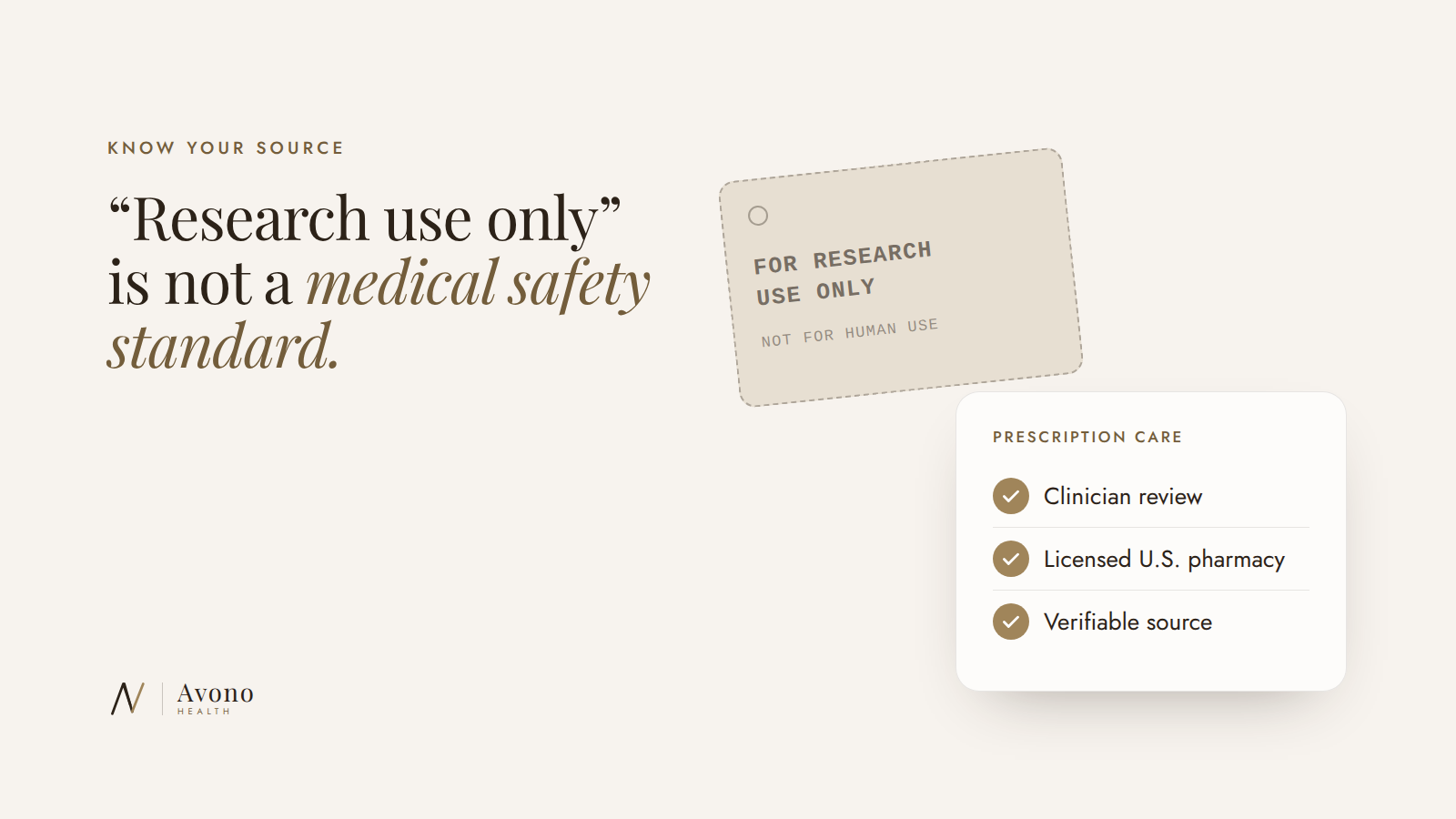
“Research Use Only.”
Maybe the website also says:
“Not for Human Consumption.”
Then, two inches farther down the page, the company tells you what the peptide supposedly does, sells you bacteriostatic water, discusses dosage or links to a community explaining how to inject it.
That contradiction should tell you something.
This is not a clever way to obtain the same medical treatment for less money.
You may be buying an unapproved injectable chemical from a seller that is deliberately operating outside the medical system.
And when the product is going into your body, that distinction matters.
A lot.
“Research use only” does not mean approved for you to inject
The phrase sounds technical.
It can make a product feel scientific.
It may arrive in a sterile-looking vial with a professional label and a purity percentage.
None of those things turn a research chemical into prescription medication.
FDA has repeatedly taken action against peptide vendors that label products “research use only” or “not for human consumption” while simultaneously marketing them in ways that demonstrate intended human use.
Recent FDA warning letters have involved products including semaglutide, tirzepatide, retatrutide, sermorelin, tesamorelin, PT-141 and other peptides.
This is not an obscure regulatory technicality.
It goes directly to what controls existed before that vial reached you.
Injectable products do not leave much room for error
Your gastrointestinal system provides barriers against many contaminants.
An injection bypasses many of them.
FDA has specifically emphasized this point in recent enforcement against research-peptide sellers, warning that injectable products can pose serious risks because they bypass key body defenses against toxins and microorganisms.
Think about what that means in practical terms.
When you inject something, you are trusting that:
The substance on the label is actually in the vial.
The concentration is accurate.
The product does not contain an unintended drug.
The product is not contaminated.
The vial is sterile.
The raw ingredients were appropriate for human pharmaceutical use.
The product was prepared under appropriate conditions.
The storage process did not compromise it.
The shipping process did not compromise it.
And the instructions you found online are actually appropriate for your body.
That is a hell of a lot of trust to place in a website because the vial was cheaper.
“99% purity” does not answer the questions you think it answers
Gray-market peptide sellers frequently lean heavily on certificates of analysis.
A laboratory document can sound reassuring.
But a certificate showing a particular analytical result does not, by itself, establish that a product was manufactured as a medication suitable for injection into a human being.
Purity is not the same thing as sterility.
A peptide identity test is not a complete sterility program.
A laboratory number does not establish that the specific vial in your hand was produced, stored and shipped through a legitimate prescription-drug supply chain.
And even an authentic test result cannot replace medical evaluation of whether the drug itself is appropriate for you.
A PDF is not a doctor.
A chromatography graph is not a pharmacy.
The product may not be what the label says
This is not hypothetical.
FDA warns that drugs obtained outside appropriate regulatory safeguards can be counterfeit, contaminated, contain varying amounts of active ingredient, or contain different ingredients altogether.
FDA has also identified fraudulent products marketed as compounded semaglutide or tirzepatide where the pharmacy named on the label did not actually make the product. In some instances, the pharmacy reportedly did not even exist.
Read that again.
A vial can look professional.
It can carry a pharmacy name.
It can have a dosage printed on it.
And those details can still be false.
Packaging is not provenance.
The dosing problem is bigger than people realize
Even if the chemical in the vial is exactly what you think it is, you still have another problem:
How much are you actually taking?
Many gray-market peptide products are sold as lyophilized powder requiring reconstitution.
That means the consumer may be responsible for adding bacteriostatic water, calculating concentration, converting milligrams to syringe units and determining a dosing schedule.
A mathematical mistake becomes a medication mistake.
A misunderstanding about vial concentration becomes a medication mistake.
Confusing milligrams with milliliters becomes a medication mistake.
Using a dosing schedule copied from Reddit, TikTok, Discord or a forum becomes a medical decision made without access to your medical history.
Prescription medication has risks even when everything is done correctly.
There is no prize for adding unnecessary risk.
“But everyone in my peptide group uses it”
Online communities can be useful places to hear other people’s experiences.
They are not clinical trials.
They are not pharmacies.
And they cannot tell you what is actually inside your vial.
A hundred anonymous people saying they used a vendor without a problem does not establish manufacturing quality.
Most people do not independently test the contents of every vial they receive.
Most cannot identify microbial or endotoxin contamination by looking at a solution.
And adverse events may never make it into the conversation at all.
A product does not become medically legitimate through community consensus.
Cheap medication can become very expensive care
Part of the appeal is obvious.
Gray-market peptides can be cheap.
No clinician fee.
No medical review.
No pharmacy process.
No rules.
Just click, pay and inject.
But look at what has actually been removed from that price.
There may be no clinician evaluating contraindications.
No licensed pharmacy accepting responsibility for dispensing.
No pharmacist reviewing the prescription.
No legitimate patient-specific prescribing process.
No medical team to contact if something goes wrong.
No established clinical record of what you were taking.
No reliable assurance about manufacturing or sourcing.
The low price is not magic.
Part of what you are not paying for may be the safeguards.
A real prescription is more than permission
People sometimes view the clinician as an obstacle standing between them and the medication they already decided they want.
That misses the point of prescribing.
A competent clinical review asks questions such as:
What are you taking now?
What medical conditions do you have?
Could this interact with another medication?
Is there a contraindication?
Does your treatment goal actually fit the medication?
What dose or formulation is appropriate?
What happens if you develop a side effect?
When should treatment be adjusted or stopped?
Does something in your history require additional testing or in-person evaluation?
The goal is not to make obtaining treatment difficult.
The goal is to avoid treating a drug like an ordinary consumer product.
Gray-market is not the same thing as legitimate compounding
This distinction is critical.
Compounded medications are not FDA-approved.
FDA does not evaluate an individual compounded medication for safety, effectiveness and manufacturing quality through the same premarket approval process used for FDA-approved drugs.
Avono does not pretend otherwise.
But legitimate prescription compounding and a “research peptide” website are not the same pathway.
Federal and state law establish conditions under which licensed pharmacies and outsourcing facilities may compound medications. For traditional 503A pharmacy compounding, this can include preparation for an individual patient based on a valid prescription and compliance with applicable requirements.
That is fundamentally different from ordering a vial marketed outside the prescription system for self-directed injection.
Patients considering compounded medication should still understand its regulatory status and discuss the risks and alternatives with a licensed clinician.
Transparency goes both ways.
Be suspicious when nobody wants to call the product medicine
Here is a simple question:
If a company expects people to inject its product into their bodies, why is it insisting that the product is not for human consumption?
Sometimes the answer is obvious.
Calling something a “research chemical” does not magically eliminate the consequences of selling an unapproved drug for human use.
FDA has repeatedly said exactly that in warning letters.
If the website looks like a medication store, talks like a medication store, provides human-use information like a medication store and sells supplies for injecting its products, a tiny disclaimer at the bottom of the page should not make you feel safer.
It should make you ask why the disclaimer is there.
Red flags worth taking seriously
Be cautious when a seller offers injectable peptides while simultaneously stating that its products are “research use only” or “not for human consumption.”
Be cautious when there is no prescription requirement.
Be cautious when there is no identifiable licensed pharmacy dispensing the medication.
Be cautious when the seller promises treatment outcomes that sound dramatically better than established evidence.
Be cautious when the company will happily sell you the peptide but there is no licensed clinician taking responsibility for determining whether you should use it.
Be cautious when the only evidence of quality is the company’s own marketing.
And be very cautious when a cheap price requires you to become your own doctor, pharmacist and sterile-compounding operation.
Why Avono takes a different approach
Avono was built around a very different principle:
If something is going into your body as medical treatment, treat it like medical treatment.
Prescription requests go through clinical review.
Independent U.S.-licensed clinicians make prescribing decisions.
When prescribed, medications are fulfilled through licensed U.S. pharmacy partners.
Patients have access to ongoing communication and support.
And Avono identifies compounded medications as compounded medications rather than presenting them as FDA-approved drugs or pretending they are identical to FDA-approved products.
That may not be as cheap as buying an anonymous vial online.
It is not supposed to be the same thing.
The bottom line
Peptides are real molecules.
Some have legitimate medical uses.
Some are promising research candidates.
Some have little meaningful human evidence.
And some products sold online are simply unapproved drugs dressed up as laboratory supplies.
Those categories should not be blurred together.
A professional-looking website does not make a research chemical pharmaceutical-grade medicine.
A certificate of analysis is not a prescription.
A Reddit recommendation is not medical oversight.
A low price is not proof of value.
And “research use only” is not a safety standard for something you plan to inject into your body.
You get one body.
Know what you are putting into it.
Know where it came from.
Know who prescribed it.
And know who you are going to call if something goes wrong.
Frequently Asked Questions
Are research peptides safe for human use?
Products labeled “research use only” are not being represented as approved medications for human use. FDA has repeatedly taken enforcement action against sellers marketing such products for human therapeutic purposes.
Are all compounded peptides gray-market products?
No. Compounded prescription medications prepared and dispensed through licensed pharmacies under applicable compounding laws are a different pathway from non-prescription research-chemical vendors. Compounded medications are still not FDA-approved.
Does a certificate of analysis mean a peptide is safe to inject?
Not by itself. Analytical purity does not establish every aspect of drug identity, sterility, manufacturing quality, patient suitability or proper prescribing.
Why are injectable gray-market peptides particularly concerning?
Injection bypasses several of the body’s natural defenses against microorganisms and toxins, making contamination or poor manufacturing especially important.
Is a cheaper peptide necessarily the same medication sold by a telehealth provider or pharmacy?
No. Similar labeling does not establish identical ingredients, strength, quality, manufacturing, sterility or provenance.
What should I look for when obtaining prescription treatment online?
Look for legitimate clinician review, clear identification of the pharmacy dispensing the medication, transparent information about FDA or compounded status, appropriate medical screening, secure patient communication and a way to obtain help during treatment.
Comparing GLP-1 options? See semaglutide and tirzepatide programs and current prices.