People taking tirzepatide lost more lean body mass than people taking semaglutide in a large study of routine care records, with a 12-month gap of 2.1 percentage points. But tirzepatide users also lost more weight overall, and once researchers accounted for that, the gap disappeared.
Key takeaways
- The study, published November 12 in npj Exercise Medicine and Health, tracked 7,965 first-time users of semaglutide or tirzepatide who had body composition measured before and during treatment.
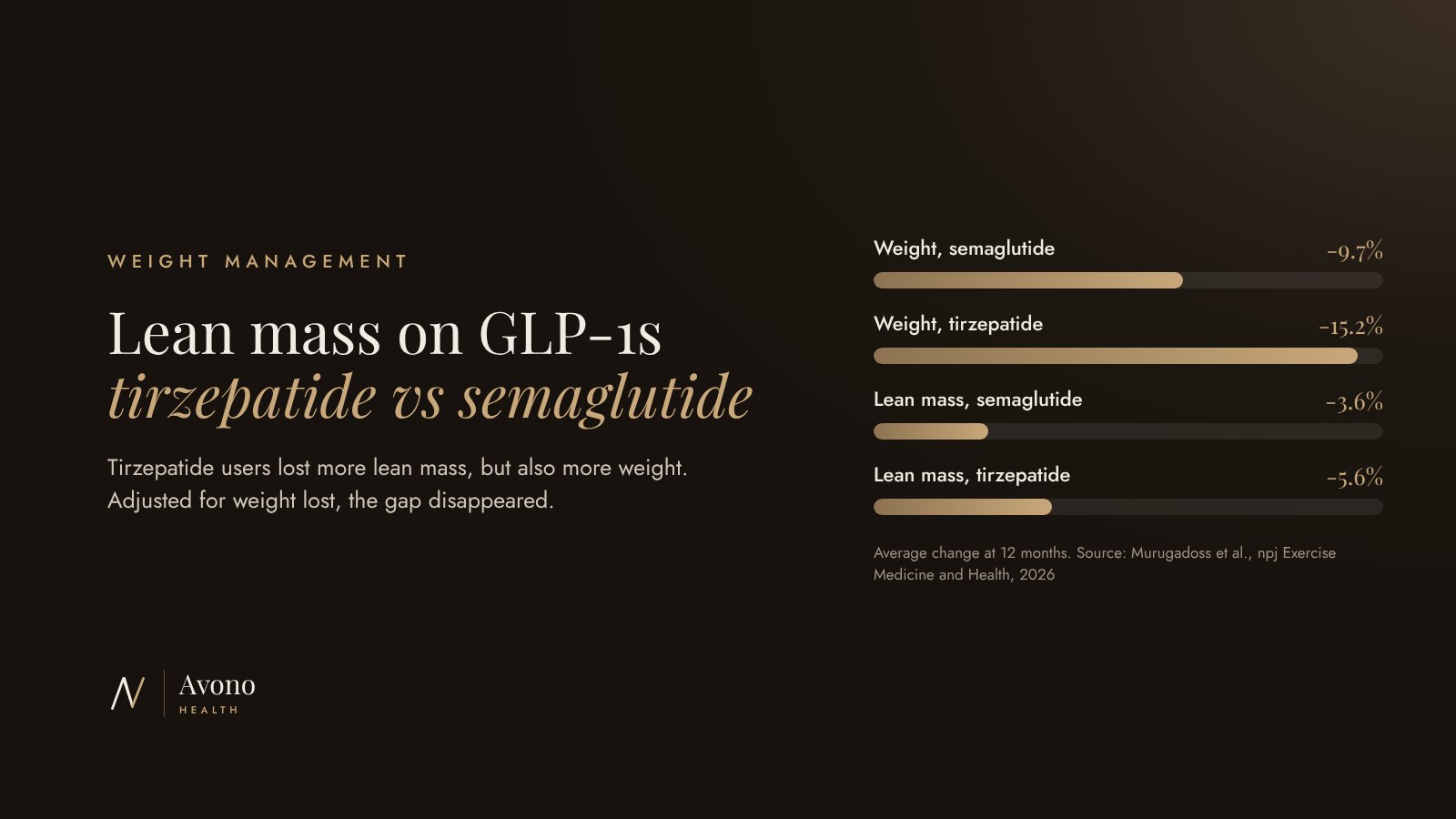
- At 12 months, lean body mass fell 3.6% on average with semaglutide and 5.6% with tirzepatide. Body weight fell 9.7% and 15.2%.
- Lean mass made up about 20% of the weight lost with either drug. After adjusting for how much weight people lost, the difference between drugs was close to zero.
- About 34% of patients on each drug lost more than 5% of their lean mass.
- This was an observational study of health records, mostly using smart-scale style measurements. It shows associations, not cause and effect.
What the study found
Lean body mass is everything in the body that is not fat, including muscle, organs and body water. The authors stress that it is not the same as muscle.
Semaglutide is sold as Wegovy and Ozempic. Tirzepatide is sold as Zepbound and Mounjaro. Semaglutide mimics one hormone, called GLP-1. Tirzepatide mimics GLP-1 and a second hormone, GIP, Reuters reported.
In the study, tirzepatide users lost more lean mass at every check-in. At 12 months the average lean mass change was -3.6% with semaglutide and -5.6% with tirzepatide. That is a difference of 2.1 percentage points (95% confidence interval, -3.8 to -0.3). A confidence interval (CI) is the range where the true value likely falls.
Tirzepatide users also lost more total weight: 15.2% at 12 months, compared with 9.7% for semaglutide. When the researchers adjusted for other factors such as age, sex and starting weight, tirzepatide still showed 1.9 points more lean mass loss. But when they also adjusted for how much weight each person lost, the 12-month gap shrank to 0.1 points (95% CI, -1.6 to 1.4), which is not a meaningful difference.
Among patients who lost at least 5% of their weight, lean mass made up 20% of the weight lost on semaglutide and 18% on tirzepatide at 12 months. Fat mass fell 12.8% and 21.1%, respectively.
| Measure at 12 months | Semaglutide | Tirzepatide |
|---|---|---|
| Average body weight change | -9.7% | -15.2% |
| Average lean body mass change | -3.6% | -5.6% |
| Share of weight lost that was lean mass* | 20% | 18% |
| Patients with more than 5% lean mass loss | 34.3% | 34.3% |
| “Prime” pattern: more than 10% weight loss, under 5% lean loss | 12.3% | 11.8% |
| “Depletive” pattern: more than 20% weight loss, over 5% lean loss | 6.7% | 10.3% |
Two patterns the researchers named
The team created two exploratory labels. The cutoffs have not been validated. A “Prime” pattern meant losing more than 10% of body weight with less than 5% lean mass loss. It was similar on both drugs (12.3% vs 11.8%, P = 0.66). A “Depletive” pattern meant losing more than 20% of body weight with more than 5% lean mass loss. It was more common with tirzepatide (10.3% vs 6.7%, P < 0.001).
That extra Depletive pattern was seen in women (12.3% vs 7.7%) and in people under 65, but not in men or in people 65 and older. It also depended on how the numbers were paired. When the researchers used lean mass measured within 90 days of each person’s lowest weight, the Depletive pattern showed up in 8.2% of patients on both drugs.
Who was studied
The researchers work at nference, a health data company in Cambridge, Massachusetts. They searched a network of electronic health records covering 29 million patients. They found 670,422 people starting semaglutide or tirzepatide for the first time. Only 7,965 of them, about 1.2%, had lean mass measured both before and after starting: 6,196 on semaglutide and 1,769 on tirzepatide.
Most measurements came from bioelectrical impedance analysis (BIA). These devices, often scales, send a weak electrical current through the body to estimate fat and lean tissue. DEXA scans, a type of low-dose X-ray, made up less than 1%.
Side effects and safety
The study did not measure strength or physical performance directly. Instead, it used software to search doctors’ notes. People with greater lean mass loss more often had notes describing reduced exercise tolerance. On semaglutide, that was 45.6% in the high lean-loss group vs 38.4% in the low lean-loss group. On tirzepatide, it was 33.3% vs 22.2%.
The authors warn that these links do not prove lean mass loss caused the problems. Less active people may lose more lean mass to begin with. Manual review found these limits were most often tied to pain that limited walking or activity. Neck pain and knee pain before treatment were also linked to greater lean mass loss on both drugs.
Men lost 7 to 10 percentage points less lean mass than women after adjustment. People 65 and older did not lose more lean mass than younger people, but that group was small. Higher doses and longer treatment were tied to more lean mass loss, but the authors say this should not be read as a direct dose effect.
Lean mass is one of several safety questions with these drugs. Separately, the FDA recently added a vision-loss warning to all GLP-1 medication labels.
How this compares with clinical trials
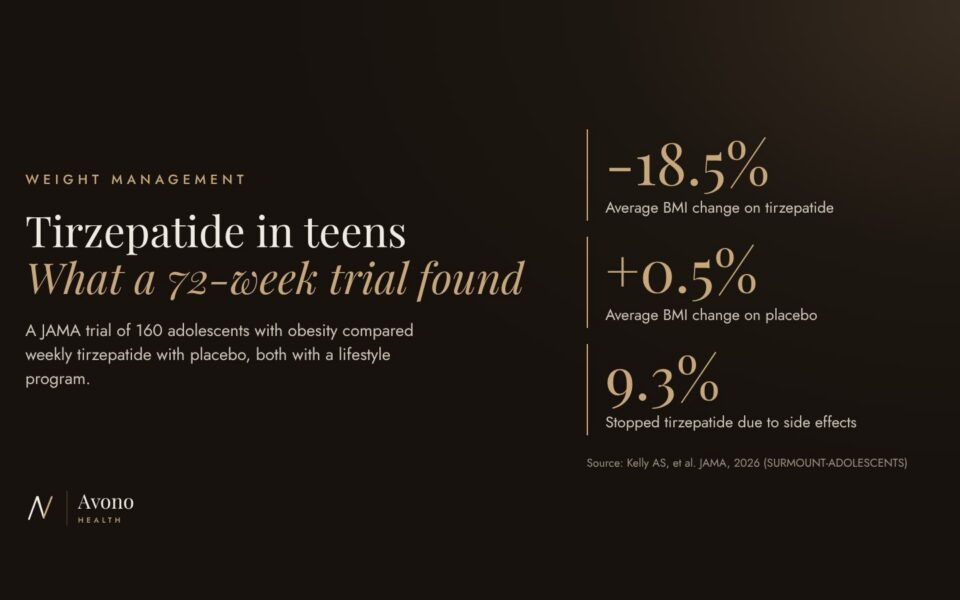
In the SURMOUNT-1 trial, 160 adults had DEXA scans before and after 72 weeks on tirzepatide or placebo. Tirzepatide users lost 21.3% of body weight, 33.9% of fat mass and 10.9% of lean mass. About 26% of the weight they lost was lean mass, and 25% for placebo, according to the trial report, which was funded by tirzepatide maker Eli Lilly.
The new study’s figure of about 20% is lower. The authors note it is similar to the roughly one quarter seen with tirzepatide in SURMOUNT-1 and below the roughly two fifths reported for semaglutide in the STEP 1 trial. The studies differ in important ways. SURMOUNT-1 was a controlled trial using DEXA for 72 weeks. The new study used routine records, mostly BIA devices, over 12 months. The paper does not fully explain the gap between these numbers. The most useful comparison is within each study: tirzepatide against semaglutide here, and tirzepatide against placebo in the trial.
What the researchers said
Our data therefore do not indicate a tirzepatide-specific effect on lean tissue beyond that expected from its greater energy deficit.
Karthik Murugadoss, A. J. Venkatakrishnan and Venky Soundararajan, nference, in the published study
Some lean-mass reduction is therefore an expected accompaniment of substantial weight loss by any means rather than a drug-specific adverse effect.
The study authors, npj Exercise Medicine and Health
An earlier version of the study was posted online in April, before peer review. At that time, study leader Venky Soundararajan told Reuters:
This suggests that patients shouldn’t simplistically be thinking, ‘I want to lose X amount of weight and I’ll go with the option that delivers greater weight loss.’
Venky Soundararajan, nference, to Reuters, April 2026
If you’re not exercising when you’re on these medicines, you are essentially causing attrition of lean body mass.
Venky Soundararajan, nference, to Reuters, April 2026
The drugmakers responded to that earlier version. A Lilly spokesperson told Reuters that lean mass loss also happens with weight loss from healthy dieting, and that in its trial, the ratio of fat loss to lean loss with tirzepatide was generally consistent with lifestyle-based obesity treatment. A Novo Nordisk spokesperson did not comment on the study but said muscle mass changes did not differ significantly between semaglutide and placebo in clinical trials, and physical function was preserved. Coverage of the preprint, including by EMJ, focused on the unadjusted gap.
Limits of the study
- It is observational, so it cannot prove cause. Diet, protein intake and exercise were not captured.
- Measurements came from different devices with different accuracy. Only 39% of patients had before and after values from the same documented device type. The authors say the result held when limited to same-device or Tanita-only measurements.
- Only about 1.2% of new users had paired measurements, so the group may not represent everyone.
- Follow-up stopped when people switched or stopped the drug. Treatment ended within 12 months for 44% of semaglutide users and 58% of tirzepatide users. Only 14.7% and 8.2% had a 12-month measurement.
- Drug use was based on prescriptions, not confirmed doses.
- The authors work for nference, which has research ties to drug companies whose products were studied. The paper says no company funded or shaped the work, and the study had no outside funding.
Compounded semaglutide and tirzepatide were not studied here, and they are not FDA approved.
What it means for you
The authors say their findings are hypothesis-generating. They call for future studies that measure body composition, strength and physical function alongside weight, and that test ways to keep lean mass during weight loss. They do not say one drug is safer for muscle than the other. If you are on either medication or weighing one, talk with a licensed clinician about your weight goals, activity and protein intake. See also our guides to choosing between tirzepatide and semaglutide and getting the most from GLP-1 treatment.
The bottom line
In real-world records, tirzepatide users lost more lean mass than semaglutide users, but they also lost more weight. Lean mass made up about one fifth of the weight lost with either drug, and the difference disappeared after accounting for total weight lost. About a third of patients on each drug lost more than 5% of their lean mass, and responses varied widely from person to person.
Frequently asked questions
Does tirzepatide cause more muscle loss than semaglutide?
In this study, tirzepatide users lost more lean body mass on average (5.6% vs 3.6% at 12 months), but they also lost more weight. After adjusting for weight lost, the difference was near zero. The study did not measure muscle directly. Source.
How much of the weight lost on GLP-1 drugs is lean mass?
About 20% with either drug in this study. In the SURMOUNT-1 trial, which used DEXA scans, about 26% of weight lost on tirzepatide was lean mass, similar to placebo. The studies used different methods and people. Source.
Does losing lean mass make people weaker?
The study could not answer this. It had no strength tests. Notes describing reduced exercise tolerance and fatigue were more common in people with greater lean mass loss, but the authors say this does not prove cause and effect.