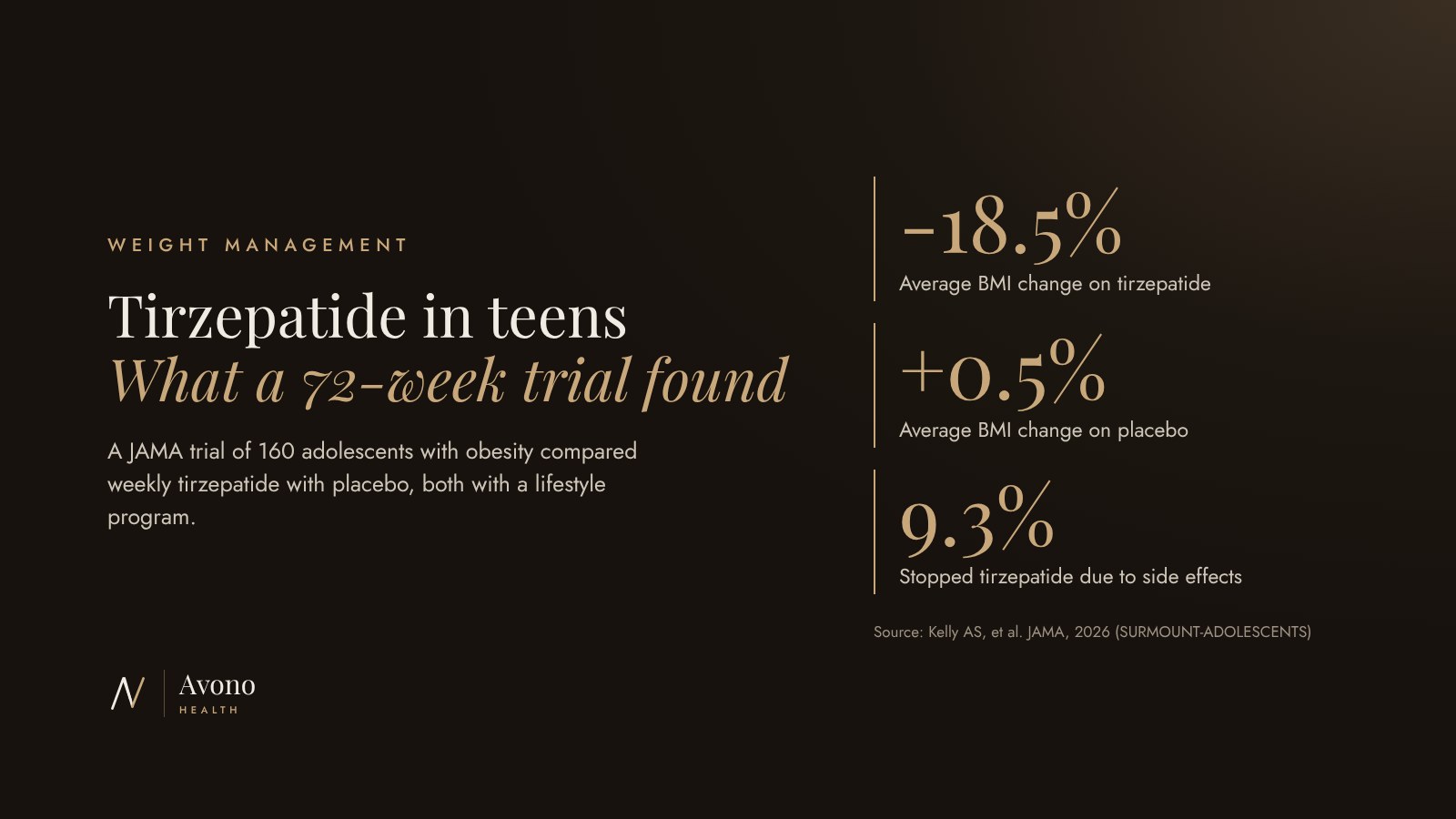
Teens with obesity who took tirzepatide for 72 weeks lowered their body mass index (BMI) by 18.5% on average, while BMI rose 0.5% in teens given a placebo, according to the SURMOUNT-ADOLESCENTS trial published in JAMA on November 15, 2026.
Key takeaways
- The trial included 160 adolescents ages 12 to 17 at 31 sites in six countries, all with a healthy lifestyle program.
- About 48% of teens on tirzepatide lowered their BMI by 20% or more, compared with about 8% on placebo.
- Stomach and gut side effects were common: half of teens on tirzepatide had vomiting and half had nausea, mostly mild to moderate and mostly while the dose was being raised.
- 9.3% of teens on tirzepatide stopped the drug because of side effects. No one on placebo did.
- Eli Lilly, which makes tirzepatide, funded the trial. Tirzepatide (Zepbound) is not FDA approved for weight management in anyone under 18.
What the study found
BMI is a measure of weight relative to height. The trial’s main goal was to see how much BMI changed from the start of the study to week 72. Counting every teen who was randomly assigned, including those who stopped the drug, BMI fell 18.5% with tirzepatide and rose 0.5% with placebo. The difference between the groups was 19.0 percentage points (95% confidence interval, 23.9 to 14.1; P < .001), the authors reported.
The researchers also ran a second analysis that asked what happens if teens keep taking the drug as planned. In that analysis, BMI fell 21.4% with tirzepatide and rose 0.4% with placebo, a difference of 21.7 percentage points. Medical Daily noted that Lilly’s announcement highlighted the 21.4% figure, while the 18.5% figure counts everyone, including teens who stopped treatment. The 18.5% figure is the more conservative of the two.
Teens on tirzepatide lost an average of 17.8 kg (about 39 pounds), or 16.9% of their body weight. Teens on placebo gained 2.3 kg, or 2.2% of their body weight. Waist size shrank by 15.7 cm with tirzepatide and grew by 0.7 cm with placebo. By the end of the trial, 53.5% of teens on tirzepatide had a BMI below the 95th percentile for their age and sex, the cutoff used to define obesity in children, compared with 7.1% on placebo. All 10 of the trial’s key secondary goals favored tirzepatide.
| Result at 72 weeks | Tirzepatide | Placebo |
|---|---|---|
| Change in BMI | -18.5% | +0.5% |
| Change in body weight | -16.9% (-17.8 kg) | +2.2% (+2.3 kg) |
| BMI down at least 5% | 79.6% | 28.5% |
| BMI down at least 10% | 71.4% | 19.5% |
| BMI down at least 15% | 63.4% | 12.4% |
| BMI down at least 20% | 48.1% | 7.9% |
| BMI below obesity cutoff at end | 53.5% | 7.1% |
Heart and metabolic measures also moved in a healthier direction. Compared with placebo, Healio reported, systolic blood pressure was 5.6 mm Hg lower, LDL cholesterol was 9.9 mg/dL lower and triglycerides were 27.8 mg/dL lower in the tirzepatide group. These measures were not adjusted for multiple comparisons, Contemporary Pediatrics noted, which means they should be read with more caution than the main result.
Who was studied
The trial ran from October 2023 to June 2026 in Canada, the Czech Republic, Israel, Italy, Poland and the United States. Teens qualified if they had obesity, or overweight plus at least one weight-related health problem. Teens who had not yet started puberty were not included. All teens first completed a 12-week lifestyle lead-in. They were then randomly assigned, two to one, to a weekly tirzepatide shot (109 teens) or a placebo shot (51 teens). Tirzepatide was slowly raised to the highest dose each teen could tolerate: 5, 10 or 15 mg. Neither the teens nor their doctors knew who got which shot, which is called a double-blind design.
On average, participants were 14.6 years old, weighed 109.7 kg (about 242 pounds) and had a BMI of 38.6. About 62% were girls. Most had severe obesity: only one participant had overweight rather than obesity, and only one had type 2 diabetes.
Side effects and safety
Side effects were more common with tirzepatide. Any side effect was reported by 95.4% of teens on tirzepatide and 82.4% on placebo. Stomach and gut problems affected 81.5% on tirzepatide and 54.9% on placebo. The most common were vomiting (50.9% vs 13.7%), nausea (50.0% vs 23.5%) and diarrhea (45.4% vs 25.5%). Most were mild to moderate and happened mainly while the dose was being increased, the study reported.
Serious side effects happened in 7.4% of teens on tirzepatide and 3.9% on placebo. There were no deaths. Ten teens on tirzepatide (9.3%) stopped the drug because of side effects, compared with none on placebo. Overall, more teens stopped treatment in the placebo group (31.4%) than in the tirzepatide group (21.1%), mostly in the placebo group because the treatment was not working.
Depression or thoughts of suicide were reported as side effects in 4.6% of teens on tirzepatide (five teens) and 2.0% on placebo (one teen). None of these events were serious, and the authors noted that all of the teens affected had a history of mental health conditions. Height and the pace of puberty were similar in both groups over the 72 weeks. For a separate safety topic that applies to all medicines in this class, see the FDA's new vision-loss warning for GLP-1s.
What the researchers said
The study results showed robust, statistically significant and clinically meaningful efficacy for tirzepatide.
Aaron S. Kelly, PhD, professor of pediatrics, University of Minnesota Medical School (Healio)
These treatment effects were very similar and comparable to adults in the SURMOUNT program.
Daniel Hsia, MD, endocrinologist, Emory University School of Medicine and Children’s Healthcare of Atlanta (Healio)
There are no signals of disruption to growth and maturation in this trial.
Claudia Fox, MD, MPH, professor of pediatrics, University of Minnesota (Healio)
Fox also urged care around mental health. “Nevertheless, adolescence does represent a very vulnerable time,” she said, adding, “These are individuals who do merit very close monitoring of their mental health,” according to Healio.
In an editorial published alongside the trial, William J. Heerman, MD, MPH, of Vanderbilt Health, and colleagues wrote that the question is now “not whether pharmacotherapy has a role in pediatric obesity treatment,” but which medicine to use and when, Contemporary Pediatrics reported. Because nearly all participants had severe obesity, the editorial authors cautioned that the results support treating teens with obesity rather than overweight, and urged individualized dosing.
How this compares with semaglutide in teens
Semaglutide (Wegovy) has been FDA approved for teens 12 and older since 2022, Medical Daily reported. In the earlier STEP TEENS trial, semaglutide 2.4 mg lowered BMI by 16.1% at 68 weeks, compared with a 0.6% rise with placebo, according to Contemporary Pediatrics.
These two numbers should not be compared directly. They come from separate trials with different teens, different lengths (68 vs 72 weeks) and different study sites, and the drugs were never tested against each other in teens. The sources do not explain how the two groups of teens differed in detail. The meaningful comparison is each drug against its own placebo group in its own trial. A head-to-head trial would be needed to say whether one works better in teens.
Limits of the study
- Short follow-up. The authors wrote that “there is a need for longer-term follow-up data.” What happens after 72 weeks, or after teens stop the drug, is unknown.
- Narrow group of teens. Only one participant had overweight and one had type 2 diabetes. About 83% of participants were White and 97% were non-Hispanic, which the authors said may affect how well the results apply to other teens.
- Most had finished puberty. 62% of girls and 43% of boys had reached sexual maturity at the start, which limits what the trial can show about growth in younger teens still developing.
- Small size. With 160 teens, the trial was too small to detect rare side effects.
- Industry funding. Eli Lilly sponsored the trial, provided the drug and was involved in the design, data analysis and writing. Several authors reported financial ties to Lilly or other drugmakers.
What it means for you
The authors concluded that tirzepatide, together with a healthy lifestyle program, “led to significant and clinically meaningful reductions in percent change in BMI at 72 weeks” in teens with obesity. They also said the side effects were generally like those seen in adults. For background on how this class of medicine works, see our guide to how GLP-1 medications work for weight loss and five things to know about tirzepatide.
Tirzepatide sold as Zepbound is approved for weight management only in adults. In children, tirzepatide is approved only for type 2 diabetes (as Mounjaro, ages 10 and older). Lilly has not said when it will ask the FDA to approve it for teens with obesity. Compounded tirzepatide was not studied in this trial and is not FDA approved.
This article is for information only and is not medical advice. Parents and teens with questions about weight, medicines or side effects should talk with a licensed clinician, such as a pediatrician or pediatric obesity specialist, about their own situation.
The bottom line
In a 72-week, placebo-controlled trial of 160 teens with mostly severe obesity, weekly tirzepatide lowered BMI by 18.5% while BMI on placebo rose slightly. Stomach side effects were very common, and about 1 in 11 teens on the drug stopped because of side effects. The trial was funded by the drug’s maker, included few teens with overweight or from diverse backgrounds, and cannot yet say what happens over the long term. A second teen trial, SURMOUNT-ADOLESCENTS-2, is expected to finish its main data collection in October 2027.
Frequently asked questions
Is Zepbound approved for teenagers?
No. Zepbound (tirzepatide) is FDA approved for weight management only in adults. Tirzepatide is approved in children 10 and older only for type 2 diabetes, as Mounjaro. Lilly has not said when it will seek approval for teens with obesity, Medical Daily reported.
How much weight did teens lose on tirzepatide?
Teens on tirzepatide lost an average of 17.8 kg (about 39 pounds), or 16.9% of body weight, over 72 weeks. Teens on placebo gained 2.3 kg. BMI fell 18.5% with tirzepatide and rose 0.5% with placebo.
What were the most common side effects in teens?
Vomiting (50.9%), nausea (50.0%) and diarrhea (45.4%) were most common on tirzepatide. Most were mild to moderate and happened while the dose was being raised. 9.3% of teens on tirzepatide stopped because of side effects.
Did tirzepatide affect growth in teens?
Height measures and the pace of puberty were similar between the tirzepatide and placebo groups over 72 weeks. However, most participants had already finished puberty, so the authors said the trial says less about growth in teens at earlier stages.
Is tirzepatide better than Wegovy for teens?
This trial cannot answer that. Tirzepatide and semaglutide (Wegovy) were tested in separate trials against placebo, not against each other, so their results should not be compared directly.