New rules for isotretinoin, the prescription pill for severe acne, took effect on November 15, 2026. Under the updated iPLEDGE program, prescribers can now let patients take monthly pregnancy tests at home after the first test, and several paperwork steps are gone.
Key takeaways
- The FDA approved the changes on February 9, 2026. They went live on November 15, 2026, after a delay from August to allow more system testing.
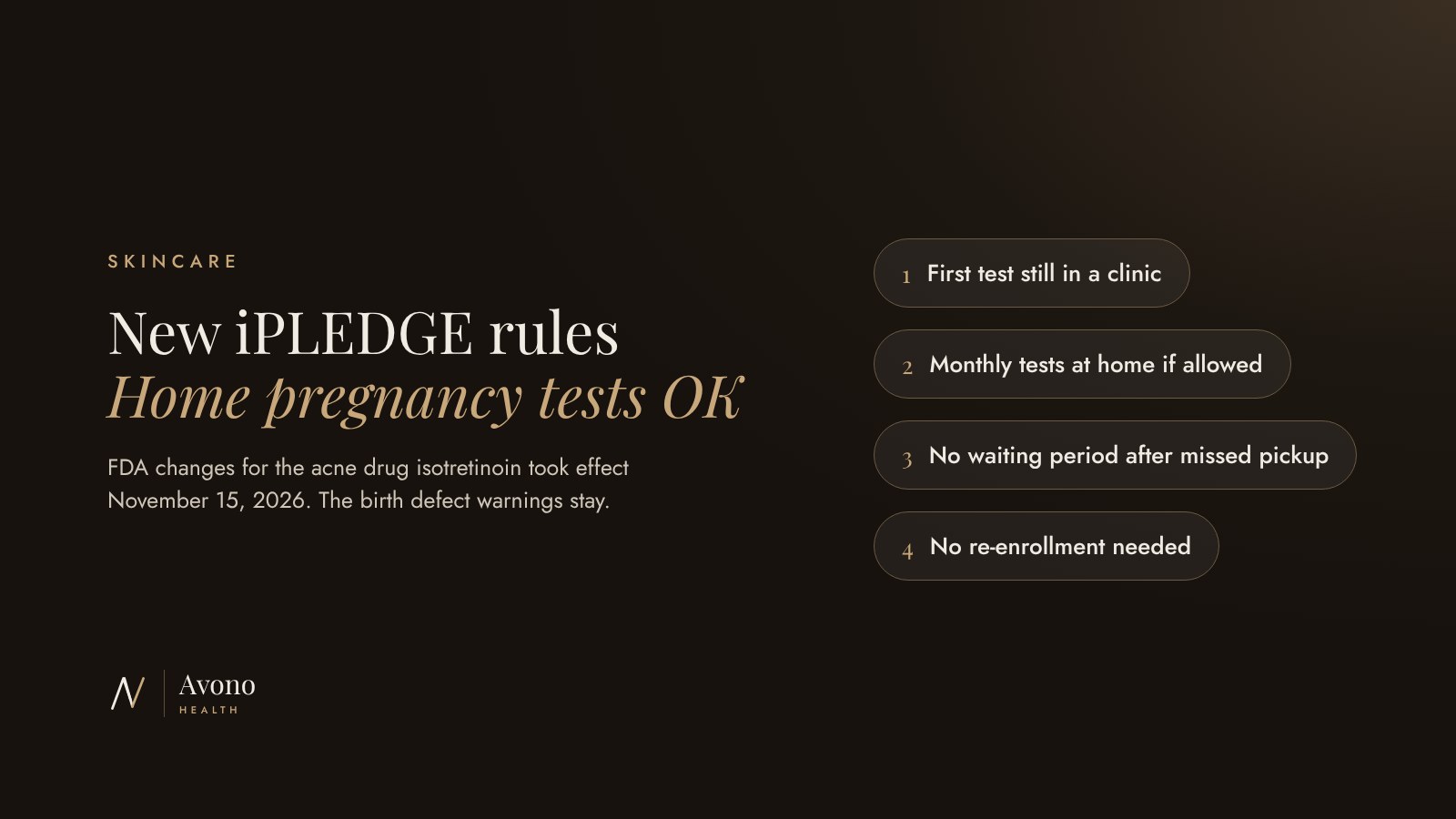
- The first pregnancy test before starting treatment must still be done in a medical setting. Later monthly tests can be done at home if the prescriber allows it.
- The extra waiting period after a missed 7-day pickup window is gone, and patients who cannot become pregnant no longer face a 30-day prescription window or monthly counseling paperwork.
- The core safety rules stay. Isotretinoin can cause severe birth defects, and iPLEDGE enrollment is still required for everyone who takes it.
- People already enrolled do not need to re-enroll.
What changed on November 15
Isotretinoin is approved for severe nodular acne that has not responded to other treatments, in patients 12 and older who are not pregnant. Because it can harm a developing baby, it can only be prescribed, dispensed and taken through iPLEDGE, a REMS. A REMS (Risk Evaluation and Mitigation Strategy) is a safety program the FDA can require for drugs with serious risks.
The FDA says the changes aim to reduce the burden on patients, prescribers and pharmacies while keeping the program’s safety goals, according to its questions and answers page. The agency approved them on February 9, 2026. They were first set to start August 8, but the date moved to November 15 to allow more time to test the updated system. Dermatology Times reported on November 16 that the rules are now in effect.
Here are the main changes, based on the FDA’s own pages:
- Home pregnancy tests. Prescribers may let patients take the monthly tests during and after treatment outside a medical setting, such as with a home test. Prescribers who allow this must set up steps to reduce the risk that results are misread or falsified.
- No more waiting period after a missed pickup. Patients who can become pregnant have 7 days after a negative test to pick up their prescription. Before, missing that window meant an extra wait before retesting, often called the 19-day lockout. Now a repeat test can be done right away. If the patient has not started isotretinoin yet, that repeat test must be in a medical setting.
- Less paperwork for patients who cannot become pregnant. They must still be counseled when they enroll, but prescribers no longer have to document that counseling every month. The FDA says counseling should still continue during treatment.
- No 30-day prescription window for patients who cannot become pregnant. Pharmacies may need to reverse authorizations in the system and return prescriptions to stock when patients do not pick them up.
- No re-enrollment. Patients, prescribers and pharmacy staff already in the program keep their accounts. Annual recertification for prescribers and pharmacies, and annual pharmacy staff training, are still required.
| Rule | Before Nov. 15, 2026 | Now |
|---|---|---|
| First pregnancy test before treatment | Medical setting | Still a medical setting |
| Monthly tests during and after treatment | Medical setting (home tests were allowed under temporary FDA flexibility) | Home testing allowed if the prescriber permits it |
| Missed 7-day pickup window | Extra waiting period before retesting | Retest right away |
| Monthly counseling records (cannot become pregnant) | Required | Not required; counseling still at enrollment |
| 30-day prescription window (cannot become pregnant) | Required | Removed |
| iPLEDGE enrollment | Required | Still required |
While the system was being updated, the FDA had been using what it calls enforcement discretion on pregnancy testing. That meant it allowed home tests during and after treatment before the formal change, as The Dermatology Digest and the FDA describe.
Why the pregnancy rules exist
The FDA describes isotretinoin as “highly teratogenic,” meaning it causes severe birth defects. The agency’s isotretinoin information page warns that it can cause birth defects, miscarriage, premature births and death in babies. Patients should never take it if they are pregnant, trying to get pregnant or could become pregnant by accident.
Under iPLEDGE, patients who can become pregnant must have a negative pregnancy test and commit to two forms of birth control or abstinence before starting, and repeat both monthly, as described in a Harvard Gazette report. None of that changed. The update only changes where the later tests can happen and trims some paperwork.
What the research shows about iPLEDGE
The program has been debated for years. A 2019 study in JAMA Dermatology looked at reports sent to the FDA Adverse Event Reporting System (FAERS) from 1997 to 2017. Researchers at Brigham and Women’s Hospital found 6,740 reported pregnancies in people taking isotretinoin. Reports peaked at 768 in 2006, the year iPLEDGE started, then settled at 218 to 310 per year after 2011. About 68.9% of all reports (4,647) came after iPLEDGE began. Reported fetal defects peaked at 34 in 2000 and fell to 0 to 4 per year after 2008.
The authors said several things may explain the decline, including fewer teen pregnancies nationally, better access to birth control, iPLEDGE’s requirements and reporting fatigue. They said the reports that continued over the last decade justify studying how well iPLEDGE works and looking for new ways to lower fetal exposure.
It is important to read these numbers carefully. FAERS collects voluntary reports. The authors note that pregnancy outcomes are likely underreported, and that without a yearly count of treatment courses they could not calculate a true pregnancy rate. So these figures show the number of reports, not how often pregnancy happens on the drug.
Home testing was also studied after iPLEDGE allowed it during the COVID-19 pandemic. In a 2022 survey in Cutis, 70 clinicians from the American Acne & Rosacea Society answered questions about it. More than 70% (52 of 70) agreed home pregnancy testing had increased access for their patients, and more than 75% (54 of 70) wanted to keep using it. Their top concern was patient deception (55.7%), followed by trouble reviewing results (27.1%) and test accuracy (27.1%). Most (73.5%) said they would require a picture of the result.
Clinicians were more comfortable with home testing for patients using long-acting reversible contraception, such as an IUD or implant (90.0%), or combined birth control pills (88.4%), than for patients relying on condoms (67.1%) or abstinence (68.6%).
Test quality is another concern. A 2020 letter in Dermatologic Therapy cited an independent evaluation that found home pregnancy test accuracy ranged from less than 50% to more than 90% depending on the brand. The same letter noted that digital tests may reduce reading errors but cost more.
What doctors and researchers have said
While the number of pregnancies among patients taking isotretinoin is low, even 200 pregnancies is too high.
Arash Mostaghimi, MD, Brigham and Women’s Hospital, senior author of the 2019 JAMA Dermatology study, in the Harvard Gazette
We need to think about regulations that can reduce that number without being overly burdensome for patients and physicians.
Arash Mostaghimi, MD, Brigham and Women’s Hospital, in the Harvard Gazette
It’s great to see that changes will finally be made to this onerous system to make a curative medication more available
Emmy Graber, MD, MBA, president of The Dermatology Institute of Boston, in The Dermatology Digest
Removing the 19-day lockout will be especially helpful for patients eager to start their medication.
Emmy Graber, MD, MBA, in The Dermatology Digest
Other side effects still matter
The iPLEDGE update is about pregnancy prevention. It does not change other warnings. The FDA lists side effects including bad headaches, blurred vision, dizziness, nausea, vomiting, seizures, stroke, diarrhea and muscle weakness, along with serious mental health problems such as depression and suicide. The FDA says patients should be watched closely for mood changes and should stop isotretinoin and contact their health care professional right away if symptoms appear. The FDA also warns against buying isotretinoin online, because that skips these safety steps.
Limits of what we know
- No study has yet measured how the November 2026 rules affect pregnancy rates or access to the drug. The 2022 survey authors said more research is needed on how home testing affects both access and pregnancy prevention.
- The 2022 survey had a 6.4% response rate, so the views may not represent all dermatologists. The authors noted possible sampling and response bias.
- The 2019 pregnancy figures come from voluntary reports, which likely undercount events and cannot give a true rate.
- Whether home testing is offered is up to each prescriber, so patients may see different rules at different practices.
What it means for you
If you already take isotretinoin, your iPLEDGE account stays the same and you do not need to re-enroll. Ask your prescriber whether they will allow home pregnancy tests, and how they want results reported. If you can become pregnant, your first test will still be in a clinic or lab, and the birth control rules have not changed. If you are using a skin medicine for milder acne, such as a topical retinoid, our explainer on tretinoin for acne and dark spots covers how that drug differs, and our review of 40 years of tretinoin research covers the evidence.
This article is for general information and is not medical advice. Talk with a licensed clinician about whether isotretinoin is right for you and how iPLEDGE applies to your care. If you become pregnant while taking isotretinoin, stop taking it and contact your prescriber right away.
The bottom line
Since November 15, 2026, iPLEDGE lets prescribers allow monthly pregnancy tests at home after the first in-office test, drops the waiting period after a missed pickup, and cuts some paperwork for people who cannot become pregnant. The drug’s risk of severe birth defects has not changed, and neither has the requirement to enroll. Researchers have long called for a program that protects pregnancies without blocking access, and how well these changes do both has not yet been studied.
Frequently asked questions
Can I take my iPLEDGE pregnancy test at home now?
Only for the monthly tests during and after treatment, and only if your prescriber allows it. The first test before you start isotretinoin must still be done in a medical setting, according to the FDA.
Is the iPLEDGE 19-day lockout gone?
Yes. If you can become pregnant and miss the 7-day window to pick up your prescription, you can repeat the pregnancy test right away. If you have not started isotretinoin yet, that test must be done in a medical setting.
Do I need to re-enroll in iPLEDGE?
No. The FDA says patients, prescribers and pharmacy staff already enrolled keep their existing accounts.
Do I still need two forms of birth control?
The pregnancy prevention requirements were not removed. Patients who can become pregnant must still follow iPLEDGE’s birth control rules. Ask your prescriber which methods count for you.
When did the iPLEDGE changes take effect?
The FDA approved them on February 9, 2026, and they took effect on November 15, 2026, after a delay from the original August date.