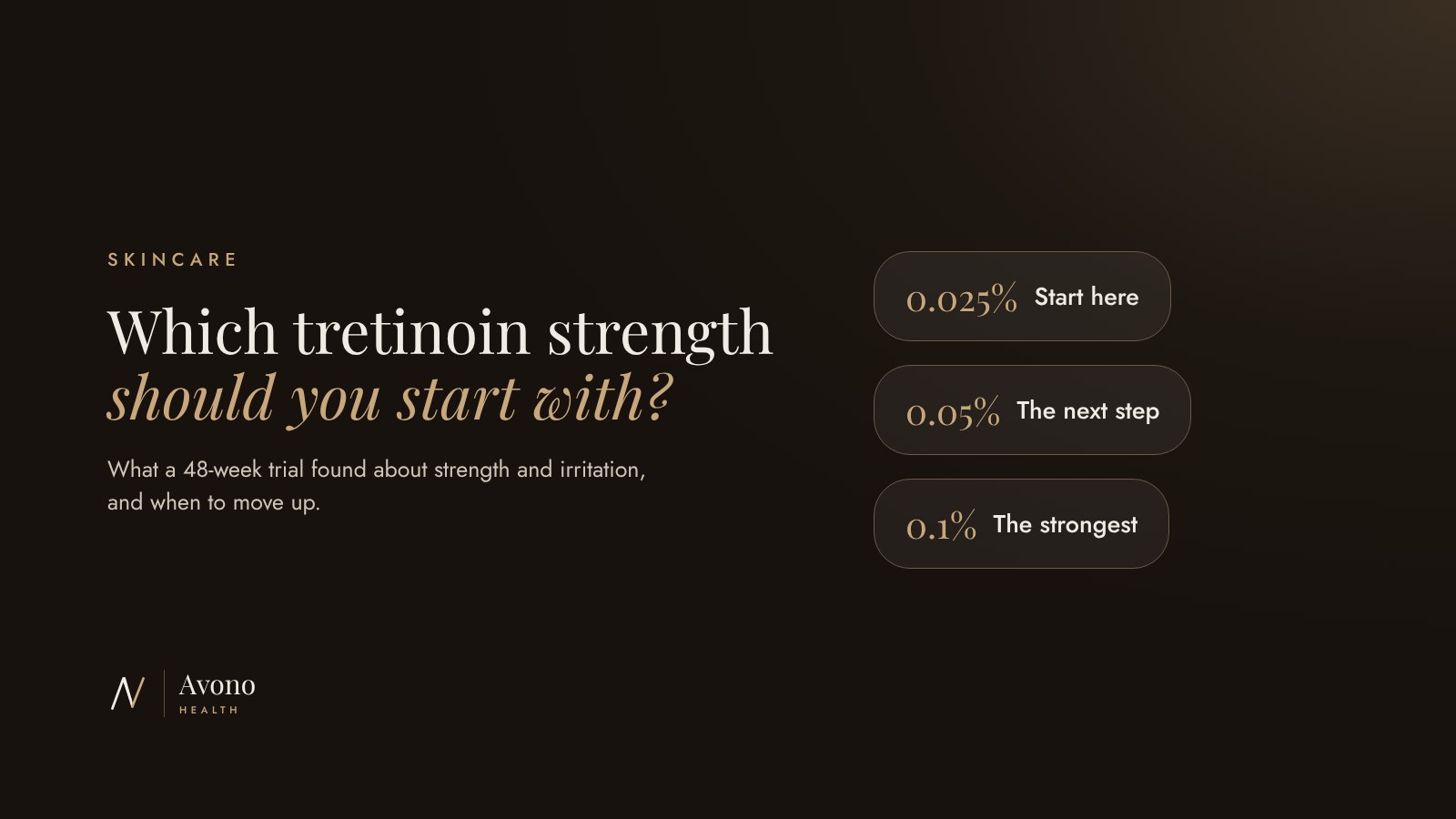
Tretinoin comes in several strengths, most often 0.025%, 0.05% and 0.1%. It is tempting to assume the strongest works best. The research says it is not that simple: strength changes how much your skin is irritated far more than it changes your results.
The short answer
Most people should start at 0.025%. If your skin adjusts well over a couple of months, your clinician may move you up to 0.05%. 0.1% is usually for stubborn acne or for skin that is already used to retinoids.
What the research says about strength
A 48-week double-blind trial published in the Archives of Dermatology in 1995 compared 0.1% tretinoin, 0.025% tretinoin and a plain cream in 99 adults with sun-damaged skin. Both strengths improved the skin compared with the plain cream, with no clinically or statistically significant difference between them. Skin thickened by about 28% with 0.025% and 30% with 0.1%.
The difference was irritation. The 0.1% group had significantly more redness and peeling. For aging skin, that means a lower strength can deliver most of the benefit with less of the discomfort that makes people stop.
Which strength is for whom
- 0.025%: the starting point. First-time tretinoin users, sensitive or dry skin, and anyone whose main goal is fine lines, texture or tone.
- 0.05%: the usual next step. For skin that has adjusted to 0.025% over 2 to 3 months, or for acne that needs a little more.
- 0.1%: the strongest. For stubborn acne, oily skin, or people who have used tretinoin before. Sun spots in the 1992 trial were treated with 0.1%.
- 0.01% in combination creams. A gentle strength paired with other ingredients, such as clindamycin for acne or estriol for skin changing with menopause, so the cream can treat more than one thing without much irritation.
How to start
- Use a pea-sized amount for the whole face, at night, on clean and fully dry skin.
- Start every other night for the first 2 weeks, then build up to nightly as your skin allows.
- Keep it away from the eyes, lips and corners of the nose.
- Use a plain, fragrance-free moisturizer, and SPF 30 or higher every morning.
- Pause other retinoids and strong exfoliating acids unless your clinician says otherwise.
The adjustment period
Expect some dryness, peeling and redness in the first 2 to 6 weeks, and sometimes a short flare of breakouts as clogged pores clear. This usually settles. If it does not, or if you get burning, swelling or blistering, stop and contact your clinician. Moving to a lower strength or using it less often usually fixes it.
When to move up
There is no prize for reaching 0.1%. Move up only if your skin has fully adjusted and you want faster progress on acne, and only with your clinician. Many people stay on 0.025% or 0.05% for years and keep improving.
Who should not use tretinoin
Tretinoin is not for use during pregnancy. Tell your clinician if you are pregnant, planning a pregnancy or breastfeeding, and about eczema, rosacea or very sensitive skin, which may call for a gentler option.
Tretinoin at Avono
- Tretinoin Cream: tretinoin with niacinamide in 0.025%, 0.05% or 0.1%.
- Post-breakout Acne Cream with Tretinoin: clindamycin, azelaic acid and tranexamic acid with 0.01% tretinoin, for breakouts and the marks they leave.
- Anti-aging Cream: 0.01% tretinoin with GHK-Cu and caffeine, for fine lines.
- Estriol + Tretinoin Cream and Peri-menopausal Skin Cream: estriol with gentle tretinoin, for skin changing with menopause.
No clinician fee, no membership fee and free shipping. A licensed U.S. clinician reviews every request and decides whether tretinoin, and which strength, is right for you. Compare every skincare option.
The studies above tested FDA-approved tretinoin products or plain study creams. Avono’s compounded creams were not studied in these trials, are not FDA-approved, and individual results vary.