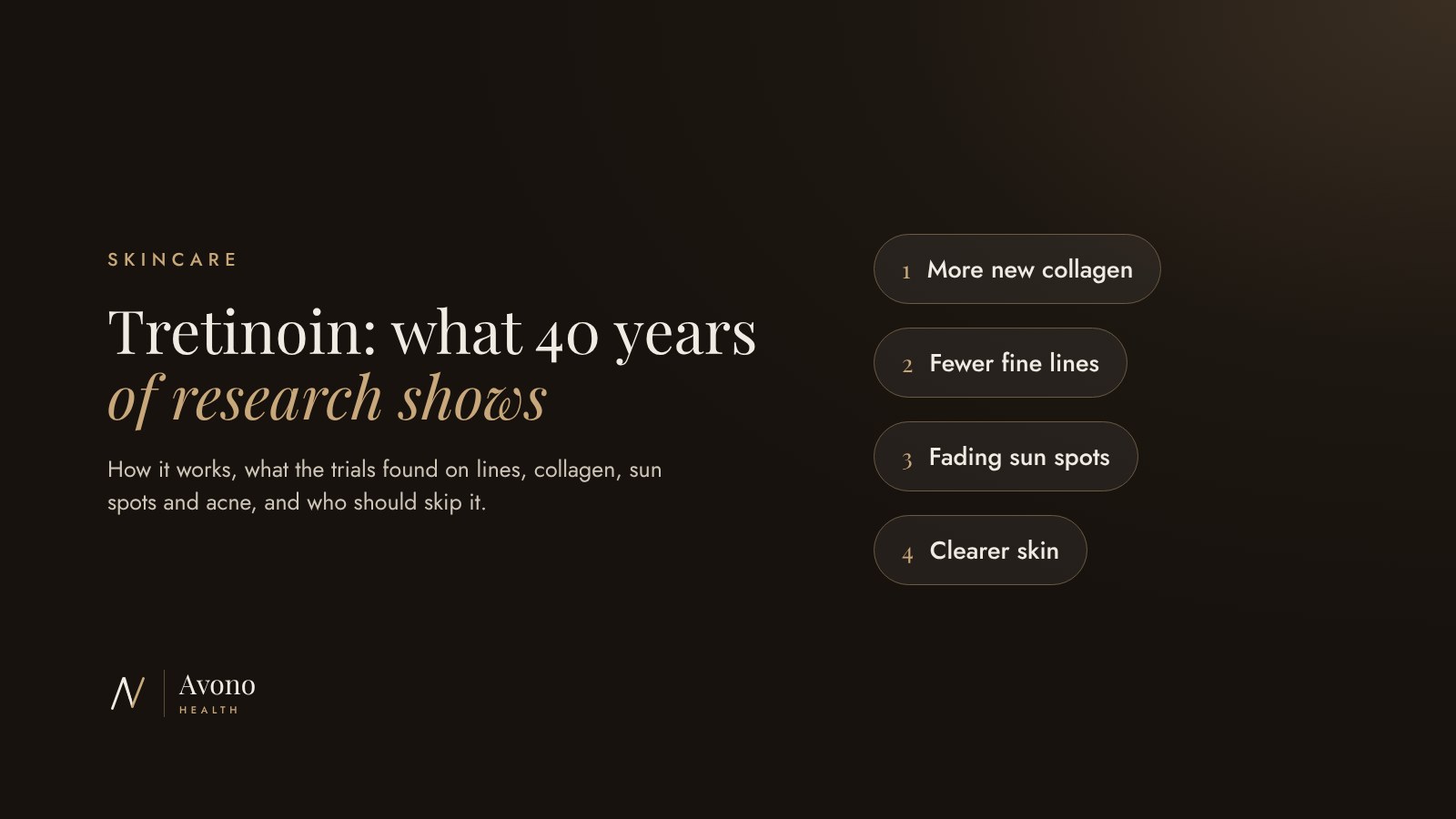
Few skincare ingredients have been studied as long or as carefully as tretinoin. It was first approved for acne in the early 1970s, and since the 1980s randomized trials have tested it on sun-damaged and aging skin. Here is what that research found, and what it means if you are deciding whether to try it.
What tretinoin is
Tretinoin is a prescription form of vitamin A, also called all-trans retinoic acid. Retin-A is one brand name. Over-the-counter retinol has to be converted in the skin before it works; tretinoin is already the active form, which is why it needs a prescription and why it works more strongly.
How it works
Tretinoin acts on two things. First, it speeds up how quickly skin cells turn over, so dead cells do not build up and clog pores. That is what clears and prevents acne. Second, it switches on collagen production and slows the enzymes that break collagen down.
A 1996 study in Nature showed why that second part matters: even small doses of UV light, below what causes visible redness, switched on collagen-destroying enzymes in human skin within hours. Applying tretinoin beforehand largely blocked that response. Repeated over years, that enzyme damage is a large part of what we see as aging skin.
What the studies found on aging skin
- Fine lines and sun damage. In a 16-week double-blind trial published in JAMA in 1988, 14 of 15 people who used tretinoin on the face improved, compared with none of those using a plain cream.
- New collagen. In a 1993 New England Journal of Medicine study, sun-damaged skin started with 56% less collagen I than sun-protected skin. After 10 to 12 months, 0.1% tretinoin raised new collagen formation by 80%, while it fell 14% with a plain cream.
- Sun spots. In a 10-month trial, facial sun spots lightened in 83% of people using 0.1% tretinoin, compared with 29% using a plain cream. Spots that cleared had not returned 6 months later.
- The big picture. A 2025 meta-analysis pooled 8 randomized trials and 1,361 patients, followed for 16 weeks to 2 years, and found tretinoin improved both fine and coarse facial wrinkles compared with a plain cream.
What the studies found on acne
The American Academy of Dermatology’s 2024 acne guidelines give topical retinoids, the group tretinoin belongs to, a strong recommendation. They also strongly recommend combining them with other treatments.
That combination point is backed by large trials. In two 12-week studies of 2,219 people, clindamycin (a topical antibiotic) combined with tretinoin cleared more acne than clindamycin alone, tretinoin alone or a plain gel. The antibiotic treats inflamed pimples; the retinoid stops new ones from forming.
What it does not do
- It is not fast. Acne improves over 8 to 12 weeks. Fine lines, texture and sun spots take 3 to 6 months, and keep improving with continued use.
- It is not a replacement for sunscreen. Tretinoin makes skin burn more easily, and UV keeps causing the damage it is trying to repair.
- It does not erase deep wrinkles or sagging. The trials show real but gradual improvement in lines and texture, not a facelift.
Side effects and who should not use it
The most common side effects are dryness, peeling, redness and stinging in the first 2 to 6 weeks, sometimes with a short flare of breakouts. Starting every other night with a pea-sized amount, using a plain moisturizer and building up slowly helps most people get through it.
Tretinoin is not for use during pregnancy. Tell your clinician if you are pregnant, planning a pregnancy or breastfeeding, and about eczema or very sensitive skin.
The studies above tested FDA-approved tretinoin products or plain study creams. Compounded creams were not studied in these trials and are not FDA approved.