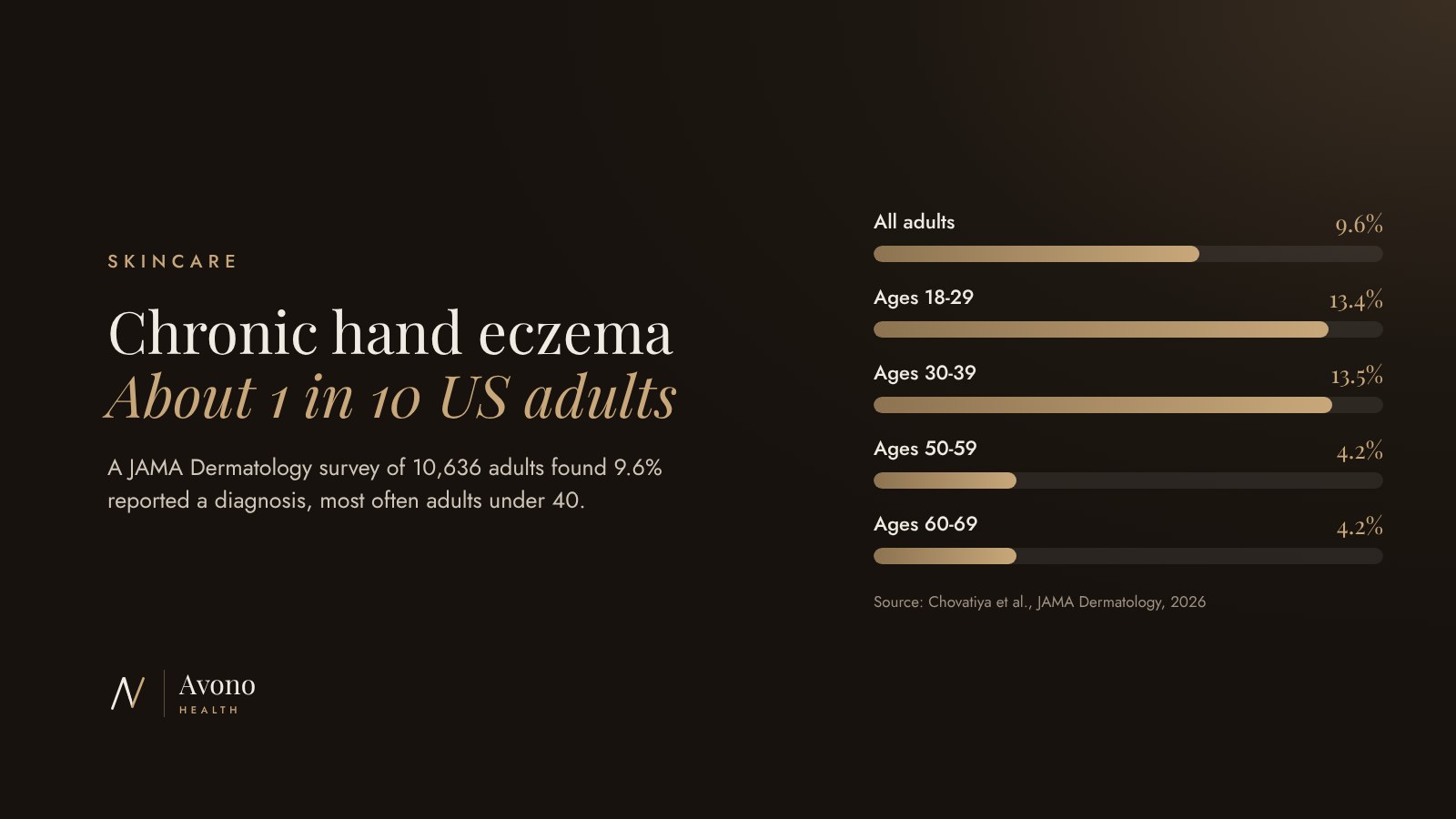
About 1 in 10 U.S. adults say a health care professional has diagnosed them with chronic hand eczema, according to a survey of 10,636 adults published November 11 in JAMA Dermatology. The study put the overall rate at 9.6%, with higher rates in men, people with jobs, city residents and adults under 40.
Key takeaways
- 9.6% of 10,636 surveyed U.S. adults reported chronic hand eczema diagnosed by a health care professional (95% CI, 9.0% to 10.2%).
- Rates were higher in men than women (10.5% vs 8.7%), in employed than unemployed adults (10.3% vs 7.8%), and in urban than rural residents (10.4% vs 6.3%).
- Adults ages 18 to 39 had the highest rates, at about 13.5%. Adults 50 to 69 had the lowest, at 4.2%.
- The study was an online survey, not a medical exam, and it was funded by LEO Pharma, which makes the first FDA-approved cream for the condition.
- The authors did not measure how severe people’s eczema was, and they say the reasons for the age and sex patterns are not known.
What the study found
Chronic hand eczema is a long-lasting, inflammatory skin disease of the hands and wrists. Inflammatory means the body’s immune response is causing redness, swelling and irritation. The study authors describe symptoms such as redness, crusting, scaling, thick skin and cracks, along with itching, burning, pain and stinging (JAMA Dermatology, full text).
Researchers counted someone as having chronic hand eczema if their hand eczema lasted at least 3 months without a break, or if it flared up at least twice in the past 12 months, and if a health care professional had diagnosed it. By that standard, 1,019 of the 10,636 people surveyed had the condition. After the researchers adjusted the numbers to better match the U.S. adult population, the rate was 9.6% (95% confidence interval, 9.0% to 10.2%). A confidence interval is the range where the true number most likely falls.
Most people with the condition had both features. Of the 1,019 people, 772 (75.8%) said their hand eczema had lasted 3 months or more and had flared at least twice in the past year. The 9.6% figure includes everyone who met the definition, no matter how mild or severe their disease was or whether they were being treated.
| Group | Share with chronic hand eczema | 95% confidence interval |
|---|---|---|
| All adults surveyed | 9.6% | 9.0% to 10.2% |
| Men | 10.5% | 9.7% to 11.3% |
| Women | 8.7% | 7.8% to 9.5% |
| Employed | 10.3% | 9.6% to 11.1% |
| Not employed | 7.8% | 6.9% to 8.6% |
| Urban residents | 10.4% | 9.7% to 11.0% |
| Rural residents | 6.3% | 5.2% to 7.5% |
| Ages 18 to 29 | 13.4% | 12.0% to 14.8% |
| Ages 30 to 39 | 13.5% | 12.0% to 14.9% |
| Ages 50 to 59 | 4.2% | 3.3% to 5.1% |
| Ages 60 to 69 | 4.2% | 3.3% to 5.2% |
The differences by sex, job status and urban or rural home were statistically significant (P < .001), meaning they were unlikely to be due to chance alone. Men ages 18 to 49 had higher rates than women the same age. The gap was clearest in people ages 40 to 49 (13.6% of men vs 8.2% of women). Differences by race and by U.S. region were not statistically significant.
Who was studied
The data came from CHECK-US, an online survey of U.S. adults run between March 27 and May 19, 2025. People were recruited from online research panels. The researchers set quotas and used statistical weighting so the group would better match the U.S. adult population by traits such as age and sex. The average age was 42.9 years, and about half (50.3%) were men.
The study was funded by LEO Pharma, which also makes delgocitinib cream. According to the paper, the funder took part in designing the study, interpreting the data, reviewing the manuscript and deciding to publish it. Oracle Life Sciences collected and analyzed the data. Lead author Raj Chovatiya, MD, PhD, of Rosalind Franklin University of Medicine and Science, and coauthor Eric Simpson, MD, of Oregon Health and Science University, disclosed financial ties to drug companies, including LEO Pharma (JAMA Dermatology).
How this compares with other estimates
The 9.6% figure is not the only estimate out there, and the numbers vary a lot. The authors say most of the gap comes from how each study defined and counted cases, so the numbers below should not be read as a direct comparison of how common the disease really is in each place.
- An older U.S. study (about 16%). The authors say this study, done about 20 years ago, used different rules for how long eczema had to last and a different design. It also only included people from one managed care network, so it may not reflect the whole country.
- European studies (3.0% to 13.3%). The new U.S. figure falls inside this range.
- The multinational CHECK study (4.7%). This is the closest match. It used the same definition and a similar online panel in Canada, France, Germany, Italy, Spain and the United Kingdom. The U.S. rate was more than twice as high. The paper does not explain why.
- The NIH All of Us program (0.7% of people with eczema). That study found chronic hand eczema in medical records. The authors say this may explain the difference, because their own study relied on people reporting symptoms and a past diagnosis.
The most meaningful comparisons are the ones inside this one survey, such as men against women or younger against older adults, because everyone was asked the same questions in the same way.
What the researchers said
This study informs clinical awareness and helps prioritize population health assessments by generating robust US-specific evidence on the true burden of CHE.
Chovatiya and colleagues, writing in JAMA Dermatology
The authors noted that their finding of higher rates in men runs against earlier research. They wrote that jobs and workplace exposures are known risk factors for hand eczema but that they could not test whether those exposures explained the difference between men and women.
Reasons for this age-related pattern remain uncertain and warrant further investigation.
Chovatiya and colleagues, JAMA Dermatology
When early results were first presented at a dermatology conference in October 2025, Dr. Chovatiya said in a statement quoted by HCPLive:
These highly powered survey results provide compelling evidence that chronic hand eczema (or CHE) is a common skin disease in the United States.
Raj Chovatiya, MD, PhD, Rosalind Franklin University of Medicine and Science, via HCPLive
Dr. Abby Waldman, a dermatologist at Mass General Brigham who was not an author of the study, told WCVB that many cases are linked to contact with everyday substances:
Actually, a lot of people don’t realize that about half of hand eczema is caused by things that you’re coming into contact with.
Dr. Abby Waldman, Mass General Brigham, to WCVB
Causes, triggers and treatment
The study authors describe the causes as a mix of genes, workplace exposures, and things in the environment such as irritants and allergens. The American Academy of Dermatology says people whose hands are often wet during the day, such as nurses, hair stylists and plumbers, can get hand eczema, and that working with solvents, detergents or cement raises the risk. The group also says having atopic dermatitis (the most common type of eczema) as a child raises the risk. Dr. Waldman told WCVB that fragrance in soaps, nickel and other metals, cold air and frequent hand washing can be triggers.
Separate data presented as conference posters in 2025, and not part of the peer-reviewed paper, found that 27.9% of people with the condition believed it was connected to their job, and 34.9% linked it to routine daily activities (HCPLive).
Until recently, no medicine had FDA approval specifically for chronic hand eczema. In July 2025, the FDA approved delgocitinib cream (Anzupgo) for adults with moderate to severe chronic hand eczema who did not respond well enough to steroid creams, or who should not use them. In two 16-week trials with 960 adults in total, 20% and 29% of people using the cream reached clear or almost clear skin, compared with 10% and 7% using a cream without the drug. The most common side effects reported in a longer follow-up study were COVID-19 and upper respiratory infections (Dermatology Times). The American Academy of Dermatology says treatment starts with finding and avoiding the cause, and may include moisturizer, barrier repair cream or cortisone cream.
Limits of the study
- It was a survey. No one was examined by a doctor for the study. Answers depended on people’s memory and honesty, which the authors say could lead to recall errors or false reports.
- It used an online panel. People were not chosen at random. The authors say some selection bias may remain even after weighting, and some income or social groups may be underrepresented.
- It was a snapshot in time. A cross-sectional study shows how common a condition is at one moment. It cannot show what causes it.
- Severity was not measured. The authors say estimating how many people have mild, moderate or severe disease was outside the study’s scope.
- Some subgroups were small. The authors call results for smaller racial groups and age-by-sex groups exploratory.
- Industry funding. The company that makes the only FDA-approved treatment helped design the study and interpret the results.
What it means for you
The authors’ main takeaway is that chronic hand eczema is a common skin disease in the United States, and that more research is needed on how severe it tends to be and what patients still need. They did not make treatment recommendations.
If you have red, cracked, itchy or painful hands that last for months or keep coming back, the sources here suggest it is worth having a licensed clinician take a look. Dr. Waldman told WCVB that fungal infections and psoriasis can look similar, so seeing a doctor helps when the cause is not clear. A dermatologist can also help find what is triggering it and talk through treatment options for your situation. Her simplest advice for a flare: “Don’t scratch it.”
For another look at how skin treatments are studied over time, see our review of what 40 years of tretinoin research shows.
The bottom line
In a large online survey, 9.6% of U.S. adults reported chronic hand eczema diagnosed by a health care professional. Rates were highest in adults under 40, men, people with jobs and city residents. The study relied on self-reports, did not measure severity, and was funded by the maker of the first FDA-approved treatment. Its authors call for more research to understand the full burden of the disease.
Frequently asked questions
How common is chronic hand eczema?
In the CHECK-US survey published in JAMA Dermatology, 9.6% of U.S. adults said a health care professional had diagnosed them with chronic hand eczema. That is about 1 in 10 adults.
What makes hand eczema chronic?
In this study, hand eczema counted as chronic if it lasted at least 3 months without a break or flared up at least twice in the past 12 months.
What causes hand eczema?
The study authors point to a mix of genes, workplace exposures and environmental triggers such as irritants and allergens. The American Academy of Dermatology says frequent wet work, chemicals like solvents and detergents, and allergies such as to latex gloves can all play a role.
Is there an FDA-approved treatment for chronic hand eczema?
Yes. In July 2025 the FDA approved delgocitinib cream (Anzupgo) for adults with moderate to severe chronic hand eczema who did not respond well enough to steroid creams or should not use them. Talk with a licensed clinician about which options fit your situation.