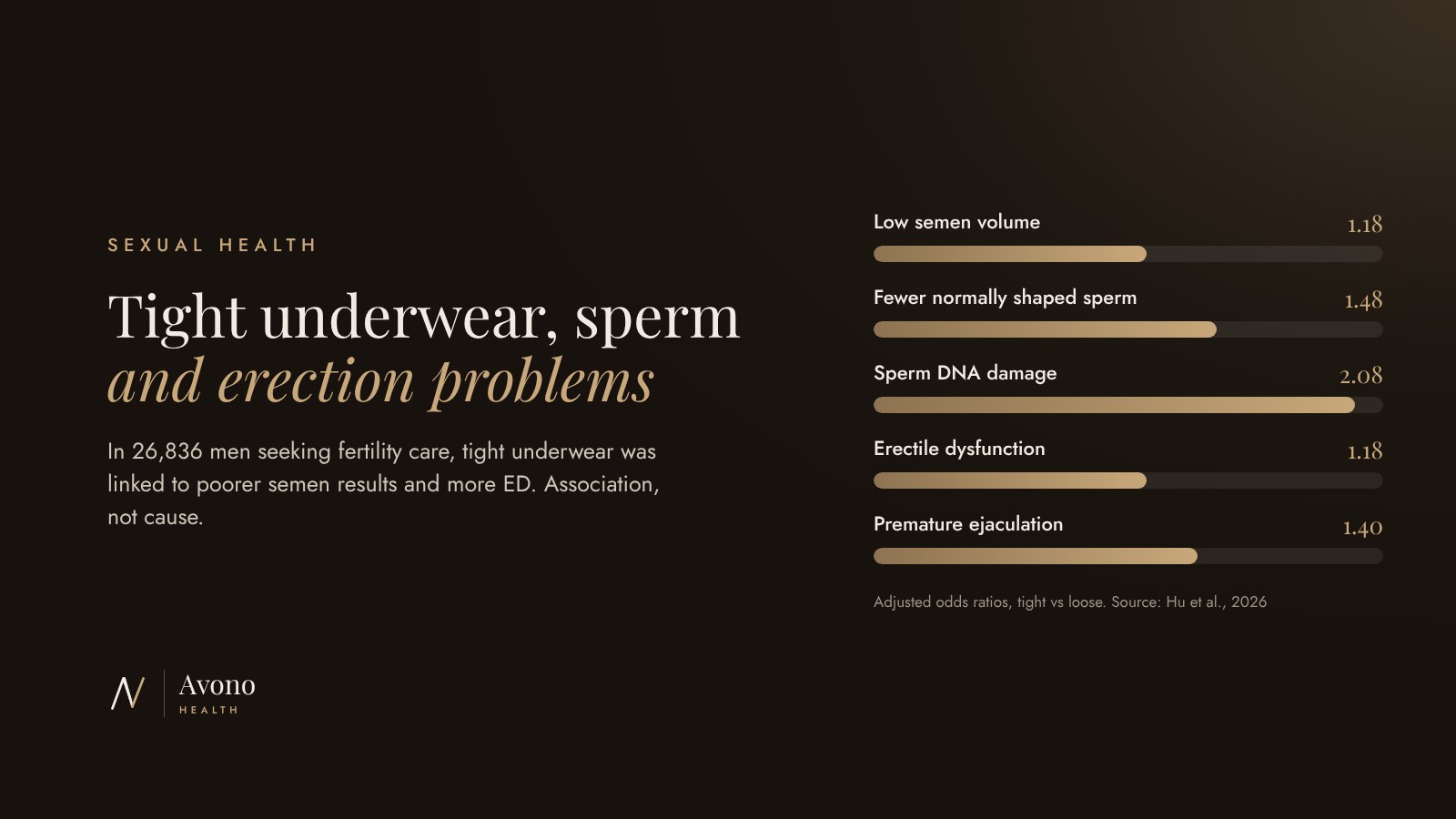
Men who usually wore tight underwear had poorer semen test results and more erection problems than men who wore loose underwear, according to a study of 26,836 men in China published in the Asian Journal of Andrology. Erectile dysfunction showed up in 62.7% of the tight-underwear group and 57.8% of the loose-underwear group, but the study cannot show that underwear caused the difference.
Key takeaways
- Researchers compared 5,615 men who mostly wore tight underwear with 21,221 men who mostly wore loose underwear. All were seeking a fertility evaluation.
- After adjusting for other factors, tight underwear was linked to higher odds of low semen volume, lower sperm movement, fewer normally shaped sperm and more sperm DNA damage.
- Erectile dysfunction (62.7% vs 57.8%) and premature ejaculation (30.8% vs 23.2%) were more common in the tight-underwear group. The authors call this part of the study exploratory.
- The study is cross-sectional, so it shows an association, not cause. Underwear type was self-reported.
- Outside experts said the results are worth considering but should not cause alarm, and that switching underwear is not a treatment.
What the study found
The study was led by urologist Xue-Chun Hu and colleagues at the First Affiliated Hospital of the University of Science and Technology of China in Hefei, according to the PubMed record and ScienceAlert. It was published online on October 27, 2026, and drew wide news coverage this month.
The main goal was to see whether underwear type was linked to semen quality. Semen quality covers things like how much semen a man produces, how well sperm swim (motility), sperm shape (morphology) and damage to the genetic material inside sperm (DNA fragmentation).
Men in the tight-underwear group smoked and drank alcohol more often. They also more often had a varicocele (swollen veins in the scrotum) or prostatitis (inflammation of the prostate). The researchers adjusted for these differences. After adjustment, tight underwear was still linked to worse results on every semen measure listed below, according to the study abstract.
| Outcome | Adjusted odds ratio (95% CI) | P value |
|---|---|---|
| Reduced semen volume | 1.18 (1.07 to 1.31) | 0.002 |
| Decreased progressive motility | 1.16 (1.09 to 1.23) | <0.001 |
| Decreased total motility | 1.13 (1.07 to 1.20) | <0.001 |
| Reduced total motile sperm count | 1.12 (1.02 to 1.23) | 0.01 |
| Decreased normal morphology rate | 1.48 (1.33 to 1.69) | <0.001 |
| Increased DNA fragmentation index | 2.08 (1.44 to 3.01) | <0.001 |
| Erectile dysfunction (exploratory) | 1.18 (1.11 to 1.26) | <0.001 |
| Premature ejaculation (exploratory) | 1.40 (1.29 to 1.53) | <0.001 |
An odds ratio compares the odds of an outcome between two groups. An odds ratio of 1.18 means about 18% higher odds. It is a relative measure, so it does not tell you how many men in each group were affected.
For one measure, the absolute numbers were reported. High sperm DNA fragmentation was found in 10.7% of men who wore tight underwear and 5.8% of men who wore loose underwear, ScienceAlert reported. That means most men in both groups did not have high levels of DNA damage in their sperm.
Erection problems and premature ejaculation
In a secondary, exploratory analysis, the team looked at sexual function. Erectile dysfunction (ED) is a condition that prevents you from getting or keeping an erection firm enough for sex, as the National Institute of Diabetes and Digestive and Kidney Diseases defines it. The study screened for ED using a short questionnaire called the IIEF-5. It screened for premature ejaculation using another questionnaire, the Premature Ejaculation Diagnostic Tool (PEDT). These are screening tools, not a diagnosis made by a doctor.
ED was found in 62.7% of the tight-underwear group and 57.8% of the loose-underwear group. Premature ejaculation was found in 30.8% and 23.2%. After adjustment, the odds were 18% higher for ED and 40% higher for premature ejaculation in the tight-underwear group.
Why the ED rates look so high
The men in this study had a median age of 30, according to ScienceAlert. Yet more than half screened positive for ED. That is higher than U.S. estimates from the NIDDK, which says about 40% of men are affected at age 40 and 70% report ED by age 70.
These numbers should not be compared directly. The study enrolled men in China who were seeking a fertility evaluation, not men from the general population. It used a screening questionnaire, which can count mild symptoms. The U.S. figures come from different research with different methods. The study materials we reviewed do not explain the gap. The meaningful comparison is the one inside the study: tight-underwear wearers against loose-underwear wearers, measured the same way.
Who was studied
- 26,836 men in China who were seeking a fertility evaluation.
- 21,221 said they usually wore loose underwear. 5,615 said they usually wore tight underwear.
- Men reported the type they wore most often over the past 3 months, ScienceAlert reported. Loose meant boxers. Tight included briefs, boxer briefs and thongs.
- Each man gave a semen sample and filled out questionnaires on sexual function.
- The funding source was not listed in the abstract or PubMed record we reviewed.
Why heat may matter
The testicles sit outside the body because sperm develop best at a slightly cooler temperature. ScienceAlert noted that sperm develop best at about 2 to 3 degrees Celsius below core body temperature, and that tight briefs can raise scrotal temperature by up to 1 degree Celsius. The study did not measure temperature itself.
An earlier Harvard study of 656 men at a U.S. fertility center found a similar pattern. Men who mostly wore boxers had a 25% higher sperm concentration (95% CI 7% to 31%) than men who did not. That study was also cross-sectional and also limited to men seeking fertility care. Its authors wrote that their results may not apply to men in the general population.
What the researchers said
“These findings are consistent with the hypothesis that scrotal heat stress contributes to impaired spermatogenesis.”
Xue-Chun Hu and colleagues, study authors, University of Science and Technology of China, as quoted by ScienceAlert
Spermatogenesis means sperm production. The authors also wrote that choosing loose underwear “may represent a simple, modifiable approach to help protect semen quality and sexual function,” ScienceAlert reported.
Doctors who were not involved in the study urged caution.
“Since this was an observational study, we can’t establish with absolute certainty that tight underwear causes problems in semen volume, sperm movement, shape, and sperm DNA fragmentation.”
Dr. Akash Kapadia, urologist, Georgia Urology, speaking to HuffPost UK
“We can say this study supports considering a change in underwear type, but not recommending it as a treatment.”
Dr. Akash Kapadia, urologist, Georgia Urology, speaking to HuffPost UK
Biomedical scientist Tim Moss made a broader point in 2022 about underwear research, writing for Healthy Male that the studies often cited “are usually conducted in groups of men who are seeking help for fertility problems, so you can’t generalize the results to the whole population,” as quoted by ScienceAlert. The same limit applies to this new study.
Limits of the study
- It shows an association, not cause. The study is cross-sectional, a snapshot taken at one point in time. It cannot prove that tight underwear lowers sperm quality or causes ED.
- Self-reported underwear. Men described their own underwear habits, which may not be exact.
- Other differences between groups. The tight-underwear group smoked and drank more and had more varicocele and prostatitis. The researchers adjusted for these, but other factors may still play a role.
- Fertility clinic patients only. The men were seeking a fertility evaluation, so the results may not apply to all men.
- Sexual function results are exploratory. ED and premature ejaculation were secondary questions, measured with screening questionnaires.
- Pregnancy was not studied. It is not known whether these semen differences change the chance of conceiving. ScienceAlert noted that a 2022 study of 3,041 couples in the U.S. and Canada found little evidence that heat around the scrotum, including tight underwear, was tied to the chance of conception.
What it means for you
The authors see tight underwear as a lifestyle factor that people can change and that may affect sperm and sexual function. Outside experts agreed it may be worth considering, but said it is not a treatment. Dr. Kapadia told HuffPost UK that a study like this “should not cause alarm.” He also said it relied on self-reported data. A GP quoted in the same article noted that a change of underwear alone is unlikely to fix ED or premature ejaculation.
ED can also be a sign of other health problems, as covered in our explainer on what erectile dysfunction can tell you about your health. Hormones can play a role too, which is explored in our report on low testosterone screening.
This article is for general information and is not medical advice. If you are having trouble conceiving, or you have erection problems or premature ejaculation, talk with a licensed clinician about your own situation.
The bottom line
In the largest study of its kind so far, Chinese men seeking fertility care who usually wore tight underwear had modestly worse semen results and more erection and ejaculation problems than men who wore loose underwear. The study shows a link, not proof of cause. It did not look at whether couples conceived, and its findings on sexual function are early. Experts said it supports considering looser underwear, not treating it as a fix.
Frequently asked questions
Does wearing tight underwear cause low sperm count?
This study cannot prove that. It found that tight underwear was linked to poorer semen results, including lower semen volume and sperm movement, but the design shows an association, not cause. An earlier Harvard study found men who mostly wore boxers had 25% higher sperm concentration.
Can tight underwear cause erectile dysfunction?
The study found ED in 62.7% of tight-underwear wearers and 57.8% of loose-underwear wearers, with 18% higher adjusted odds. The authors call this analysis exploratory, and it cannot show cause. Experts quoted in news coverage said changing underwear alone is unlikely to fix ED.
Are boxers better than briefs for fertility?
Men who wore boxers had better semen results on average in this study and in a 2018 Harvard study. But a 2022 study of 3,041 couples found little evidence that scrotal heat, including tight underwear, was tied to the chance of conception, ScienceAlert reported.
How long does it take for sperm to recover after a lifestyle change?
Dr. Deborah Lee told HuffPost UK that it takes about three months to make a batch of sperm, so changes made today take about three months to show up on a semen test. This study did not test whether switching underwear improves results.