Oral vs. Topical
Minoxidil has been used in hair-loss treatment for decades.
But today, patients increasingly encounter two very different versions of it:
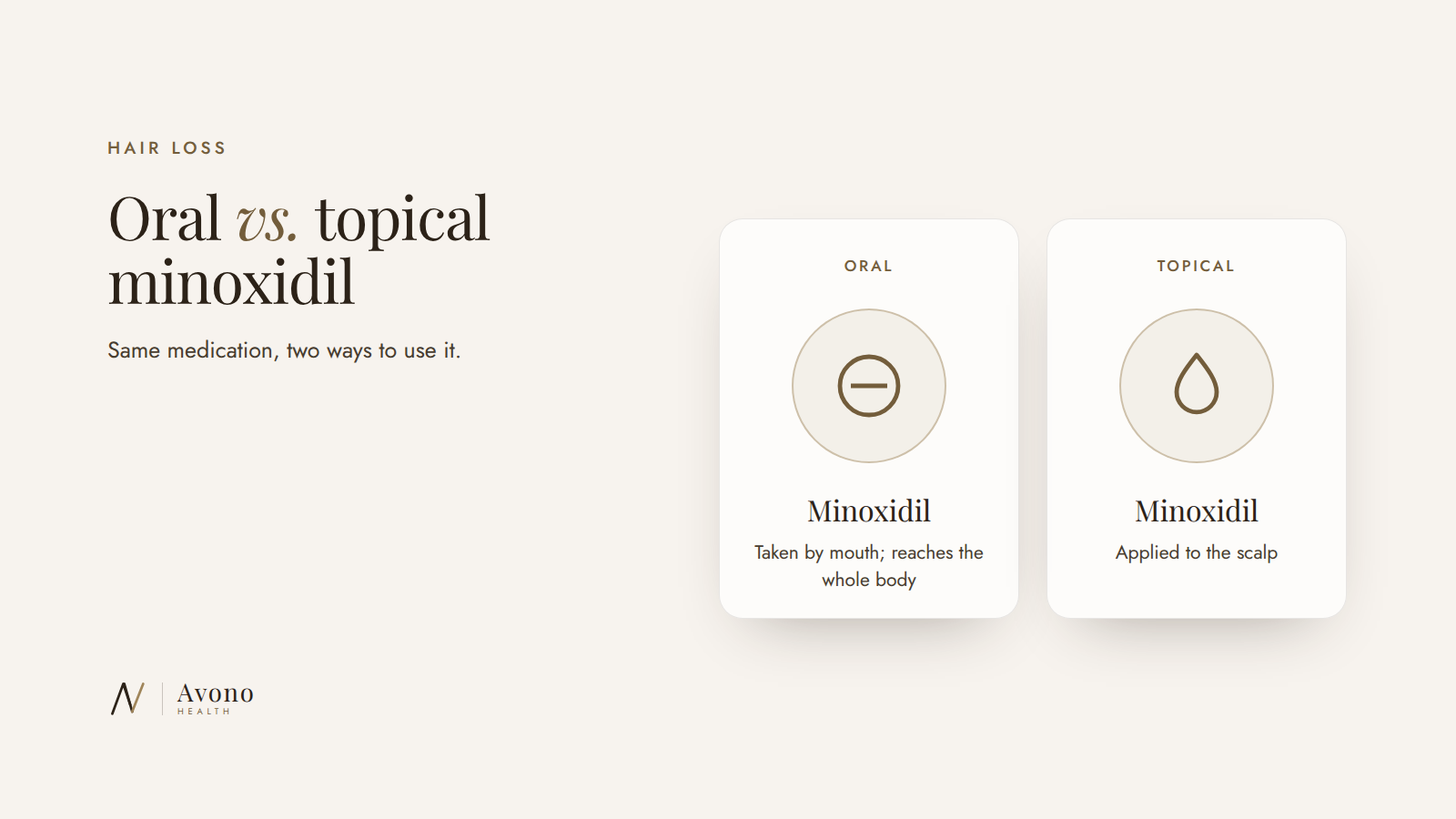
Topical minoxidil applied directly to the scalp.
And:
Low-dose oral minoxidil taken as a tablet.
They contain the same underlying drug, but that does not mean the two approaches are identical.
Their FDA status differs.
Their side-effect profiles differ.
Their convenience differs.
And recent clinical research suggests the choice may be less about finding a universally superior version and more about identifying which route makes sense for the individual patient.
What is minoxidil?
Minoxidil was originally developed as an oral medication for high blood pressure.
Researchers eventually observed increased hair growth in some people taking it.
That observation led to development of topical minoxidil for hair loss.
Today, topical minoxidil is FDA-approved for certain forms of pattern hair loss.
Low-dose oral minoxidil for hair loss is an off-label use.
That distinction matters.
It does not mean oral minoxidil has no evidence behind it. Research into low-dose oral minoxidil has expanded significantly.
But it means the oral medication does not carry an FDA indication specifically for treating androgenetic alopecia.
How does minoxidil help hair grow?
The full mechanism is not completely understood.
Minoxidil appears to influence the hair-growth cycle and can help promote or maintain the anagen, or active growth, phase of the follicle.
Unlike finasteride and dutasteride, minoxidil is not primarily a DHT-blocking medication.
That makes the therapies complementary rather than redundant.
One treatment may act on the growth cycle.
Another may reduce the androgen signal contributing to follicle miniaturization.
This is one reason combination strategies are common in modern hair-loss treatment.
Does topical minoxidil work?
Yes, for many patients.
Topical minoxidil is one of the most established pharmacologic treatments for pattern hair loss.
The American Academy of Dermatology notes that it can reduce hair loss, stimulate growth and strengthen existing hairs, although it does not restore a full head of hair for every patient. Results generally require consistent use over months.
One of the major challenges is not whether topical minoxidil can work.
It is whether someone will consistently use it.
Applying a scalp treatment every day for years requires more effort than taking a tablet.
Products may also affect hair texture, leave residue or irritate the scalp in some users.
For someone who uses the product consistently and tolerates it well, none of that may matter.
For someone who repeatedly skips applications because they dislike the routine, it matters a great deal.
What is low-dose oral minoxidil?
Low-dose oral minoxidil is the use of oral minoxidil at lower doses for hair loss under medical supervision.
Its use in androgenetic alopecia is off-label.
Interest has grown because oral administration removes the daily scalp-application burden and may be an option for selected patients who dislike or cannot tolerate topical treatment.
But moving from the scalp to the bloodstream changes the risk profile.
Oral treatment creates greater systemic exposure.
That is why oral minoxidil should not be treated like an ordinary hair supplement.
Which works better: oral or topical minoxidil?
Recent research has made this question particularly interesting.
A 2024 randomized clinical trial involving men with androgenetic alopecia compared oral minoxidil with topical 5% minoxidil over 24 weeks. Oral minoxidil did not demonstrate overall superiority to topical minoxidil, although photographic analysis showed a difference favoring oral treatment in the vertex area.
An even newer randomized controlled trial published in September 2026 compared low-dose oral and topical minoxidil in men and women with androgenetic alopecia.
At 24 weeks, dermatologist-assessed improvement occurred in approximately 67% of the oral group and 73% of the topical group. The difference was not statistically significant. Patient satisfaction numerically favored oral treatment, but that difference was also not statistically significant.
The practical takeaway is useful:
Oral minoxidil is not clearly a universally superior version of topical minoxidil.
Both can produce meaningful improvement.
For many patients, the decision may come down to tolerability, medical history, convenience and adherence.
What are the advantages of topical minoxidil?
Topical treatment delivers minoxidil to the scalp with less systemic exposure than oral administration.
Its long history and FDA-approved hair-loss status are meaningful advantages.
Potential disadvantages include scalp irritation, itching, product residue and the inconvenience of regular application.
The September 2026 randomized trial found contact dermatitis in some topical users, while it did not occur in the oral-treatment group.
What are the advantages of oral minoxidil?
Convenience is the obvious one.
A tablet may be easier to incorporate into a daily routine than applying medication to the scalp.
That can matter because a medication sitting unused in a bathroom cabinet does not produce much benefit.
Oral treatment may also be considered when topical minoxidil causes significant irritation or is difficult to use consistently.
But convenience comes with different potential risks.
What are the side effects of oral minoxidil?
Because oral minoxidil circulates throughout the body, effects can occur outside the scalp.
In the September 2026 randomized trial, unwanted hair growth elsewhere on the body, known as hypertrichosis, was more common with oral treatment. The study also reported systemic effects including episodes of increased heart rate, mild orthostatic hypotension and edema in some oral-minoxidil participants.
Another randomized trial in men found hypertrichosis and headache among the most common adverse effects in its oral-minoxidil group.
That is why a clinician needs to consider cardiovascular history, blood pressure, medications and other relevant health factors before prescribing oral minoxidil.
Does minoxidil cause shedding at first?
Some patients notice increased shedding after beginning treatment.
Hair follicles do not all grow continuously. They move through phases.
A shift in the hair cycle can cause older hairs to shed as follicles transition.
That can be alarming when someone has just started treatment specifically to stop hair loss.
The important distinction is between a temporary change in shedding and progressive worsening that should be evaluated by a clinician.
Patients should report concerning or persistent changes rather than automatically assuming every increase in shedding is normal.
How long does minoxidil take to work?
Hair treatment requires patience.
The American Academy of Dermatology notes that visible results from topical minoxidil can take six to twelve months in some patients.
That does not mean nothing is happening before then.
It means hair grows slowly enough that judging a treatment after only a few weeks can be misleading.
Consistent photographs can help evaluate progression more objectively.
What happens if you stop minoxidil?
The benefits generally do not persist indefinitely after treatment ends.
If minoxidil has been helping maintain or stimulate hairs, stopping it allows the underlying hair-loss process to continue.
The American Academy of Dermatology specifically notes that the benefits of topical minoxidil are lost after discontinuation.
That means treatment choice should take sustainability into account.
The best theoretical treatment is not necessarily the best real-world treatment if someone cannot realistically maintain it.
What about combining minoxidil and finasteride?
This is increasingly important.
Minoxidil and finasteride address different aspects of androgenetic alopecia.
A 2025 meta-analysis of seven randomized controlled trials involving 396 men found that topical combinations of finasteride and minoxidil produced better outcomes than topical minoxidil alone across several measures, although researchers noted that additional larger and longer studies remain useful.
Avono’s current hair catalog includes several formulations combining minoxidil and finasteride, as well as oral minoxidil and other clinician-guided hair-loss options.
Combination treatment is not automatically appropriate for every patient.
But it reflects an important principle:
Hair loss can have more than one treatment target.
Oral vs. topical minoxidil: the bottom line
Neither route is automatically better.
Topical minoxidil has an established FDA-approved role in pattern hair loss and avoids some of the systemic exposure associated with oral treatment.
Low-dose oral minoxidil is used off-label and may be attractive for selected patients because of convenience or difficulty tolerating topical treatment.
Recent randomized trials suggest both approaches can produce meaningful improvements without establishing a dramatic overall efficacy advantage for oral treatment.
The decision should be based on more than convenience.
It should account for your type of hair loss, medical history, cardiovascular considerations, other medications, prior treatment and ability to maintain the regimen consistently.
Frequently Asked Questions
Is oral minoxidil FDA-approved for hair loss?
No. Oral minoxidil is FDA-approved for blood-pressure treatment. Its use in hair loss is off-label.
Is topical minoxidil FDA-approved for hair loss?
Yes, certain topical minoxidil formulations are FDA-approved for pattern hair loss.
Does oral minoxidil work better than topical minoxidil?
Recent randomized trials have not established clear overall superiority of oral minoxidil over topical minoxidil.
Can oral minoxidil cause body hair growth?
Yes. Hypertrichosis, or increased hair growth outside the scalp, is a known potential effect and has been observed relatively frequently in some clinical studies.
Can minoxidil and finasteride be used together?
They may be combined when clinically appropriate, and clinical research supports combination approaches in some patients with androgenetic alopecia.