Finasteride vs. Dutasteride for Hair Loss: What’s the Difference?
If you have researched treatments for male pattern hair loss, you have probably come across two names repeatedly: finasteride and dutasteride.
Both medications affect the same hormonal pathway. Both can reduce levels of dihydrotestosterone, better known as DHT. And both have been studied for androgenetic alopecia, the medical term for pattern hair loss.
But they are not interchangeable.
Finasteride is FDA-approved for male pattern hair loss. Dutasteride is FDA-approved in the United States for benign prostatic hyperplasia, not hair loss, although it is prescribed off-label for androgenetic alopecia in some patients. Clinical research suggests dutasteride may suppress the DHT pathway more broadly and may produce greater hair-count improvements in some men, but that does not automatically make it the right treatment for every patient.
Understanding the difference starts with understanding why DHT matters.
Why does DHT cause hair loss?
Male pattern hair loss is strongly influenced by genetics and androgen hormones.
Testosterone can be converted into dihydrotestosterone, or DHT, by enzymes known as 5-alpha-reductase.
In people genetically susceptible to androgenetic alopecia, DHT can progressively affect certain scalp hair follicles.
Over time, those follicles may become smaller.
The growth phase of the hair cycle can shorten.
Hair strands can become finer, shorter and less visible.
Eventually, affected follicles may produce very little visible hair.
This process is known as follicular miniaturization.
That is why treatments aimed at reducing DHT are fundamentally different from treatments such as minoxidil.
Minoxidil primarily works through pathways related to the hair-growth cycle.
Finasteride and dutasteride address one of the hormonal drivers contributing to follicular miniaturization.
For some patients, clinicians may use more than one strategy because the medications target different parts of the problem.
How does finasteride work?
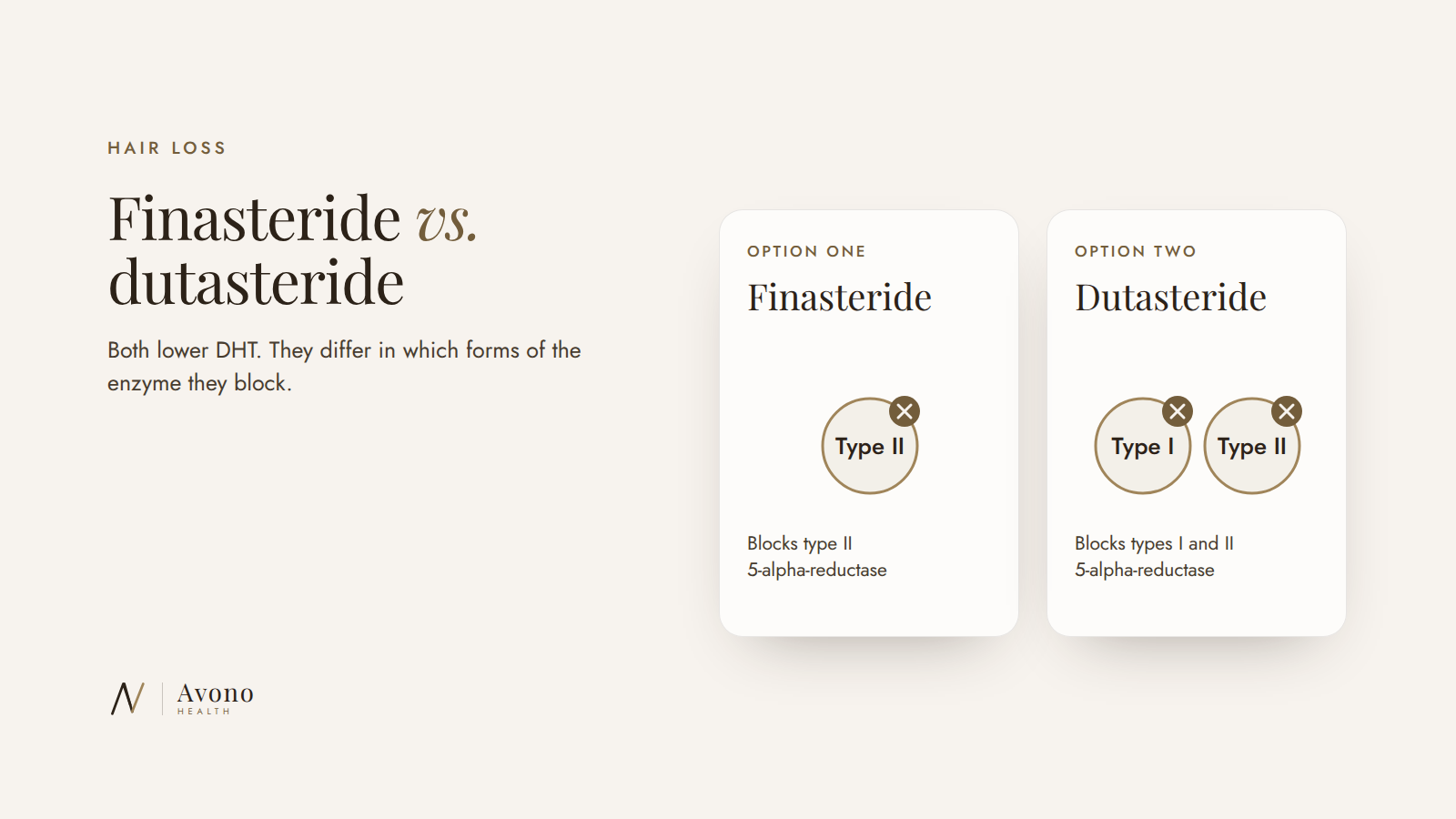
Finasteride is a 5-alpha-reductase inhibitor.
At the dose used for male pattern hair loss, it reduces the conversion of testosterone into DHT.
The FDA-approved finasteride product Propecia is indicated for male androgenetic alopecia. Its prescribing information notes that continued treatment is generally required to maintain the effect and that stopping treatment leads to reversal of its benefit over time.
This is an important concept with nearly every effective medical hair-loss treatment:
Hair-loss treatment is usually maintenance therapy, not a permanent cure.
If the biological process causing hair loss continues after medication is stopped, progression can resume.
How does dutasteride work?
Dutasteride also inhibits 5-alpha-reductase, but it affects the enzyme system more broadly.
That gives dutasteride a stronger overall effect on DHT production.
In the United States, dutasteride is FDA-approved for benign prostatic hyperplasia. Its use for androgenetic alopecia is therefore considered off-label.
Off-label does not mean illegal or automatically inappropriate.
Licensed clinicians may prescribe FDA-approved medications for uses outside their approved labeling when they determine that doing so is medically appropriate.
But patients should know when a treatment is being used off-label rather than assuming every medication offered for hair loss carries an FDA hair-loss indication.
Is dutasteride more effective than finasteride for hair loss?
Some comparative evidence suggests that it may be more potent.
A systematic review and meta-analysis of randomized trials comparing dutasteride and finasteride in men with androgenetic alopecia found greater improvements in several measures of hair growth with dutasteride during the study periods analyzed.
A more recent systematic review likewise found stronger hair-count improvements in some studied dutasteride groups compared with finasteride. The evidence base remains smaller than the decades of experience supporting finasteride, however, and many studies have been relatively limited in size and duration.
So the practical conclusion is not simply:
Dutasteride is better.
A better conclusion is:
Dutasteride may produce stronger DHT suppression and may offer greater efficacy for some patients, while finasteride has the advantage of an FDA-approved indication specifically for male pattern hair loss.
That is exactly the type of tradeoff a clinician should help evaluate.
Why not just start everyone on the stronger medication?
Because medicine is rarely that simple.
Treatment choice is not based only on which medication has the strongest pharmacologic effect.
A clinician may consider:
- the pattern and severity of hair loss
- age
- medical history
- previous treatments
- treatment response
- side-effect concerns
- fertility considerations
- other medications
- patient preference
A person with early thinning who responds well to finasteride may have little reason to move to a more potent DHT-suppressing medication.
Another patient whose hair loss continues despite treatment may have a different conversation with their clinician.
The objective is not to suppress the maximum possible amount of DHT.
The objective is to choose an appropriate treatment with a reasonable balance of benefit, risk and tolerability.
What are the possible sexual side effects?
This is one of the most searched questions about finasteride and dutasteride.
Finasteride labeling includes potential adverse effects involving libido, erectile function and ejaculation, among other effects.
Dutasteride can also produce sexual adverse effects.
Studies directly comparing the two medications have not consistently demonstrated major differences in reported sexual adverse-event rates, although individual response varies and available studies have limitations.
These risks should not be exaggerated, but they should not be hidden either.
If sexual function, fertility or other hormonal concerns are particularly important to you, tell the clinician evaluating your treatment.
Can finasteride or dutasteride regrow a completely bald area?
Treatment tends to work best before follicles have undergone advanced miniaturization.
That is one reason dermatologists often emphasize treating androgenetic alopecia earlier rather than waiting until significant hair loss has occurred.
Medical therapy may help preserve vulnerable follicles and can produce regrowth or thickening in some patients, but it cannot guarantee restoration of every area of lost hair.
A completely smooth area that has been bald for years is not equivalent to an area where hairs have simply become thinner.
Realistic expectations matter.
How long does hair-loss medication take to work?
Hair grows slowly.
Finasteride labeling notes that at least several months of continued daily use are generally needed before benefit is observed. The American Academy of Dermatology similarly notes that visible response to medical treatment often takes months rather than weeks.
That makes hair-loss treatment particularly vulnerable to premature abandonment.
A person may take medication for six weeks, see no dramatic change and conclude it has failed.
Biologically, six weeks may simply be too early to judge.
Progress photographs taken under consistent lighting and at consistent angles can be more useful than checking the mirror every day.
What happens if you stop finasteride or dutasteride?
The protective effect does not permanently alter your genetic predisposition to androgenetic alopecia.
With finasteride, FDA labeling specifically states that discontinuation leads to reversal of its effect over time.
The same general principle applies to DHT suppression more broadly.
If treatment is discontinued, the hormonal environment influencing susceptible follicles changes again.
That is why it is helpful to think about hair-loss medication as long-term management.
Can finasteride or dutasteride be combined with minoxidil?
They can be used in treatment strategies that also include minoxidil when clinically appropriate.
This makes biological sense because the medications address hair loss through different mechanisms.
Evidence also supports combination treatment. A 2025 meta-analysis of randomized trials found that topical finasteride/minoxidil combinations produced greater improvement in several hair-growth outcomes than topical minoxidil alone in men with androgenetic alopecia, although the researchers also noted limitations in study size and the need for additional long-term research.
Avono currently offers several clinician-guided hair options involving finasteride, minoxidil and dutasteride, including oral and topical formulations. Medication selection is determined through clinical review rather than assuming one treatment is appropriate for everyone.
Finasteride vs. dutasteride: the bottom line
Both medications target DHT.
Finasteride has an FDA-approved indication for male pattern hair loss and has been extensively used for androgenetic alopecia.
Dutasteride suppresses the DHT pathway more broadly and has shown strong results in comparative studies, but its use for hair loss in the United States is off-label.
The fact that dutasteride may be more potent does not automatically make it the better choice for every patient.
Hair loss is personal, progressive and highly variable.
The right question is not simply:
Which medication is strongest?
It is:
Which treatment makes the most sense for my hair loss, health history, goals and tolerance for potential side effects?
That is a clinical decision.
Frequently Asked Questions
Is dutasteride better than finasteride for hair loss?
Some comparative studies suggest dutasteride can produce greater improvements in hair-count measures, but finasteride is FDA-approved specifically for male pattern hair loss while dutasteride use for hair loss is off-label in the United States.
Does dutasteride block more DHT than finasteride?
Dutasteride inhibits the 5-alpha-reductase pathway more broadly, which results in greater overall suppression of DHT.
Can I switch from finasteride to dutasteride?
A clinician may consider a treatment change based on response, tolerability and medical history. Patients should not change prescription therapy without discussing it with their prescriber.
Can I use minoxidil with finasteride or dutasteride?
Combination treatment may be appropriate for some patients because minoxidil and 5-alpha-reductase inhibitors work through different mechanisms.
Will hair loss return if I stop treatment?
It can. These treatments manage an ongoing biological process rather than permanently eliminating the underlying predisposition to androgenetic alopecia.