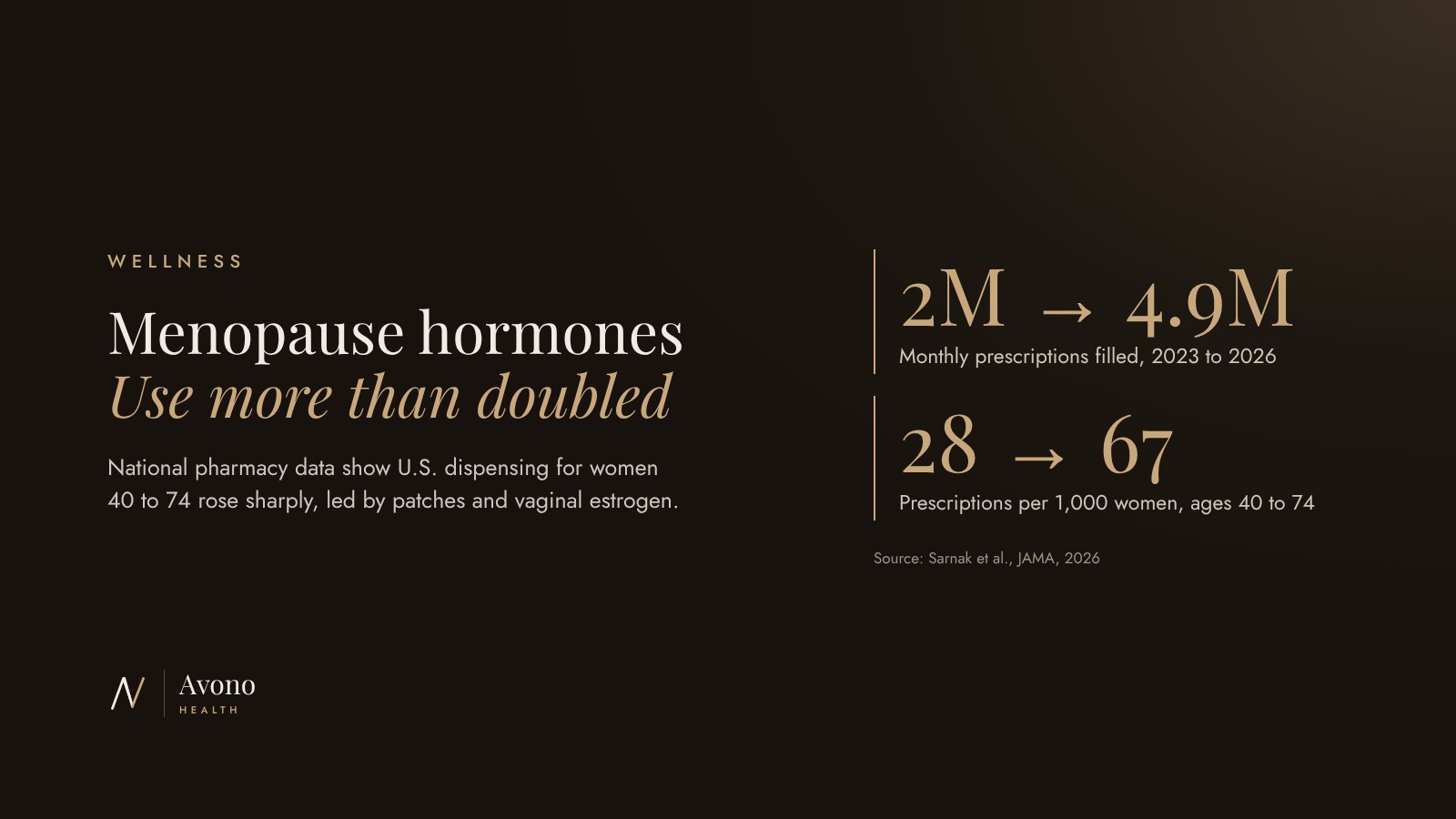
U.S. pharmacies now fill about 4.9 million menopause hormone therapy prescriptions a month for women aged 40 to 74, up from 2 million in 2023, according to a new research letter in JAMA. The researchers estimate the rate rose from 28 to 67 prescriptions per 1,000 women in that age group.
Key takeaways
- Monthly dispensing of menopause hormone therapy for U.S. women aged 40 to 74 rose from 2 million to 4.9 million between 2023 and 2026.
- The estimated rate went from 28 to 67 prescriptions per 1,000 women. The rise began in 2024, before the FDA removed most boxed warnings in November 2025.
- Growth came from estrogen patches and gels, vaginal estrogen and progesterone products. Use of oral (pill) forms stayed about the same.
- The study counted prescriptions filled. It was not designed to explain why use rose or whether patients benefited.
What the study found
Menopause hormone therapy (MHT) replaces some of the estrogen, and often progesterone, that the ovaries stop making around menopause. It is used to treat hot flashes, night sweats and vaginal symptoms. The new study, by Dana O. Sarnak, PhD, Wen Shen, MD, and G. Caleb Alexander, MD, of Johns Hopkins, was published online in JAMA on November 19, 2026.
The team used national pharmacy dispensing data. Monthly dispensing for women aged 40 to 74 more than doubled since 2023, growing from 2 million to 4.9 million, Science News reported. Because the data are aggregate, meaning they count prescriptions rather than track individual patients, the researchers used population figures to estimate a rate. That rate jumped from 28 to 67 prescriptions per 1,000 women over the study period.
The increase began in 2024. It continued through 2025, both before and after the FDA’s November 2025 decision to remove the “black box” warning, and into 2026, according to Science News.
The growth was not spread evenly across products. Use rose for transdermal estrogen (patches and gels absorbed through the skin), for vaginal estrogen and for progesterone products. Women who still have a uterus need to take a progestogen along with estrogen. Use of oral formulations stayed stable.
Who was studied
The national study looked at prescriptions filled at U.S. pharmacies for women aged 40 to 74. It is a cross-sectional analysis, which means it describes patterns in prescription data at points in time. It does not follow individual women, and it does not include information on symptoms, health outcomes or why a prescription was written.
A separate Johns Hopkins analysis by Sarnak and Shen, presented at The Menopause Society Annual Meeting in October 2026, used electronic medical records from 103,488 female patients aged 40 to 69 seen in obstetrics and gynecology at the Johns Hopkins Health System from 2016 into early 2026. That work was presented at a meeting rather than published as a full paper.
| Measure | National pharmacy data (JAMA) | Johns Hopkins medical records (meeting) |
|---|---|---|
| Who was counted | Women aged 40 to 74 across the U.S. | 103,488 gynecology patients aged 40 to 69 |
| What was counted | Prescriptions filled at pharmacies | Hormone therapy orders written by clinicians |
| Earlier rate | 28 per 1,000 women (2023) | 18 to 28 per 1,000 patients (through 2024) |
| Latest rate | 67 per 1,000 women (2026) | 61 per 1,000 patients (first quarter of 2026) |
| Where the rise was largest | Patches, gels, vaginal estrogen, progesterone | Women aged 45 to 59 |
The two sets of numbers look similar but should not be compared directly. The national study counted prescriptions picked up at pharmacies and divided them by an estimate of all U.S. women in a wider age range. The Hopkins study counted orders written for women already seeing a gynecologist, and Sarnak noted it measured prescribing, not medicines dispensed or picked up. The meaningful comparison is each data set against its own earlier years. Both show the rate roughly doubling or more, with the climb starting before the 2025 label change.
Why use may be rising
Prescribing of hormone therapy fell sharply after 2002, when the Women’s Health Initiative (WHI), a large federal study, linked hormone pills to higher rates of breast cancer, stroke, heart disease and blood clots in the lungs, the JAMA authors write. In November 2025, the FDA began removing boxed warnings about cardiovascular disease, breast cancer and probable dementia from hormone therapy labels. In February 2026, it approved the first six updated labels. In a September 2026 update, the FDA said demand for estrogen patches increased following that action.
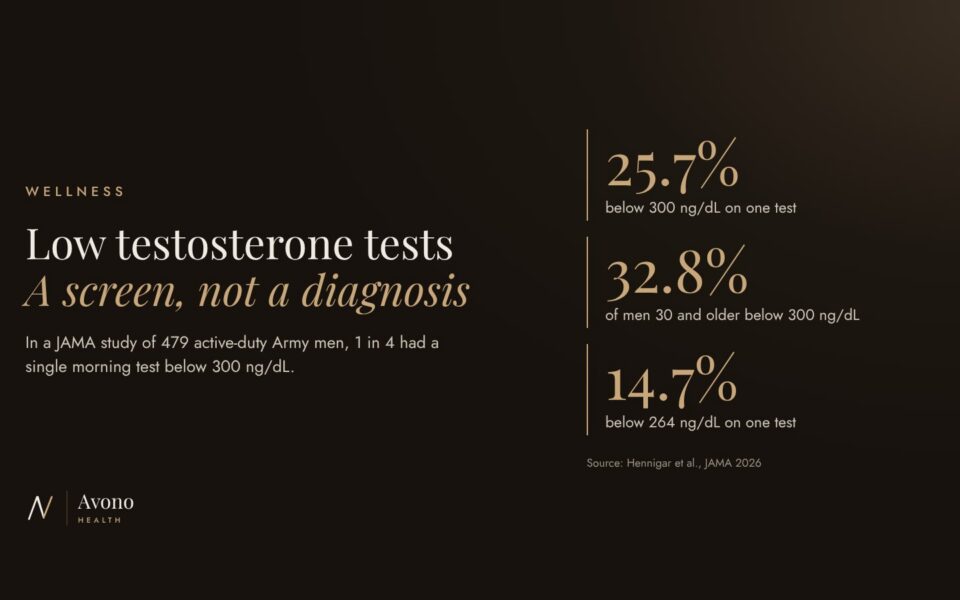
Interest in hormone testing and treatment is not limited to women. A recent study looked at how often men screen low for testosterone on a single test.
What the researchers said
Greater attention to women’s health, updated medical guidance supporting individualized menopause hormone therapy and social media may all be contributing to increased interest.
Dana Sarnak, PhD, Johns Hopkins School of Medicine, to Science News
Those were increasing up to the FDA landmark decision in November 2025.
Dana Sarnak, PhD, on prescribing of vaginal estrogen, progestogen and transdermal estrogen at Johns Hopkins, to Contemporary OB/GYN
My poor nurses are taking the brunt of this.
Wen Shen, MD, MPH, Johns Hopkins, on patient calls about hormone patches, to Contemporary OB/GYN
Shen said her nurses field 20 to 30 calls a day from patients seeking hormone therapy, mostly patches, and that her team turns to gels and sprays when patches are not available, Contemporary OB/GYN reported. Sarnak said tracking demand for specific products means institutions “can be better prepared and do better forecasting.”
Side effects and safety
This study did not measure side effects or health outcomes. It only counted prescriptions. Hormone therapy still carries risks, and the label changes did not remove all warnings. The FDA kept the boxed warning for endometrial cancer (cancer of the uterine lining) on systemic estrogen-alone products. The original boxed warning wording remains available to prescribers lower down on the label, the Associated Press reported.
The FDA’s labeled recommendation is to start systemic hormone therapy within 10 years of menopause onset or before age 60, while noting that timing and length of use are decisions for the prescriber and patient. Medical groups such as the Menopause Society recommend hormone therapy for women with symptoms who are younger than 60 or within 10 years of menopause, absent certain risk factors including prior breast cancer and stroke, Science News noted.
The science is still debated. A September 2025 reanalysis of WHI data found that women in their 50s taking estrogen-based drugs faced no increased risk of heart problems, while women in their 70s did, and the data were unclear for women in their 60s, the AP reported. Harvard’s Dr. JoAnn Manson told the AP the evidence for broad health benefits is not as conclusive as FDA leaders described, but she supported removing the warning.
The black box is really one size fits all. It scares everyone away.
JoAnn Manson, MD, Harvard Medical School, to the Associated Press
Some experts also criticized how the change was made. They said the FDA should have convened its independent advisory committees to publicly review the warnings, according to the AP.
About compounded hormones: Some hormone products are made by compounding pharmacies and sold as “bioidentical.” These are not FDA approved, and a National Academies report said compounded preparations have not been subjected to regulatory oversight. The label changes described here apply to FDA-approved products, and the trends in this study should not be read as a finding about compounded versions.
Limits of the study
- It counted prescriptions filled, not people. One woman can fill several prescriptions, and the data do not show how many individual women started treatment.
- The rate per 1,000 women is an estimate built from aggregate data and population figures.
- It does not show why use rose, who received treatment, or whether patients had symptoms that called for it.
- The Johns Hopkins records analysis came from one health system and was presented at a meeting, not published as a full peer-reviewed paper.
What it means for you
The study shows that many more women are filling prescriptions for menopause hormone therapy than in 2023. It does not say whether any one person should use it. Sarnak said the data can help health systems and manufacturers plan for demand and shortages, and future work will look at whether the increase is shared fairly across income levels, regions and types of prescribers, Contemporary OB/GYN reported.
If you cannot find your usual estrogen patch, the FDA advises contacting your pharmacist, talking with your health care provider about other options, and not stopping or changing your medicine on your own. If you have menopause symptoms, talk with a licensed clinician about your age, health history and the risks and benefits of each option.
The bottom line
Menopause hormone therapy use in the U.S. more than doubled from 2023 to 2026, driven by patches, gels, vaginal estrogen and progesterone products. The rise started before the FDA’s 2025 label change and continued after it. The study tracked prescriptions only, so it cannot say why use rose or what it means for women’s health.
Frequently asked questions
Is menopause hormone therapy becoming more common?
Yes. A 2026 JAMA study found monthly pharmacy dispensing for U.S. women aged 40 to 74 rose from 2 million in 2023 to 4.9 million in 2026, or from an estimated 28 to 67 prescriptions per 1,000 women.
Did the FDA remove the black box warning on hormone therapy?
In November 2025, the FDA began removing boxed warning language about cardiovascular disease, breast cancer and probable dementia. The boxed warning for endometrial cancer remains on systemic estrogen-alone products.
Why are estrogen patches hard to find?
The FDA says demand has increased and it is working with all six manufacturers to raise supply. It says patches remain available, though specific brands may vary by pharmacy.
Who is hormone therapy recommended for?
Medical groups such as the Menopause Society recommend it for women with symptoms who are younger than 60 or within 10 years of menopause, absent certain risk factors such as prior breast cancer and stroke, according to Science News. A clinician can help you weigh your own risks.