Sermorelin has become increasingly visible in conversations about peptides, recovery, body composition, sleep and healthy aging.
But online explanations of sermorelin are often much more confident than the science justifies.
You may see claims that sermorelin builds muscle, burns fat, reverses aging, improves sleep and restores youthful hormone levels.
The actual story is more nuanced.
There is good biological evidence explaining what sermorelin does to the growth-hormone pathway.
There is much less evidence proving that using compounded sermorelin for general adult wellness produces all of the downstream benefits commonly advertised online.
Understanding that distinction is essential.
What is sermorelin?
Sermorelin is a synthetic peptide related to a naturally occurring hormone called growth hormone-releasing hormone, or GHRH.
GHRH is produced in the hypothalamus, a region of the brain involved in hormone regulation.
Its job is exactly what its name suggests:
It signals the pituitary gland to release growth hormone.
Sermorelin mimics part of that natural GHRH signal.
Is sermorelin HGH?
No.
This is one of the most important distinctions to understand.
Human growth hormone, or HGH, is growth hormone itself.
Sermorelin does not directly provide growth hormone.
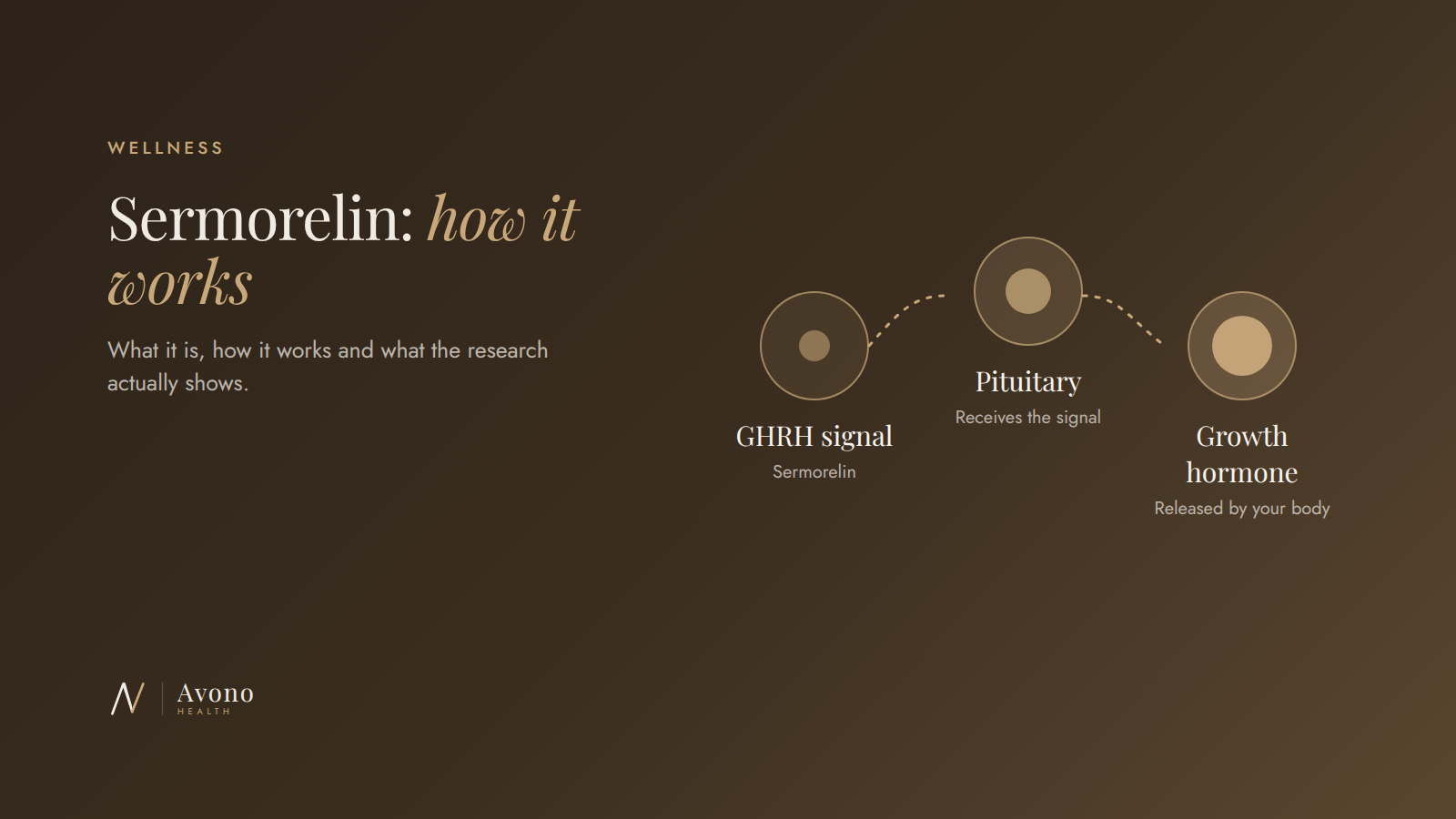
Instead, it sends a signal to the pituitary gland encouraging the body to release more of its own growth hormone.
A useful simplified model is:
Sermorelin → pituitary signal → growth hormone release
rather than:
HGH injection → growth hormone directly enters the body
That difference is central to understanding the medication.
What does growth hormone do?
Growth hormone has a broad range of physiological effects.
It is particularly important during childhood and adolescence, but adults continue to produce growth hormone throughout life.
Growth hormone signaling is involved in:
- growth and tissue regulation
- protein metabolism
- fat metabolism
- bone physiology
- production of insulin-like growth factor 1, or IGF-1
Growth-hormone secretion is naturally pulsatile.
That means the body releases GH in bursts rather than maintaining one constant level throughout the day.
Release is particularly associated with sleep.
How does sermorelin work?
Sermorelin is modeled on the active portion of GHRH.
When it activates GHRH receptors in the pituitary, the pituitary can respond by releasing growth hormone.
Human research established decades ago that GHRH-related peptides such as sermorelin can stimulate growth-hormone release.
That underlying mechanism is real.
But there is an important distinction:
Showing that a peptide increases growth-hormone secretion does not automatically prove that it improves muscle mass, sleep, fat loss, recovery or longevity in healthy adults.
Those outcomes each require their own evidence.
Why do adults use sermorelin?
Today, adults commonly explore sermorelin in wellness settings because they are interested in areas such as:
- recovery
- sleep
- body composition
- exercise
- vitality
- age-related changes
- growth-hormone signaling
These interests largely stem from what is known about growth hormone biology.
But adult wellness use of sermorelin should not be confused with an FDA-approved treatment indication.
Is sermorelin FDA approved?
This topic is frequently explained poorly online.
Sermorelin was historically marketed as an FDA-approved product called Geref.
That product is no longer marketed.
There is no currently marketed FDA-approved sermorelin product for adult wellness, anti-aging, muscle gain or fat loss.
Sermorelin available through wellness practices today is generally compounded.
Compounded medications are not FDA-approved, and FDA does not evaluate them through the same premarket process for safety, effectiveness and manufacturing quality as an FDA-approved drug.
FDA has also taken enforcement action against sellers making unapproved therapeutic claims for sermorelin products, including claims around metabolism, weight loss and muscle growth.
This does not mean sermorelin is prohibited.
It means the regulatory status needs to be described accurately.
Sermorelin vs. growth hormone therapy
Sermorelin and recombinant growth hormone should not be treated as interchangeable.
Sermorelin
Stimulates the pituitary gland to release endogenous growth hormone.
HGH
Provides exogenous growth hormone directly.
That difference can affect how the growth-hormone axis behaves.
In legitimate endocrine medicine, true adult growth hormone deficiency is a specific medical condition that generally requires appropriate diagnostic evaluation. Endocrine Society guidance notes that confirmation of adult growth hormone deficiency usually requires stimulation testing unless particular established circumstances are present.
A vague feeling of being tired or getting older is not, by itself, a diagnosis of growth hormone deficiency.
Does sermorelin increase growth hormone?
This is one of the better-supported aspects of sermorelin biology.
Human research has demonstrated that GHRH(1-29), the peptide sequence associated with sermorelin, can stimulate growth-hormone release.
That is why sermorelin historically had medical utility in evaluating or influencing the growth-hormone axis.
But again, a hormone response is an intermediate biological effect.
It is not the same thing as demonstrating a particular health outcome.
Does sermorelin build muscle?
This is where marketing often jumps ahead of evidence.
Growth hormone and IGF-1 have roles in tissue and protein metabolism.
Because sermorelin can stimulate GH release, it is biologically plausible that researchers would be interested in body-composition effects.
But there is not a strong modern body of randomized clinical evidence demonstrating that compounded sermorelin treatment reliably builds meaningful muscle in otherwise healthy adults.
Saying:
“Sermorelin stimulates growth-hormone release.”
is supported by human physiology research.
Saying:
“Sermorelin will build muscle.”
is a substantially stronger claim.
Those statements should not be treated as interchangeable.
Does sermorelin burn fat?
The same caution applies.
Growth hormone participates in fat metabolism, which provides a biological reason to investigate the question.
However, sermorelin should not be presented as a proven weight-loss medication.
If someone’s primary goal is treatment of overweight or obesity, medications specifically studied and approved for chronic weight management have a much stronger evidence base.
Sermorelin is a different treatment targeting a different biological pathway.
Does sermorelin improve sleep?
Growth-hormone secretion and sleep are closely related physiologically, with GH pulses frequently occurring during deep sleep.
That association has contributed to interest in sermorelin for sleep-related wellness goals.
But an association between sleep and natural GH secretion does not establish that sermorelin is an effective treatment for insomnia or other sleep disorders.
Strong clinical evidence supporting broad claims of improved sleep in healthy adults remains limited.
Persistent sleep problems deserve appropriate medical evaluation rather than assuming a growth-hormone-related peptide is the answer.
Does sermorelin slow aging?
There is no medication proven to “reverse aging” simply by increasing growth-hormone signaling.
Age-related changes in growth hormone have led researchers and wellness providers to study the GH axis, but aging is not a single hormone deficiency.
Human aging involves numerous systems, including:
- cardiovascular health
- metabolic health
- immune function
- muscle and bone health
- neurologic changes
- cellular damage and repair
- genetics
- lifestyle and environment
Increasing one hormonal signal should not be marketed as turning back that entire process.
Sermorelin is not proven to reverse aging or extend lifespan.
Sermorelin and IGF-1
Growth hormone stimulates production of insulin-like growth factor 1, commonly called IGF-1.
For this reason, clinicians evaluating growth-hormone-axis therapies may consider IGF-1 levels along with broader clinical context.
But interpreting IGF-1 is not as simple as deciding that “higher is better.”
Hormone levels exist within physiologic ranges, and both abnormally low and abnormally elevated signaling can be clinically important.
The objective of clinician-guided treatment should not be to maximize a laboratory number.
Are there risks?
Any medication affecting hormonal signaling deserves clinical oversight.
Potential considerations can vary according to dose, formulation and individual health history.
Symptoms or effects discussed with growth-hormone-axis therapies can include issues involving:
- injection-site reactions
- headache
- flushing
- dizziness
- fluid retention
- tingling or altered sensation
- changes in glucose regulation
Individual risks may differ substantially, particularly for people with endocrine conditions, malignancy-related concerns or other medical issues.
A licensed clinician should evaluate whether treatment is appropriate rather than treating sermorelin as an ordinary wellness supplement.
What about peptide websites selling sermorelin “for research use only”?
This is a particularly important distinction.
Products sold online as “research use only” or “not for human consumption” are not the same thing as prescription medication prepared and dispensed for a specific patient through legitimate clinical and pharmacy channels.
FDA has taken enforcement action against businesses marketing purported research peptides for human therapeutic purposes.
If a product is being sold outside ordinary prescription and pharmacy safeguards while simultaneously being marketed as something people should inject into themselves, that should raise serious questions.
How is sermorelin taken?
Sermorelin is commonly associated with subcutaneous injection.
Avono offers clinician-guided sermorelin treatment in injection and oral-dissolving formats when prescribed.
These routes should not automatically be assumed to have identical pharmacology or evidence.
Peptides are generally susceptible to degradation in the gastrointestinal system, which is one reason injectable delivery has historically been common for peptide medications.
Specific formulation and administration decisions should be discussed with the prescribing clinician.
Sermorelin vs. GLP-1 medication
Sermorelin and GLP-1-based medications have completely different purposes and mechanisms.
GLP-1-based weight management
Primarily targets appetite, food intake and metabolic pathways involved in body-weight regulation.
Sermorelin
Targets the growth-hormone signaling pathway by stimulating pituitary GH release.
Someone seeking evidence-based obesity treatment should not think of sermorelin as a substitute for semaglutide or tirzepatide.
They are fundamentally different treatments.
Who should consider discussing sermorelin with a clinician?
Sermorelin may be something an adult chooses to discuss with a clinician when interested in the growth-hormone axis or related wellness goals and after understanding the limitations of current evidence.
The appropriate decision depends on:
- age
- medical history
- medications
- endocrine history
- treatment goals
- contraindications and risks
- clinician assessment
Treatment should never be presented as guaranteed to improve muscle, sleep, recovery, body composition or longevity.
What to look for in a sermorelin provider
If you are considering sermorelin, ask basic questions that should have clear answers.
Is there a real clinical evaluation?
Prescription therapy should involve a licensed clinician.
Is the medication coming from a licensed U.S. pharmacy?
Avoid mystery sourcing.
Is the provider honest about FDA status?
Modern compounded sermorelin is not an FDA-approved wellness medication.
Are the claims realistic?
Be skeptical of promises involving guaranteed muscle growth, rapid fat loss or “reversing aging.”
Can you contact someone after treatment begins?
Medical treatment should involve an actual care pathway, not merely a checkout page.
Sermorelin at Avono Health
Avono provides access to clinician-guided sermorelin wellness programs when a licensed clinician determines treatment is appropriate.
Our position is straightforward.
Sermorelin’s mechanism is established: it acts as a GHRH analog and stimulates the pituitary to release growth hormone.
Interest in its potential effects on recovery, sleep, body composition and healthy aging is understandable.
But evidence supporting those broader outcomes in otherwise healthy adults is much more limited than many online advertisements imply.
Avono believes patients should know that before beginning treatment, not discover it afterward.
Suggested internal links: Sermorelin Treatment, Wellness, Medical Oversight, Compounded Medications, Research Use Only Peptides, How It Works
Frequently asked questions
What is sermorelin?
Sermorelin is a synthetic GHRH-related peptide that stimulates the pituitary gland to release growth hormone.
Is sermorelin HGH?
No. HGH provides growth hormone directly. Sermorelin stimulates the body’s own pituitary gland to release growth hormone.
Is sermorelin FDA approved?
There is no currently marketed FDA-approved sermorelin product for adult wellness use. Sermorelin used in contemporary wellness treatment is generally compounded and is not FDA-approved.
Does sermorelin build muscle?
Sermorelin can stimulate growth-hormone release, but strong clinical evidence proving that compounded sermorelin reliably produces meaningful muscle growth in healthy adults is limited.
Does sermorelin help with weight loss?
Sermorelin is not an FDA-approved obesity medication and should not be presented as a proven substitute for treatments specifically studied for chronic weight management.
Does sermorelin improve sleep?
Growth-hormone secretion is associated with sleep physiology, but strong evidence establishing sermorelin as a treatment for sleep problems in otherwise healthy adults is limited.
Is sermorelin an anti-aging treatment?
No treatment has established sermorelin as a therapy that reverses human aging or extends lifespan.
How is sermorelin different from semaglutide?
They target completely different biological systems. Semaglutide activates GLP-1 receptors and is extensively studied in weight management. Sermorelin stimulates growth-hormone release through the GHRH pathway.
Comparing GLP-1 options? See semaglutide and tirzepatide programs and current prices.